
What Does Success Mean in Pickleball? How to Set Goals and Measure Progress
A player finally reaches the rating they have been chasing. For a few days, it feels great.
Then the finish line moves.
The rating is not high enough. The medal was silver instead of gold. The bracket was too small. The opponent had an off day. Better players still are not inviting them into games.
The problem is not wanting more. Ambition is healthy. The problem is building a definition of success that is never allowed to become true.
I have coached plenty of players from 3.0 to 3.5 and then toward 4.0. Almost every time the number moves, the finish line moves with it. Wanting the next level is healthy. Refusing to let the last one count is not.
Pickleball Success, in One Sentence
Pickleball success means defining what matters to you, connecting the result you want to work you can actually control, and recognizing evidence of progress before one rating, medal, or match gets the final vote.
Wins, ratings, medals, skill development, health, partnership, community, and enjoyment can all matter. SCORE helps you decide which ones belong on your scorecard for this season.
The PickleTip SCORE Framework
I use SCORE to answer two questions that players often mix together: What am I actually trying to accomplish, and what evidence will tell me I am moving toward it?
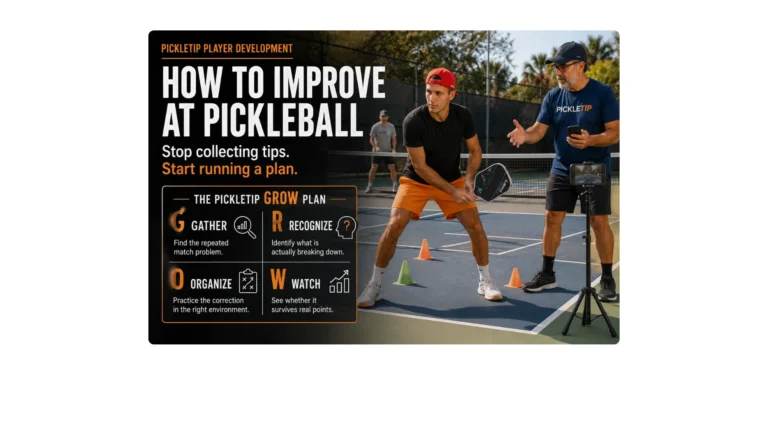
SCORE tells you what you are chasing and what progress should look like. It does not tell you how to run every practice. Once the destination and scorecard are clear, the GROW Plan for improving at pickleball organizes the work that moves you toward them.
I started thinking about this problem more seriously after watching it happen in my own family. When AJ made the leap from 4.0 to 4.5, his drilling and hard work were clearly paying off, but the finish line moved almost as soon as he reached it. The improvement was real. So was the next challenge. Those two things can be true at the same time.
| SCORE Step | Main Question | Result |
|---|---|---|
| S — Set Your Definition | What matters to me this season? | A definition of success you can actually recognize |
| C — Choose the Controllables | What can I influence today? | Useful work instead of outcome chasing |
| O — Organize the Goals | How do the result, performance, and repeated work connect? | A goal system instead of one isolated number |
| R — Recognize Real Progress | What evidence shows development before the final result changes? | A usable progress scorecard |
| E — Evolve the Plan | What should stay, change, pause, or end? | A goal and method that still fit |
Suppose a 3.7 player wants to reach 4.0. SCORE does not tell that player to stop caring about the number. It asks what becoming a stronger player should look like before the rating moves: perhaps deeper returns, fewer rushed attacks, better balance through transition, or more dependable decisions late in games.
The rating remains on the scorecard. It just stops being the only item on it.
A Better 4.0 Scorecard
“Reach 4.0” is a legitimate outcome. It is just a lousy daily assignment. Keep 4.0 on the scorecard, then add things you can actually work on and recognize: deeper returns, fewer rushed attacks, better balance through transition, and better decisions when games get tight.
What Actually Counts as Pickleball Success?
There is no single scorecard that fits every player.
Success may mean a medal to one player, a dependable third shot to another, playing three times a week without recurring pain to someone else, or finally becoming the partner people trust in a tight game.
| Success Can Include | Success Does Not Require |
|---|---|
| Winning meaningful matches | Never losing |
| Improving a specific skill | Every practice session feeling good |
| Building a more reliable game | A permanently rising rating |
| Playing regularly without recurring pain | Ignoring physical limits |
| Becoming a better partner | Approval from every player |
| Finding community | Winning every comparison |
| Enjoying competition | Feeling satisfied every moment |
| Helping other players improve | Proving your worth through one result |
A medal can show that something went well. A rating can summarize recorded competitive results. Neither one measures the whole player, and neither one has to be discarded to make room for other evidence.
The Moving Finish Line
The pattern usually sounds something like this:
- I will feel successful when I reach 3.5.
- Then 3.5 becomes 4.0.
- Then 4.0 does not count without a medal.
- Then the medal does not count because the bracket was small.
- Then the player needs approval from stronger players.
A new target after an achievement is normal. Development would be pretty boring if reaching one goal meant you were never allowed to want another.
The useful distinction is whether the next target builds on the last achievement or erases it.
The Moving-Goalpost Problem
Ambition creates a next target. A broken scorecard makes every previous target stop counting.
S — Set Your Definition
Success should fit the player you are, the season you are in, and the reason you are playing now.
| Area | What Success Might Look Like |
|---|---|
| Competition | Medal, win a league, or compete successfully at a higher level |
| Skill | Build a dependable third shot, return, reset, counter, or other specific tool |
| Reliability | Raise the floor of your game and reduce major breakdowns |
| Health | Play regularly while respecting recovery and physical limitations |
| Partnership | Become more dependable, communicative, and predictable |
| Community | Build friendships, belonging, or a local playing group |
| Enjoyment | Compete seriously without making every session a referendum on your level |
| Contribution | Coach, organize, encourage, or help other players develop |
I would not try to maximize every category at once. Pick the two or three that matter most for this season.
- What would meaningful progress look like this season?
- Which result would I genuinely like to achieve?
- What would make the work worthwhile before that result arrives?
- Which achievements will I allow myself to recognize?
For the 3.7 player, success might include reaching 4.0 while also building a more dependable return, making better attack decisions, and becoming comfortable enough against stronger competition that every game no longer feels like a rating exam.
C — Choose the Controllables
You can want an outcome without pretending you can command it.
| Control Directly | Influence but Cannot Guarantee | Cannot Control |
|---|---|---|
| Preparation | Match result | Bracket or draw |
| Practice quality | Rating movement | Net cords |
| Attention | How quickly a skill transfers | Another player’s opinion |
| Effort | Partner performance | Opponent behavior |
| Recovery habits | Tournament finish | Recognition |
| Shot selection | League placement | Exact development timeline |
| Communication | Whether a close ball lands in | Whether stronger players invite you into a game |
I saw the controllables split clearly at a DUPR Day at Pelican Park. Rain had soaked the courts, AJ and I had already driven 40 minutes across Lake Pontchartrain, and only four courts were playable when we arrived. I could not play because of an injury. AJ could not control the weather, the delay, or when his group would be called. He signed in, grabbed a squeegee, and started helping dry courts. The matches had not even started, but I had already learned something about how he was going to handle a day that was not cooperating.
For the 3.7 player, 4.0 can stay on the scorecard. Today’s assignment still cannot be “make DUPR go up.” Return depth, attack selection, movement, preparation, and practice quality are things the player can actually work on.
Six Things You Can Actually Control
| Controllable | What It Looks Like |
|---|---|
| Preparation | Arrive ready, know the format, bring what you need, warm up with purpose, and give the session a clear job. |
| Attention | Notice the actual task, listen to useful coaching, watch patterns, and avoid collecting mindless repetitions. |
| Effort | Move honestly, complete the work at an appropriate intensity, and avoid confusing maximum effort with useful effort. |
| Response | Treat errors as information and return attention to the next useful action. |
| Practice quality | Recreate the real problem, use feedback, track something meaningful, and progress toward realistic pressure. |
| Coachability | Ask questions, test useful adjustments, and examine evidence without surrendering your own judgment. |
Natural ability influences the starting point. Controllable habits determine how much useful work you give that ability.
O — Organize the Goals
When I work through a goal with a player, I usually break it into three pieces: the result they want, what has to improve, and the work they are actually willing to repeat.
| Goal Level | Question | Example |
|---|---|---|
| Outcome | What result do I want? | Reach a rating, medal, or win a league |
| Performance | What needs to become better or more dependable? | Deeper returns, better attack decisions, more balanced transitions |
| Process | What useful work will I repeatedly do? | Practice twice weekly, review match evidence, track one relevant measure |
The outcome tells you where you are trying to go. The performance targets tell you what a better version of your game should look like. The process is the work you are willing to repeat long enough to get there.
For the 3.7 player, 4.0 is the outcome. Deeper returns and fewer poor attack decisions might be performance targets. Two focused practice sessions and one regular match review might be the process.
Do Not Make the Outcome Prove More Than It Can
Wanting a medal, rating, league title, or tournament result is legitimate. The problem begins when the same result is also expected to prove that you belong, guarantee that other players respect you, or determine whether all the work was worthwhile.
A result can tell you something about performance. It cannot settle every question you have about yourself.
I had to remind myself of that after the 2025 NOLA Picklefest Mixed 5.0 final. I watched my son AJ and Diana lose the final ball and stand there with silver waiting for them. As his father, I felt how close they had come. As a coach, I knew the last ball could not explain the tournament. They had reached the final in their first tournament together, played a three-game final, and adjusted their partnership after a rolled ankle changed what they could comfortably do. Silver was not what they came for. It still counted.
| Goal | Outcome | Performance | Process |
|---|---|---|---|
| Tournament | Compete for a medal | Reach the kitchen balanced and reduce rushed transition attacks | Scenario drills, partner-pattern work, and pressure games |
| Health and participation | Play three times weekly while staying physically sustainable | Maintain movement quality and recovery | Warm up, manage volume, recover appropriately, and maintain useful strength or mobility work |
When You Don’t Feel Like Doing the Work
You will not feel equally motivated every day. That is normal. A low-energy Tuesday does not need a new philosophy; it needs a useful version of the work you already decided matters.
- Keep one current priority visible.
- If energy is low, shrink the session instead of inventing a new goal.
- Track one thing that actually connects to the goal.
The question here is simple: does the work still point toward something you intentionally chose?
R — Recognize Real Progress
This is the part players miss when the rating refuses to cooperate.
A lot can get better before the number at the end finally moves. A player may be returning deeper, choosing better attacks, recovering more balanced, or holding up longer against pace before a rating or medal reflects any of it.
| Area | Possible Evidence of Progress |
|---|---|
| Technical | Cleaner contact, smaller misses, better depth |
| Tactical | Fewer forced attacks, earlier recognition, better target selection |
| Movement | More balance, earlier recovery, less reaching |
| Mental | Faster attention resets, less panic, better commitment |
| Partnership | Clearer communication, fewer surprises, better shared coverage |
| Competition | More points built intentionally and more of your normal game surviving stronger opposition |
| Physical | Better endurance, fewer flare-ups, or improved recovery where appropriate for the player |
| Community | Stronger relationships, more meaningful participation, or useful contribution |
I drill with AJ often, and players sometimes joke that I am sandbagging because my DUPR has not caught up with how I am playing. But improvement in drilling does not enter a rating automatically. DUPR says the rating updates from submitted match results, with performance versus expectation, match type, recency, and match volume affecting the calculation. That better version of my game still has to show up in recorded results before the number can reflect it. If the number itself is confusing, I break that process down in how the DUPR algorithm works.
When the Rating Lags Behind Your Game
A rating can lag behind improvement. If your returns are deeper, your decisions are better, and more of your normal game survives against stronger players, that improvement can be real before your DUPR reflects it. Eventually those changes still have to show up in recorded results. The number matters; it just is not always the first thing to move.
That is exactly why I separate leading evidence from lagging outcomes. The first tells me whether useful changes are appearing. The second tells me whether those changes have eventually affected the result I care about.
| Leading Evidence | Lagging Outcomes |
|---|---|
| Practice quality | Rating |
| Decision quality | Medals |
| Return depth | Wins |
| Balance | Division movement |
| Communication | Recognition |
| How well the trained behavior survives real points | Tournament finish |
Leading evidence does not mean you get to call a bad plan successful forever. If months of focused work are not changing the thing you are trying to change, something in the method, diagnosis, measurement, or goal deserves another look.
Progress Can Be Real Before It Looks Smooth
Improvement does not require every session to be better than the last one.
A player can improve overall while still having poor sessions, flat stretches, a familiar shot that temporarily feels unavailable, or strong practice followed by disappointing match results.
That is why the scorecard should look for repeated evidence rather than treating one good day as proof or one bad day as a collapse.
- Stopping before contact more often
- Resetting one extra difficult ball
- Recognizing the attackable ball earlier
- Returning deeper late in games
- Holding the correction when the point becomes less predictable
If one repeated situation swings too widely between good and bad versions, use RANGE to diagnose the variation and FLOOR to improve pickleball consistency.
A plateau and a slump are different problems. A plateau means progress has slowed while the player’s recent baseline may remain fairly stable. A slump means that established baseline has stayed meaningfully lower across multiple sessions.
If the game has genuinely fallen below your recent normal, use the TRACE framework for a pickleball slump rather than treating a sustained decline as ordinary goal-setting or motivation trouble.
E — Evolve the Plan
A goal can still matter even when the original route stops making sense.
Review the destination, the scorecard, and the cost of the pursuit periodically instead of letting an old goal run your entire relationship with the sport.
I spent a long time trying to use my height to hit an Erne as often as possible. The reach was there, but my mobility was not what it used to be. Eventually I had to stop building the plan around the player I used to be. Now I create pressure with shots that make the next ball easier instead of forcing myself to win the point from outside the sideline.
I did not stop wanting to create pressure. I changed what successful pressure looked like for the player I actually am.
| Choice | When It Makes Sense |
|---|---|
| Keep the goal, change the method | The destination still matters, but the training method, feedback, volume, partner, timeline, or metric is not working. |
| Modify the goal | The original target no longer fits your health, schedule, priorities, or current game. |
| Pause | Recovery, overload, life demands, or another temporary constraint makes the current pursuit inappropriate. |
| End the goal | The pursuit no longer matters enough to justify its cost. |
Stay committed to the destination only while it still matters. Stay flexible about the route.
- What improved?
- Which goal still matters?
- Which goal came mainly from comparison or outside approval?
- What did the pursuit cost?
- What part of the method should change?
- What achievement have I refused to recognize?
- What would enough for this season look like?
Changing a goal is not automatically quitting. Sometimes the evidence is telling you to change the practice method, timeline, partner, measurement, or goal itself. The 3.7 player should keep the 4.0 target only while it still fits the game and life they actually have.
Let It Count. Then Decide What Comes Next.
There is a difference between recognizing progress and deciding you never need to improve again.
Enough does not mean forever finished. It means the current achievement, season, partnership, or level is allowed to matter before you decide what comes next.
- This medal counts.
- Returning after injury counts.
- Playing confidently against stronger opponents counts.
- Becoming a better partner counts.
- Building a version of one shot you can finally trust counts.
Then you can choose another goal without pretending the previous one was worthless.
Use Comparison as Information, Not as Your Scorecard
Another player may improve faster because they are younger, have more time, started with a stronger athletic background, play with different partners, receive more coaching, enter different events, or simply began from a different starting point.
Use other players as information, not as your deadline. Their path can show you possibilities. It cannot tell you whether your own season is working.
If comparison, rating identity, belonging, or the need to prove someone wrong has become the real problem, the scorecard is no longer the thing that needs fixing. That is where the Mental Hurdles work becomes more useful.
A loss can also hurt while still providing useful evidence. Maybe one pattern held up better, communication improved, you recovered from pressure sooner, or more of your normal game survived against stronger opponents.
When SCORE Is Not the Right Tool
| What Is Happening? | Better Starting Point |
|---|---|
| You know the destination but need a complete improvement process | GROW Plan |
| You need to decide which repeated match problem deserves work | REVIEW framework |
| One similar situation varies too widely between good and bad versions | RANGE framework |
| A correction exists but does not survive realistic play | FLOOR framework |
| Your established game has declined across multiple sessions | TRACE framework |
| An error keeps affecting later rallies | PACE |
| A recurring belief about rating, belonging, or worth is driving the problem | Mental Hurdles |
| Partner trust or expectations are breaking down | Team Chemistry |
| Calls, middle ownership, or switches are unclear | Doubles Communication |
Some problems simply need a different tool. SCORE will not fix your backhand mechanics, explain every DUPR swing, diagnose an injury, or solve a specific doubles pattern. Sometimes the right answer is simply a different problem.
The PickleTip Success Scorecard
You can use this as a one-page checkpoint at the beginning of a season and return to it on the review date you choose.
MY CURRENT DEFINITION OF SUCCESS:
Which two or three things matter most this season?
OUTCOME GOAL:
What result would I like?
PERFORMANCE GOALS:
What needs to become better or more dependable?
PROCESS GOALS:
What useful work will I repeatedly do?
CURRENT CONTROLLABLE:
Which action or habit deserves my attention now?
LEADING EVIDENCE:
What should begin changing before the final outcome moves?
LAGGING OUTCOME:
Which rating, result, medal, level, or other outcome am I ultimately watching?
ENOUGH FOR THIS SEASON:
What achievement will I allow to count?
REVIEW DATE:
When will I reassess the goal, evidence, and method?
Once the scorecard is filled out, the next question is no longer “What does success mean?” It becomes “How am I going to improve toward it?” That is the handoff to the GROW Plan.
Pickleball Success FAQs
Pickleball success means defining what matters to you, connecting the result you want to work you can control, and recognizing evidence of progress before one rating, medal, or match gets the final vote. Competition, skill, reliability, health, partnership, community, and enjoyment can all be part of the scorecard.
SCORE defines the destination and the evidence that will count as progress. GROW organizes the improvement process used to move toward that destination. Use SCORE to decide what success means; use GROW when you need to turn that goal into purposeful practice, feedback, and live-play transfer.
Start with the outcome you want, identify the performance changes that would support it, and define the repeated process you are willing to follow. Then choose leading evidence you can watch before the final result changes and set a date to review whether the goal and method still fit.
Track leading evidence related to the part of your game you are actually working on, such as return depth, balance, decision quality, communication, recovery after errors, cleaner contact, or whether a trained behavior survives real points. Ratings and results can remain useful lagging outcomes without being your only measure.
Your game can improve before your DUPR reflects it because drilling and practice changes are not rating results. DUPR updates from submitted match results, so the stronger version of your game has to transfer into recorded competition. Track leading evidence such as decision quality, return depth, balance, and how well trained patterns survive real points while you wait for the lagging rating outcome.
A plateau means progress has slowed while your recent performance baseline may remain fairly stable. A slump is a sustained decline below an established recent baseline across multiple sessions. Ordinary variation belongs in a consistency diagnosis; a sustained below-baseline decline needs broader review.
No. Letting progress count means recognizing what has improved and allowing an achievement to matter. Complacency means avoiding useful work or ignoring problems that still deserve attention. You can recognize your current level and deliberately choose another goal.
Review a goal when the evidence, health demands, schedule, priorities, or cost of the pursuit changes. You may keep the destination and change the method, modify the target, pause it, or end a goal that no longer matters enough to justify the work.
Use other players as information, not as your deadline. Their age, time, athletic background, coaching access, partners, competition, injuries, priorities, and starting point may differ from yours. Keep your own definition of success and progress evidence visible.
Let the Progress Count
The player from the opening is still allowed to want the next rating, the next event, or the next medal.
They just do not have to erase the current achievement to make room for ambition.
Define what the next level means. Decide what evidence will count before you get there. Work on what you can control. Review whether the plan is actually producing change.
Then, when something genuinely improves, let it count before moving the finish line again.
Define what matters. Control what you can. Connect the work to the goal. Recognize what is changing. Evolve the plan when the evidence says you should.