
Vatic Pro ONI Delisting: What Happened and Why It Matters
The Vatic Pro ONI case is not simply a story about a paddle being “banned.” The ONI was approved, sold, and used as a tournament-eligible paddle before Vatic Pro told customers in June 2024 that USA Pickleball had scheduled the ONI line for delisting. Vatic canceled outstanding preorders, refunded customers, and offered free returns to owners who had already received launch paddles.
Short Answer
Was the Vatic Pro ONI banned? In June 2024, Vatic Pro told customers that the ONI paddles were “scheduled to be delisted” by USA Pickleball after previously being sold as approved. Vatic tied the change to newly adopted USA Pickleball testing methods, stopped outstanding orders, refunded preorders, and offered free returns. What we still do not have is a public technical record identifying one specific ONI measurement that caused the delisting.
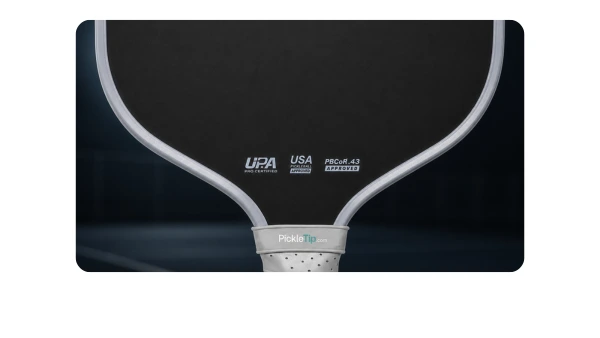
For current tournament use, do not rely on an old product page, an approval logo printed on a paddle, or a screenshot from 2024. Verify the exact model in PickleTip’s USA Pickleball Approved Paddle List and check the event’s own equipment rules before competing.
Case reviewed: . I went back through this case because some explanations that sounded plausible while the story was moving in 2024 never became documented facts. Where the record stops, I stop.
Was the Vatic Pro ONI Delisted by USA Pickleball?
Yes. In June 2024, Vatic Pro told ONI customers that the paddles were “scheduled to be delisted” by USA Pickleball.
The wording mattered. Buyers were not being told that an unapproved prototype had accidentally reached the market. They had purchased or preordered a paddle that had been presented as approved, and Vatic was now responding to an impending loss of that tournament status.
Vatic’s customer notice also made clear that the company was stopping the rollout and giving affected buyers a remedy.
Vatic attributed the situation to the “changing landscape of the sport” and “newly adopted USAP testing methods.” That tells us what Vatic told its customers. It does not tell us the exact laboratory measurement, sample, test result, or internal USA Pickleball decision that triggered the delisting.
Why the ONI Delisting Still Matters
The ONI case sits in a different lane from the OWL approval case. OWL is primarily about an alternative and reportedly provisional approval pathway that was not visible to the public. The ONI is more useful for understanding what happens when a paddle enters the market as approved and then loses that status.
An approval date tells you that a paddle cleared a pathway at one point in time. It does not guarantee permanent tournament eligibility.
That became especially important as high-powered foam-assisted designs changed the performance conversation. Testing a fresh paddle only tells you what you have on day one. With these designs, the harder question became what the paddle turns into after people actually play with it.
Vatic Pro ONI Approval and Delisting Timeline
| When | What happened | Why it matters |
|---|---|---|
| Spring 2024 | Vatic Pro launched the ONI as a high-powered foam-assisted paddle line, including Flash and V7 shapes. | The ONI entered the market during the rapid rise of so-called Gen 3 power-paddle designs. |
| May 2024 | Contemporary paddle reviews and player discussions raised concerns about unusually rapid break-in, internal “crunching,” core change, and large shifts in feel or power in some ONI samples. | Those reports created an early durability and lifecycle-performance question, but they were not official certification results. |
| June 10, 2024 | Vatic customers circulated the company’s notice that ONI paddles were scheduled to be delisted by USA Pickleball. | The issue moved from reviewer concern to tournament-eligibility consequences. |
| June 2024 | Vatic halted outstanding ONI orders and offered buyers refunds or free returns. | The company treated the status change as serious enough to stop the rollout rather than continue selling through the uncertainty. |
| After the delisting | The ONI became part of the larger industry debate over power testing, break-in, compliance sampling, and how approval should handle paddles that change with use. | The ONI became an example of why paddle approval has to account for what happens after launch. |
What Vatic Pro Actually Told Customers
The clearest evidence we have is Vatic Pro’s own message to ONI customers. Contemporary coverage from The Dink reproduced the customer email and reported the delisting announcement on June 10, 2024.
Vatic connected the coming delisting to the sport’s changing landscape and newly adopted USA Pickleball testing methods.
What Vatic’s Notice Proves, and What It Doesn’t
| Supported | Not established |
|---|---|
| The ONI had previously been treated as approved | The exact laboratory result that caused the decision |
| Vatic said the ONI was scheduled for delisting | That one specific test, such as exit velocity or PBCoR, was definitively the sole cause |
| Vatic linked the situation to newly adopted testing methods | That Vatic knowingly designed the ONI to evade the rules |
| Vatic stopped outstanding orders and offered refunds/free returns | That every ONI unit changed performance in the same way |
Why the ONI’s Break-In Became Part of the Story
Before the delisting notice, reviewers and players were already discussing how quickly some ONI paddles appeared to change.
In a May 3, 2024 Pickleball Studio ONI review, Chris Olson described an unusually dramatic break-in experience across more than one ONI sample. Community discussion around the review included reports of internal crunching, changing sweet spots, crushed-core sounds, and paddles becoming substantially hotter or harder to control after use.
Those reports matter because they show what players were observing before the delisting announcement. They are not a substitute for USA Pickleball laboratory data.
Community reports were also inconsistent. Some owners said their paddles changed quickly. Others said they had played many sessions without noticing the same problem. That variation is exactly why I would not turn the anecdotes into a universal claim that “all ONIs core-crushed” or that every retail paddle would have produced the same compliance result.
The useful question is not whether every ONI changed. It is whether a certification system should account for predictable performance change after repeated use.
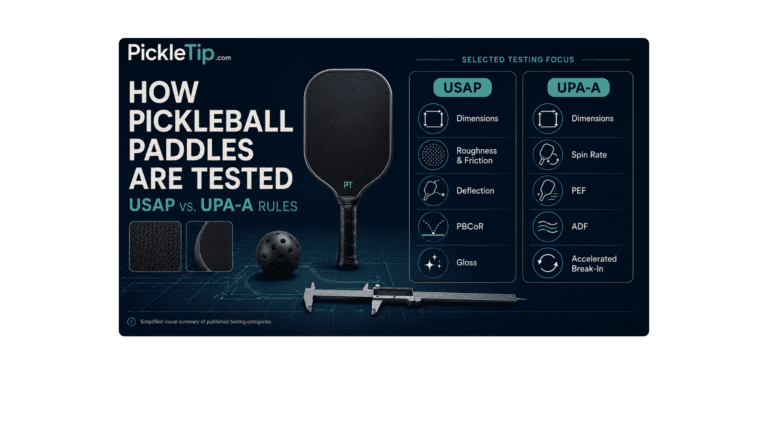
Break-in and lifecycle behavior eventually became much bigger parts of the paddle-testing conversation. For the technical side (accelerated break-in, power testing, surface testing, spin, PBCoR, and why certification systems can produce different results) see How Pickleball Paddles Are Tested: USA Pickleball vs. UPA-A.
Why Was the Vatic Pro ONI Delisted?
Here is what we can actually prove: Vatic Pro said the ONI was scheduled for delisting in the context of newly adopted USA Pickleball testing methods. I have not found a public USA Pickleball technical report that identifies one exact failed measurement for the ONI.
So blaming one specific test (exit velocity, PBCoR, core crushing, intentional break-in, or something else) goes beyond the evidence we have. Those were reasonable questions in 2024 because power-paddle testing was changing rapidly, but questions and theories are not the same as a documented delisting reason.
Here’s where I stop: Vatic said “newly adopted USAP testing methods.” Without the actual ONI test results, I am not going to quietly turn that into “it failed PBCoR,” “it failed exit velocity,” or “core crushing caused the delisting.”
How Can a Paddle Be Approved and Then Delisted?
Because approval and ongoing compliance are not the same event.
A paddle gets approved under the tests, samples, and rules being used at that time. Later, a new compliance question can appear if a governing body changes or adds a test, post-approval testing identifies a performance problem, a retail or production sample differs materially from what was approved, or normal use changes performance beyond an allowed limit.
Not every one of those things happened in the ONI case. The larger point is simpler: an approval system needs a way to handle what happens after the original certification date.
Approval is current status, not a lifetime warranty.
How the ONI Delisting Differed From the JOOLA Gen 3 Case
The two controversies happened close together, which made them easy to blend into one story. They should not be treated as identical.
The JOOLA Gen 3 controversy involved its own certification and submission history. Vatic’s customer communication described the ONI problem differently: it pointed to newly adopted USA Pickleball testing methods.
To the player, both stories looked similar: a paddle that had been legal was suddenly no longer tournament eligible. How they got there was different.
| Question | Vatic Pro ONI | JOOLA Gen 3 |
|---|---|---|
| What is the main issue? | An approved paddle was later scheduled for delisting during a changing testing environment | A separate certification and delisting controversy with its own submission and approval history |
| What should players understand? | Initial approval did not guarantee continuing tournament eligibility | The same tournament outcome can come from a very different certification problem |
| Where should you read the full chronology? | This ONI case study | PickleTip’s JOOLA Gen 3 delisting article |
What ONI Owners Were Saying in 2024
The community reaction matters because it shows the consumer impact of a paddle losing tournament eligibility after people had already spent money on it.
Some owners said they submitted return requests. Some kept the paddle because they liked it for recreational play. Others were frustrated with USA Pickleball, while another group argued that stricter lifecycle testing was necessary if paddles could become more powerful after use.
That left players with a very practical decision: return it, keep it for rec play, or buy another paddle for competition.
Contemporary r/Pickleball discussion of the Pickleball Studio review is useful evidence of buyer reaction and individual ownership experience. It is not authoritative evidence of why USA Pickleball made its decision.
Two ONI Claims That Never Became Established Facts
When the story was moving in 2024, several explanations sounded plausible. Looking back, two of the bigger ones still need to stay on the theory side of the line:
- Exit velocity was discussed, but the record here does not establish it as the documented ONI failure. It belongs in the historical testing conversation, not as a definitive explanation of why the ONI was delisted.
- Chinese manufacturing was not a causal explanation. The fact that many paddles are manufactured in China does not establish coordinated rule-pushing, intentional circumvention, or the cause of the ONI delisting.
Getting rid of those theories does not weaken the ONI story. It makes the facts that survived much easier to trust.
The ONI Exposed a Problem With “Approved”
I do not think the useful lesson is Vatic good, USA Pickleball bad, or the reverse. The harder problem is what “approved” is supposed to mean when a high-performance paddle can change after it leaves the lab.
High-performance paddles can change as they break in, wear, or develop internal damage. Sometimes that change is normal. Sometimes it is a defect. Sometimes it changes performance enough to matter for compliance.
For the ONI case, three questions matter most:
- What does a representative paddle do when new?
- How does its performance change after realistic use or conditioning?
- What happens to players who bought it while it was legitimately approved?
The ONI problem was not only whether the paddle passed once. It was whether “approved” told players enough about what would happen after the paddle entered real use.
What Vatic Pro Did Right for Buyers
Whatever a player thinks about the ONI design or USA Pickleball’s process, Vatic’s response to customers was unusually clear.
- Preorders were canceled.
- Refunds were promised.
- Existing owners were offered free returns.
That does not answer the technical delisting question, but it does answer an important consumer question: What did the company do after tournament eligibility became uncertain?
That is part of the risk calculation with cutting-edge equipment. Approval status matters, but so do warranty terms, return policies, and how a manufacturer responds when a certification problem appears after launch.
Delisted Does Not Mean Worthless
A delisted paddle can still be fun to hit recreationally where the organizer allows it. Delisting answers an equipment-eligibility question. It does not automatically answer whether a paddle feels good, whether it was innovative, or whether every individual unit was defective.
The reverse is also true: being approved does not mean a paddle is durable, well controlled, or a good fit for your game.
Approval is a competition-status label, not a product review.
What Players Should Check Before Buying a High-Power Paddle
PickleTip Approval-Risk Check
- Verify the exact model today. Approval is model-, thickness-, and version-specific.
- Check the event system. USA Pickleball approval and UPA-A certification do not automatically open the same competitions.
- Look for lifecycle information. Pay attention to credible reports of large performance changes after break-in, not only launch-day numbers.
- Read the warranty and return policy. Cutting-edge construction carries more risk if the manufacturer offers no practical remedy.
- Recheck before an important tournament. Approval can change after purchase.
What Remains Unclear About the ONI Delisting
There are still a few things I would love to see the actual test record answer:
- Which exact laboratory measurement or compliance criterion was decisive?
- Which ONI samples were tested when the delisting decision was made?
- Were those samples new, conditioned, broken in, or retail-purchased?
- Did Flash and V7 variants produce the same compliance concern?
- How much of the problem was design behavior versus sample-to-sample variation?
- What precise standard or procedure changed between original approval and the delisting decision?
Until somebody produces the actual testing record, I’d rather leave those questions open than turn a two-year-old theory into a fact.
Coach Sid’s Take: Approval Has to Mean More Than “Passed Once”
I understand why players were angry. They bought a paddle that had been approved, and then the approval changed after the money had already changed hands.
I also understand why a governing body cannot promise permanent approval if a paddle later behaves differently from what the certification system is supposed to allow. Those two ideas are not contradictory.
I did not have USA Pickleball’s ONI lab data in 2024, and I do not have a public ONI lab report now. What I can judge is the system around it.
Manufacturers should know the lifecycle tests before launch. Testing should account for what a paddle is expected to become, not only what it is on day one. Status changes should be obvious in public databases. And players should not have to learn what their approval stamp means only after the paddle is already in their bag.
Vatic at least gave its buyers an immediate remedy. The harder industry problem is making sure the next paddle does not put players in the same position.
An approval system earns trust when “approved” means the same thing before the sale, after break-in, and on tournament day.
Current-status reminder: This is a historical ONI case study, not a live approval database. For tournament eligibility, use the current USA Pickleball Approved Paddle List and the rules for the event you are entering.
Vatic Pro ONI Delisting FAQ
Yes. The ONI was sold and used as an approved paddle before Vatic Pro told customers in June 2024 that the line was scheduled to be delisted by USA Pickleball.
Vatic Pro told customers that the delisting came amid newly adopted USA Pickleball testing methods. A public technical record identifying one exact failed ONI measurement has not been established here, so claims that exit velocity, PBCoR, core crushing, or another single mechanism definitively caused the delisting go beyond the documented evidence.
Vatic Pro said it would cancel outstanding ONI preorders, refund those purchases to the original payment method, and offer free returns to customers who had already received ONI paddles.
Contemporary reviewers and some owners reported rapid changes, internal crunching, core damage, or large shifts in feel and power in certain ONI paddles. Other owners reported much less change. Those accounts document player experience, not an official USA Pickleball finding that every ONI behaved the same way.
No. Approval status can later change through compliance testing, new procedures, production or performance issues, or other eligibility decisions. Verify the exact model before an important event.
That depends on the organizer or facility. A delisted paddle may still be allowed in recreational or unsanctioned play, but it should not be assumed legal for sanctioned competition. Check the equipment policy for the court or event you are entering.
Related Paddle Rules and Approval Guides
- Paddle Rules & Approvals: PickleTip’s approval, testing, governance, and case-study hub.
- Banned and Decertified Pickleball Paddle List: check current removed or restricted models.
- USA Pickleball Approved Paddle List: verify an exact model for current USA Pickleball status.
- UPA-A Certified Paddle List: verify professional UPA-A certification status.
- How Pickleball Paddles Are Tested: PBCoR, spin, roughness, break-in, and compliance testing.
- OWL Paddle USAP Approval: a different approval case involving a reported roughness waiver and provisional pathway.
- Who Governs Pickleball?: understand which rulebook and equipment system applies in each competition environment.
- Are Paddle Brands Moving From USAP to UPA-A?: manufacturer certification strategy and market direction.
- JOOLA Gen 3 Delisting: the separate JOOLA case and its own approval history.
Sources and Historical Record
The central historical source is Vatic Pro’s June 2024 customer notice. That email was reproduced in contemporary coverage by The Dink. Contemporary paddle-review reporting and player discussions help document what people were seeing and saying around ONI break-in, but I use those sources for reported experience and reaction, not as substitutes for an official USA Pickleball technical finding.
- The Dink — “Vatic Pro Oni the Latest Paddle Delisted by USA Pickleball” (June 10, 2024), including the Vatic Pro customer email.
- Pickleball Studio — “Vatic Pro Oni Review | Is ‘Gen 3’ a Train Wreck Waiting to Happen?” (May 3, 2024), documenting the reviewer’s ONI break-in experience.
- r/Pickleball discussion of the Pickleball Studio ONI review (May 2024), used only for player reaction and individual ownership reports.
- PickleTip’s current paddle-testing explainer for PBCoR, break-in, spin, surface testing, and certification context.