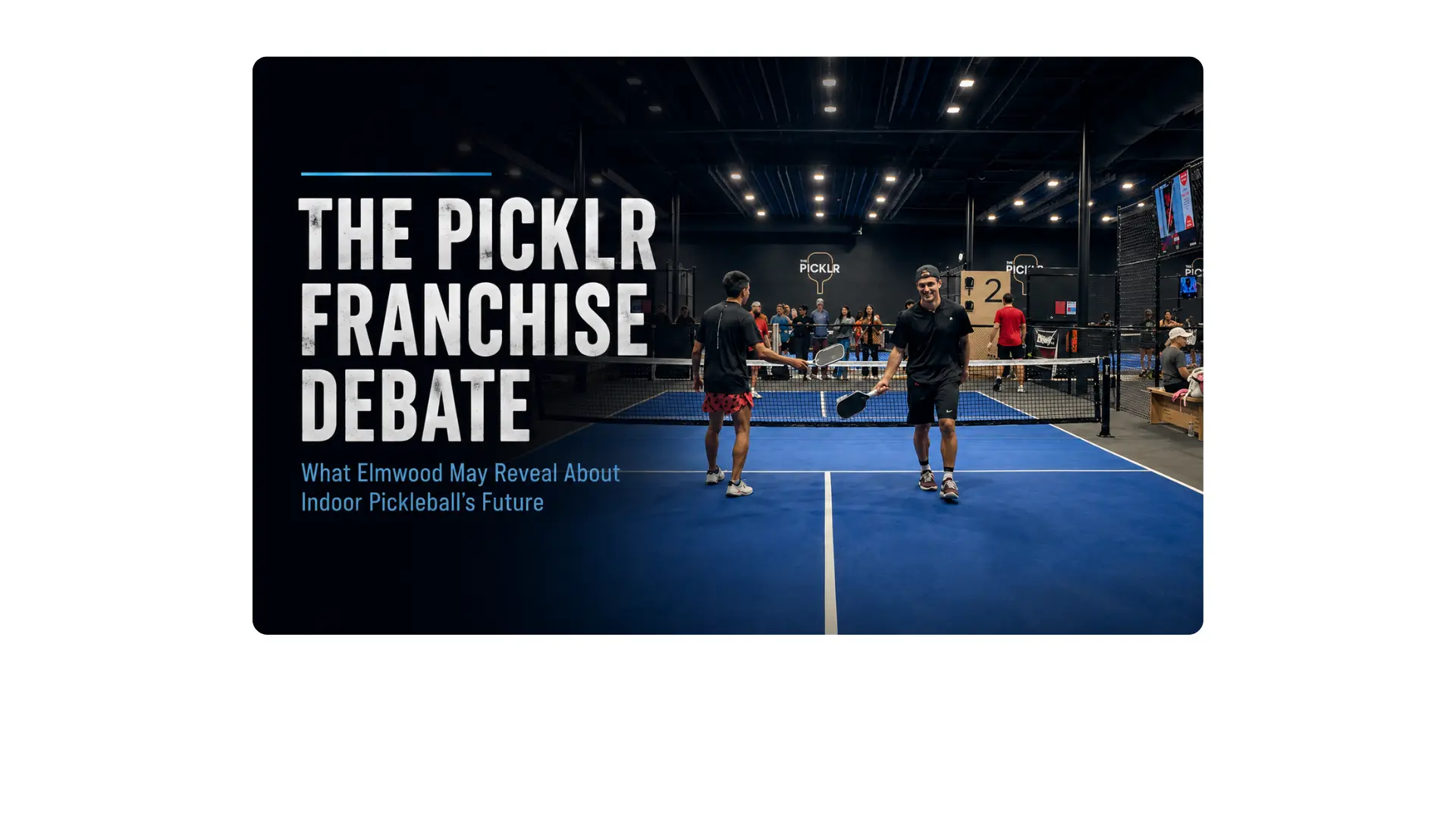
The Picklr Franchise Debate: What It Means for Elmwood and Indoor Pickleball
Every serious pickleball player in Jefferson Parish has probably had the same thought while driving near Bloomfield Street: Man, if that place opened, it would be packed.
That is why the delay surrounding the planned 16-court The Picklr Elmwood facility still matters. We already covered the local status of that project in detail, including the permits, the stalled construction timeline, and the questions surrounding the local franchise situation. This follow-up looks at the bigger issue now circling the sport: whether the premium indoor pickleball club model can consistently make enough money to justify the cost.
Now, a growing national conversation around The Picklr franchise model, indoor pickleball economics, pickleball franchise profitability, and membership-based pickleball clubs may offer broader context for why projects like Elmwood can stall even when player demand is obvious.
This is not an article claiming The Picklr is failing. That would be irresponsible and inaccurate. The brand continues expanding nationally, many players love their local Picklr clubs, and premium indoor pickleball still has a strong case in the right market.
But the public discussion does raise one important question:
Can premium indoor pickleball clubs consistently generate enough long-term revenue to justify their buildout costs, staffing, rent, programming, royalties, and ongoing operations?
That question matters in New Orleans because the Elmwood delay may look less like a random local stumble and more like part of a bigger industry stress test.
In other words, maybe the pause was not simply bad news. Maybe it was caution. Maybe it was risk management. Maybe, depending on what the numbers looked like behind the curtain, hesitating saved somebody from lighting a very expensive match.
What Does The Picklr Franchise Debate Mean?
The Picklr franchise debate matters because it highlights the biggest challenge facing indoor pickleball clubs: demand for courts is real, but demand does not automatically equal profit. Premium indoor facilities must solve high rent, buildout costs, staffing, HVAC, programming, member retention, court utilization, and local competition. For the New Orleans area, that makes the delayed Picklr Elmwood project more understandable. A 16-court indoor facility could succeed, but only if the business model works beyond the grand-opening excitement.
Bottom line: indoor pickleball is not dying, but the indoor pickleball business model is entering a more demanding phase where profitability, retention, and operational discipline matter more than expansion hype.
Why This Matters to New Orleans Area Pickleball
The New Orleans metro has already proven that pickleball demand is real. Public courts stay busy. Private venues have found audiences. Serious players want consistent conditions, better scheduling, and relief from heat, rain, glare, and humidity.
So no, the problem is not whether people want to play pickleball.
They do.
The harder question is whether enough people will pay premium monthly prices, every month, for a private indoor club once the new-car smell wears off.
That is the whole enchilada.
A large indoor pickleball club is not just a pickleball dream. It is a real business with real bills: rent, utilities, staffing, software, programming, cleaning, insurance, marketing, maintenance, and possibly franchise fees layered on top.
And real businesses do not survive on vibes, Facebook excitement, and “everybody says they would join.” They survive on utilization, retention, pricing power, payroll discipline, and whether the 11 a.m. Tuesday court schedule looks alive or like a refrigerator light in an empty garage.
That is the hidden tension behind the Picklr Elmwood delay: New Orleans may have the players, but any operator still has to prove the economics.
For readers who want the full local timeline, including the original Elmwood status, permit discussion, and site-specific questions, start with our earlier report on The Picklr Elmwood delay. This article is the bigger-picture follow-up.
The Picklr Franchise Numbers That Sparked the Debate
The national conversation gained steam after pickleball players and business-minded observers began discussing financial details from The Picklr franchise disclosure materials. The public debate focused on reported corporate losses during expansion years, franchisee performance questions, buildout costs, EBITDA, royalties, and whether some indoor pickleball markets may become oversaturated.
The most discussed topics around The Picklr franchise include:
- The Picklr franchise cost
- The Picklr franchise disclosure document
- The Picklr financials
- Picklr franchise profitability
- indoor pickleball franchise economics
- pickleball club EBITDA
- pickleball facility buildout costs
- membership-based pickleball club sustainability
The bear case is that the numbers show a fragile model with heavy upfront costs, thin margins, and major pressure on local franchisees.
The bull case is that early-stage franchise systems often lose money while expanding, and that strong operators in strong markets can still build valuable local clubs.
Both views deserve oxygen.
Because this is not a cartoon where one side is brilliant and the other side is eating paste in the corner. Indoor pickleball is complicated. It has real upside and real risk. The court surface can be beautiful while the balance sheet is sweating through its shirt.
What the Public Franchise Filing Adds to the Conversation
The public Wisconsin franchise filing for Picklr Franchise Inc., doing business as The Picklr, gives this debate more substance than ordinary court gossip. The filing shows a registered franchise disclosure document uploaded on May 8, 2026, which is why players and business-minded observers have been digging into the numbers.
The key detail is not that the numbers prove failure. They do not. The key detail is that they show a wide range of possible outcomes for franchise operators.
According to public discussion of Item 19, the sample included 12 clubs. Within that sample, the reported spread was dramatic: the weakest performer was discussed as losing roughly $175,000 per year, while the strongest performer was discussed as generating roughly $567,000 per year on about $1.8 million in revenue. That gap matters.
It suggests that premium indoor pickleball can work in the right conditions, but it can also punish operators who enter the wrong market, carry too much buildout cost, miss on programming, or fail to retain enough members after the grand-opening rush fades.
There was also balance in the discussion. Public discussion surrounding the filing referenced approximately $189,000 in Q1 net income, which complicates any overly simple “the model is doomed” narrative. At the same time, some observers questioned expense allocation details, including discussion that a significant share of the marketing fund was being used to cover corporate payroll.
Coach Sid translation: this is not a smoking gun. It is a caution light. And when you are about to spend serious money converting a warehouse into a premium indoor pickleball club, caution lights matter.
The Real Indoor Pickleball Business Model Problem
The biggest challenge for indoor pickleball clubs is not getting players excited. It is converting that excitement into profitable, repeatable, year-round revenue.
A packed parking lot can fool you.
Some clubs look like a gold rush at 6 p.m. and a ghost town by lunch the next day. That is the dirty little secret of indoor pickleball economics: peak-hour excitement does not always pay industrial HVAC bills.
Most facilities have the same peak demand problem:
- weekday evenings are busy
- weekend mornings are busy
- some weekday mornings work if there is a strong retired-player base
- midday and early afternoon can be difficult
- late nights depend heavily on local culture
That means the business has to make enough money during high-demand windows to carry the slower hours. A court that sits empty still costs money. The rent does not care if nobody signed up for skinny singles at 1:30 p.m.
For indoor pickleball clubs, the core business challenge is simple to state and brutal to solve:
Can the club fill enough courts, often enough, at the right price, with enough retained members, to cover large fixed costs and still produce a return?
That is the spreadsheet monster hiding behind the pretty court photos.
The Bear Case: Why Some Believe Indoor Pickleball Is Becoming Overbuilt
The skeptical argument is not anti-pickleball. It is anti-bad-math.
Indoor pickleball facilities are expensive to build and expensive to operate. Depending on the location and concept, an operator may have to deal with:
- large lease obligations
- construction and conversion costs
- court surfacing
- industrial lighting
- HVAC demands
- acoustic treatment
- insurance
- staffing
- software platforms
- coaches and programming
- maintenance
- marketing expenses
- member acquisition costs
- franchise royalties or fees, if applicable
Then the club has to compete against free or cheaper alternatives.
That is where the human behavior piece gets spicy.
Players say they want premium. But many still choose convenience.
Most players do not care about franchise branding as much as operators hope. They care about:
- drive time
- court availability
- who else is playing
- whether games match their skill level
- reservation ease
- air conditioning
- price
- whether they can get on a court Tuesday night without drama
That is why a beautiful facility can still struggle if the local player base fragments, if nearby clubs undercut pricing, or if public courts satisfy enough casual players for free.
The concern is not that pickleball is shrinking.
The concern is that some markets may eventually have too many premium indoor clubs chasing the same limited pool of high-frequency paying members.
That is a very different problem.
The Year Two Problem: When the Grand Opening Buzz Fades
Here is the part nobody likes to say out loud:
The first six months are not the real test.
New clubs get curiosity traffic. Players want to see the courts. Local influencers post videos. Everyone wants to try the fancy new place with clean lines, bright lights, and bathrooms that do not feel like a public park concession stand from 1987.
That honeymoon period can be powerful.
But Year Two tells the truth.
By then, the novelty crowd has made its decision. The casual players know whether the monthly fee fits their lifestyle. The serious players know whether the competition is strong enough. The operator knows whether programming actually fills courts outside peak windows.
Indoor pickleball clubs do not win because people visit once. They win because enough people keep coming back when the sparkle becomes routine.
That is why the national conversation matters to Elmwood. A delayed opening may be frustrating, but a rushed opening with weak economics would be worse. Nobody wants a beautiful facility that becomes a cautionary tale after the ribbon-cutting photos stop circulating.
Coach Sid translation: the first game is adrenaline. The second year is footwork.
The Bull Case: Why Premium Indoor Pickleball Can Still Work
Now let’s not throw the baby out with the bathwater, the paddle bag, and somebody’s half-eaten protein bar.
Premium indoor pickleball can absolutely work in the right market with the right operator.
Many players love their indoor clubs for good reasons:
- consistent court conditions
- no rain delays
- no wind
- better lighting
- higher ceilings
- cleaner facilities
- organized open play
- skill-based sessions
- easy reservations
- coaching programs
- DUPR-rated events
- stronger competition
- social community
For serious players, those advantages are not cosmetic. They change development.
When you remove wind, glare, random bounces, and weather cancellations, you get cleaner feedback. Your third shot either landed or it did not. Your reset either worked or it floated. Your speed-up either had purpose or it was just emotional confetti.
That matters.
In a climate like New Orleans, the indoor argument may be even stronger than in mild-weather markets. Summer heat, humidity, rain, and brutal afternoon conditions create a real need for climate-controlled play. Around here, “indoor pickleball” is not just luxury. In July and August, it can feel like survival with a paddle.
So the bullish case for New Orleans is real:
- hot and humid weather supports indoor demand
- rain creates frequent outdoor interruptions
- serious players want consistent training conditions
- league and DUPR programming can create sticky communities
- a premium club could become a regional hub
- Jefferson Parish has a strong and growing player base
The question is not whether indoor pickleball has value.
It does.
The question is whether the pricing, programming, and cost structure can line up cleanly enough for the business to survive after the grand-opening thunderclap.
The DUPR and Competitive Play Tension
There is another cultural angle that deserves more attention: DUPR fatigue.
Structured play can be fantastic. DUPR-rated sessions, skill-based courts, leagues, ladders, and competitive programming help serious players improve. They also help clubs organize chaos. Anybody who has watched a 2.8 wander onto a 4.2 challenge court knows structure has a purpose.
But there is a tension.
A club built entirely for grinders can accidentally squeeze out the exact casual members needed to stabilize the business financially.
Not every paying member wants every Tuesday night to feel like a ratings audit with a hydration break.
Some players want clean courts, friendly games, air conditioning, and a place to laugh after they dump a dink into the net. Others want DUPR pressure, high-level reps, tournament prep, and games where every ball feels like it has a lawyer attached to it.
A successful indoor pickleball club has to serve both groups without letting either one ruin the room.
That is harder than it sounds.
If the club becomes too casual, strong players leave. If it becomes too intense, casual players stop paying. The operator has to build a culture where competitive players feel challenged and recreational players still feel welcome.
That balance may be one of the most important long-term success factors for any Picklr, independent club, or future indoor pickleball facility in the New Orleans area.
Why The Picklr Elmwood Delay Looks More Understandable Now
When the Picklr Elmwood project first stalled, many players naturally saw it as a local execution issue. That local story still matters, but this broader franchise debate adds another layer.
If local operators were reassessing buildout cost, financing risk, operating complexity, franchise obligations, market competition, or long-term membership math, that is not necessarily foolish. It may be prudent.
Let’s be careful here: we do not know exactly what every decision-maker saw, thought, or decided behind closed doors.
But we can say this:
A delayed project may be disappointing for players, but a bad investment can be devastating for operators.
If the numbers did not feel right, pausing may have saved someone a lot of money.
That does not mean The Picklr model cannot work. It does not mean Elmwood cannot eventually happen. It does not mean indoor pickleball is doomed.
It means this industry is moving from dream board to balance sheet.
And sometimes the balance sheet walks into the room like a grumpy old tournament director and says, “Hold up, partner. Show me the math.”
For the detailed local version of what was known about Elmwood before this broader franchise debate picked up steam, read the original Picklr Elmwood report.
Demand Is Not the Same Thing as Profitability
This may be the most important takeaway from the entire Picklr franchise debate.
Packed courts do not automatically equal a profitable indoor pickleball business.
A public park can be overflowing every night while a private facility nearby still struggles. That sounds contradictory until you remember that one has taxpayers behind it and the other has rent, payroll, insurance, utilities, debt service, software fees, marketing costs, cleaning costs, and maybe franchise fees.
Public demand and private profitability are two different animals.
One eats enthusiasm.
The other eats cash flow.
For a private indoor pickleball club to work, the operator has to solve:
- How many members are needed to break even?
- How often will those members actually play?
- Can courts be filled outside peak hours?
- Will casual players keep paying after the novelty fades?
- Will serious players stay if the competition level drops?
- Can leagues, clinics, lessons, and events create enough added revenue?
- Can pricing stay high without pushing players back to public courts?
- Can the facility survive slower seasons?
- Can the operator manage staffing without bloating payroll?
That is why the indoor pickleball business model is harder than it looks from the baseline.
On court, you can win a point with chaos.
In business, chaos sends invoices.
Premium Indoor Pickleball vs Convenience: What Players Really Choose
One of the most important human behavior lessons in this debate is that players often say they want the best facility, but they repeatedly choose the easiest routine.
That means a premium club has to be more than beautiful.
It has to be useful.
For most players, the real decision tree looks like this:
- How far is it from my house?
- Can I get games at my level?
- Can I reserve without fighting the app?
- Are my friends there?
- Is the price reasonable for how often I play?
- Do I feel welcome?
- Is the facility better enough to change my habits?
That last question is the monster.
A premium indoor pickleball club does not just compete against other clubs. It competes against habit. It competes against the free court five minutes from home. It competes against the group text that already knows where everybody is playing tonight.
Branding can attract curiosity. Convenience builds routines.
And routines are where membership businesses either grow roots or dry out.
This is one reason the “pickleball is a fad” debate misses the real issue. Participation growth and sustainable business economics are not always the same thing.
The Future of Indoor Pickleball May Include Consolidation
The next phase of indoor pickleball may not be endless new openings.
It may be consolidation.
That does not mean failure across the board. It means stronger operators may eventually absorb weaker locations, buy distressed assets, renegotiate leases, refine programming, and build more sustainable clubs after the first wave of excitement clears.
This happens in recreation industries all the time. Golf did it. Boutique fitness did it. Indoor trampoline parks did it. Climbing gyms did it. The first wave often proves demand. The second wave figures out who can actually operate.
Indoor pickleball may follow a similar path.
Facilities Most Likely to Survive
- strong local operators
- disciplined programming
- smart market selection
- manageable buildout costs
- reasonable rent
- balanced competitive and recreational cultures
- good retention systems
- clear pricing
- strong off-peak utilization
Facilities Most Likely to Struggle
- oversaturated markets
- weak programming
- poor member retention
- excessive buildout debt
- unclear positioning
- too much dependence on novelty traffic
- bad location decisions
- pricing that does not match local player behavior
That is the real future to watch.
Not just who opens.
Who survives.
Why New Orleans Is Still a Strong Indoor Pickleball Market
Even with all the caution above, New Orleans still has one big advantage for indoor pickleball:
Our weather can be rude.
Heat, humidity, rain, glare, slick courts, summer storms, and swampy evening air all make indoor pickleball more attractive here than in markets where outdoor play is comfortable most of the year.
A premium indoor pickleball facility in Jefferson Parish would not be selling only luxury. It would be selling predictability.
- predictable court times
- predictable playing conditions
- predictable leagues
- predictable training environments
- predictable social routines
That is valuable.
But again, value is not the same as automatic profitability. The operator still has to price it correctly, program it intelligently, and keep both serious players and recreational players engaged.
The market opportunity is there.
The execution has to match it.
What This Means for New Orleans Pickleball Players
For local players, the takeaway is not “give up on Elmwood.”
The takeaway is: understand what kind of facility would actually last.
The New Orleans area does not just need more courts. It needs stable courts. It needs clubs that are still healthy after the launch party. It needs operators who understand programming, community behavior, pricing, competitive balance, and Louisiana weather.
If a premium indoor facility eventually opens in Elmwood, the best version would be one that has learned from the national debate rather than ignored it.
That means players should ask smarter questions:
- Will there be enough open play at different skill levels?
- Will casual players feel welcome?
- Will competitive players find strong games?
- Will DUPR events be balanced instead of overwhelming?
- Will pricing match how often people actually play?
- Will court reservations be fair?
- Will the club build community or just sell access?
- Will the operator still be strong in Year Two?
Those are the questions that matter after the banners come down.
For players, this also creates a consumer caution point: before buying any prepaid membership, founders deal, or early access package for a facility that is not yet open, make sure the refund terms, opening timeline, and ownership details are clear.
Because players do not just need a place to hit balls.
They need a place that works.
Frequently Asked Questions About The Picklr Franchise Debate
No responsible analysis should make that claim based only on public discussion. The better question is whether the premium indoor pickleball franchise model can produce consistent profitability across different markets. Some locations may thrive while others struggle.
It matters because the delayed Picklr Elmwood project may reflect the same broader issues being debated nationally: buildout costs, franchisee risk, financing, membership demand, and indoor pickleball profitability. For the full local timeline, readers should see the original Picklr Elmwood report.
Indoor pickleball can be profitable, but profitability depends on rent, buildout cost, pricing, staffing, court utilization, programming, retention, and local competition. High player demand does not automatically guarantee strong business economics.
Indoor clubs often require large buildings, HVAC, lighting, court surfacing, insurance, staffing, software, maintenance, cleaning, marketing, programming, and sometimes franchise fees or royalties.
Yes, it could. A delayed project is not the same as a canceled project. The future likely depends on operator stability, financing, construction economics, and whether the business model can support the local market.
Yes, there is a strong case for indoor pickleball in New Orleans because heat, humidity, rain, and inconsistent outdoor conditions create demand for climate-controlled courts. The challenge is building a facility that is financially sustainable.
The biggest risk is confusing early excitement with durable membership demand. A club must retain members, fill off-peak court times, balance competitive and recreational play, and survive after the novelty fades.
Final Thoughts: Indoor Pickleball Is Meeting the Spreadsheet
The New Orleans area deserves premium indoor pickleball.
The player base exists. The passion exists. The weather case exists. The need for consistent, climate-controlled courts is real.
But the national Picklr franchise debate reveals something every fast-growing sport eventually has to face:
Building courts is the easy part. Building a sustainable indoor pickleball business is much harder.
The Elmwood delay may ultimately prove temporary. A stronger operator could emerge. Financing could stabilize. Construction could begin later under a better structure. Or the market could evolve in a different direction entirely.
Either way, this debate is useful.
It forces players, investors, operators, and local communities to think past the hype and ask better questions.
Not “Do people love pickleball?”
They do.
The better question is:
Can indoor pickleball operators turn that love into a stable, well-run, long-lasting business?
That is where the sport is now.
The honeymoon is still fun. The courts are still calling. The game is still growing.
But the spreadsheet has entered the kitchen.
And in the long run, that may be exactly what indoor pickleball needs.
About the Author: Coach Sid Parfait is a lifelong Louisiana resident, competitive DUPR-rated pickleball player, and the founder of PickleTip.com. He writes about pickleball strategy, paddle performance, DUPR culture, local court development, and the business forces shaping the future of the sport.