
Pickleball Power Paddles: Power vs. Pop Explained
A power paddle is not simply a thin, stiff, head-heavy paddle anymore. Modern paddle power comes from the entire face-core-mass system: rebound, flex and recovery, swing weight, leverage, thickness, shape, balance, and how efficiently the finished paddle returns energy to the ball. Just as important, power and pop are not the same thing. A paddle can give you easy speed on a short counter without producing your highest full-swing velocity, or do the opposite.
Players love asking me one version of the same question:
“Coach, is this a power paddle?”
Years ago, that was fairly easy to answer.
Thin core. Firm face. Maybe elongated. Maybe a little head heavy.
Yep. Probably power.
That shortcut does not survive the modern paddle market.
Today I can hand you two paddles with the same thickness and completely different rebound profiles. One paddle may feel quiet during a dink and wake up when you accelerate. Another may give you immediate speed from a six-inch counter. A third may have plenty of leverage on a full drive but very little of what players call “free pop” around the kitchen.
Power is not one ingredient. It is what the finished paddle does with the energy you give it.
Jump to: Power vs pop · What creates power · Free pop · Core thickness · Swing weight · Tradeoffs · Who needs power? · How to test it · FAQs
Power vs. Pop: They Are Not the Same Thing
Before we go any farther, I separate power from pop.
Players use power and pop interchangeably, but I do not think that is useful.
| Trait | How I Use the Term | Where You Notice It |
|---|---|---|
| Power | How much ball speed the finished paddle helps produce when you make a committed swing | Serves, drives, overheads, attacking roll volleys, full counters |
| Pop | How readily the ball comes off the paddle during shorter, compact contact | Blocks, counters, punch volleys, speed-ups, quick kitchen exchanges |
| Free pop | Pace you receive without supplying a large swing or much acceleration yourself | Hands battles and passive/compact contact |
Those are practical PickleTip testing terms, not three official equipment classes.
A paddle can make a full drive nasty while staying relatively calm when you simply hold the face out for a block.
Another paddle can feel like somebody installed a launch button in your counter but may not add nearly as much to your maximum full-swing pace.
Power tells me what happens when I ask for speed. Pop tells me how much speed shows up before I ask very hard.
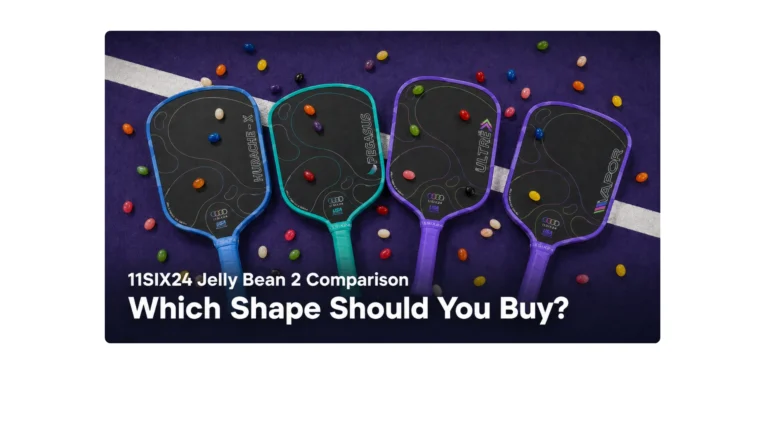
I have seen that separation in my own testing. In my 11SIX24 Power 2 comparison, the Vapor’s quick recovery helped me stay on offense in fast exchanges, but it punished lazy paddle-face control on resets sooner than the Ultre or Pegasus. The Hurache-X rewarded me most when I actually committed to the swing and used its elongated leverage. Same power family. Very different ways of delivering speed.
Paddle Rebound Can Actually Be Measured
This is no longer just reviewers arguing about whether a paddle “feels hot.”
USA Pickleball introduced its Paddle/Ball Coefficient of Restitution test, or PBCoR, to quantify paddle rebound behavior.
Coefficient of restitution compares rebound speed with incoming speed. In paddle testing, that gives the governing body a way to evaluate how much energy a paddle returns to the ball and limit excessive trampoline-like performance.
That does not mean a PBCoR number tells you everything about how powerful a paddle will feel in your hand.
Your swing, paddle mass, swing weight, shape, contact location, ball, and the rest of the construction still matter.
Paddle rebound is a measurable performance characteristic, not just marketing vocabulary.
Current approval can change, so use the USA Pickleball approved-equipment database when legality or tournament certification matters.
What Actually Makes a Pickleball Paddle Powerful?
There is no single recipe anymore.
I think about paddle power as a system with several major inputs.
| Input | How It Can Affect Power | Important Catch |
|---|---|---|
| Core rebound | Can return more of the incoming/deformation energy to the ball | Core material alone does not predict the finished response |
| Face flex & recovery | Can change how energy is stored and returned during impact | More flex does not automatically mean more usable power |
| Swing weight | More rotational mass can create greater momentum through the ball | Too much can make you late |
| Shape & leverage | Longer geometry can increase leverage and tip speed potential | It can also affect maneuverability and stability |
| Static weight | More moving mass can contribute to momentum | Where the weight sits matters enormously |
| Core thickness | Changes the face/core structure and can influence firmness and response | Thickness alone no longer predicts power reliably |
| Perimeter structure | Foam, frames and reinforcement can change support and energy behavior | Two foam-enhanced paddles can respond very differently |
| Player acceleration | Your own racquet-head speed supplies much of the energy | The paddle does not swing itself |
If you want the construction side of those variables (the difference between honeycomb, EPP, MPP, full foam, floating cores, carbon layups and perimeter structures) that can be found in my pickleball paddle materials and construction guide.
What I care about here is simpler:
What did that construction accomplish when the ball hit the paddle?
What Players Mean by “Free Pop”
Free pop is one of those phrases that makes perfect sense on a court and sounds ridiculous in an engineering meeting.
I still use it.
When I say a paddle has more free pop, I mean it produces useful pace from a short motion without demanding much acceleration from me.
You notice it when:
- a compact counter jumps off the face,
- a punch volley gets deep with very little swing,
- a passive block carries farther than expected,
- or a tiny speed-up produces more pace than the motion seems to deserve.
Free pop can be wonderful.
In fast hands exchanges, I do not have time to take a beautiful full swing. A paddle that gives me useful speed from six inches of movement can be a weapon.
But the same characteristic can require recalibration on shots where I want to absorb pace rather than return it.
Free power is only free until you have to control it.
Are Thinner Pickleball Paddles More Powerful?
Sometimes. Not automatically.
I used to put too much weight on core thickness.
I used to describe 14mm-or-thinner construction as one of the defining traits of a power paddle.
Back then, that shortcut worked more often than it does now.
It is not a rule anymore.
Modern manufacturers can create substantial rebound from 16mm paddles by changing the core, face layup, flex behavior, perimeter support and manufacturing method.
JOOLA’s current Perseus Pro V, for example, is sold in both 14mm and 16mm versions while using the same broader KineticFrame/Propulsion Core concept. JOOLA describes its Propulsion Core as adding controlled flex and a responsive, spring-like effect for easier access to power on drives, counters, and speed-ups.
That does not prove the 14mm and 16mm versions perform identically.
It proves why thickness should be treated as one construction variable rather than a power label.
Fourteen millimeters is a measurement. It is not a personality.
Swing Weight and Usable Power
Another old shortcut says a power paddle should be head heavy.
Sometimes, but only if you can still move it.
Putting more mass farther from your hand increases its rotational effect. That can increase momentum and leverage through a full swing.
But there is a bill attached.
If the paddle becomes too demanding to accelerate, you may arrive late, lose hand speed, or fail to produce the swing velocity that made the added mass attractive in the first place.
That is why I care more about usable power than theoretical power.
I ran into this exact tradeoff in my Vapor Power 2 vs. Spartus P1 Hybrid comparison. The P1’s higher swing weight gave me a denser, more stable response and calmer blocks and resets, but it could tax the forearm and wrist late in a session. The Vapor accelerated faster and gave me easier pop in quick exchanges, but that liveliness also made late, open-face blocks more expensive. More mass can help the ball. It can also make you late to it.
The most powerful paddle is not the one with the biggest number. It is the one you can still put in the right place at the right time.
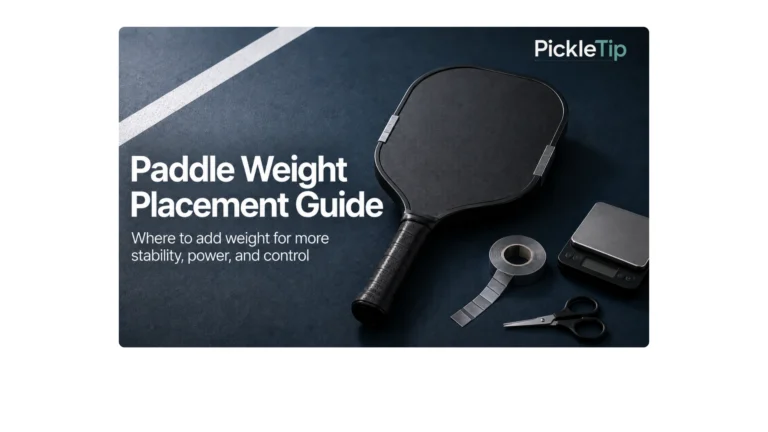
If you want to deliberately alter balance, swing weight or twist resistance, use my pickleball paddle weight-placement guide. Here, I am more interested in what those changes do to the ball, and what they cost you in timing.
Does an Elongated Paddle Automatically Have More Power?
No.
An elongated shape can give you more leverage and potentially more tip speed because the hitting surface extends farther from your hand.
That can contribute to power.
But shape also changes:
- reach,
- balance,
- swing weight,
- twist behavior,
- sweet-spot geometry,
- and how quickly the paddle moves through short exchanges.
A standard or hybrid paddle with a lively face/core system can have more free pop than an elongated paddle that produces better full-swing leverage.
Can a Paddle Have High Power but Low Pop?
Yes, and this is one of the most useful things to understand when comparing modern paddles.
Imagine a paddle that stays relatively calm during compact contact but rewards a bigger swing with substantially more speed.
That is a very different experience from a paddle that gives you immediate rebound from almost every short contact.
| Profile | What It May Feel Like | Possible Fit |
|---|---|---|
| High power / high pop | Lots of speed from both full swings and compact contact | Player who wants maximum offensive response and trusts touch |
| High power / moderate pop | Calmer in short game but plenty available when you accelerate | Player who creates pace and wants more separation between soft and hard swings |
| Moderate power / high pop | Quick around the kitchen without huge full-swing speed | Player who values counters and compact offense |
| Moderate power / moderate pop | More neutral response across shot types | Player prioritizing predictability or all-court balance |
Those are performance profiles, not official paddle classifications.
Those profiles are still far more useful than labeling everything either “power” or “control.”
Do Power Paddles Have Less Control?
Not inherently.
I do not use that rule anymore either.
A paddle can have substantial power and still be predictable.
What changes is the amount of energy you have to manage.
If a paddle returns more speed than you expect during compact contact, your face angle, grip pressure, contact point and motion need to account for it.
That is not the same thing as the paddle having “no control.”
Control is not the absence of power. Control is predictable output from the input you intended.
A high-response paddle that behaves predictably may be easier for one player to control than a “control paddle” whose response they cannot read.
That is why I hit the finished paddle before I decide what it is. Material names and marketing categories can tell me what to investigate. They do not get the verdict.
A Powerful Paddle Can Make Defense Easier, Until It Doesn’t
Power paddles are usually marketed with drives, overheads and speed-ups.
But easy rebound can also be useful when you are defending.
On a fast counter or block, the opponent is already supplying most of the incoming pace. A responsive paddle may let you redirect that ball with a very compact movement, which can be a real advantage.
The tradeoff is that when you want to remove energy (for example on a difficult transition reset) you still need a face and hand response that produce the trajectory you intend.
I saw that tradeoff in the Power 2 shapes too: the Vapor punished lazy reset contact sooner, while the Pegasus gave me more room when doubles got late, crowded, or ugly.
So I do not ask:
“Is power good for defense?”
I ask:
“Can I predict the rebound when I am defending?”
Who Should Consider a Power Paddle?
I do not think there is a DUPR number where somebody hands you permission to use one.
The better question is what your game needs.
| If This Sounds Like You… | More Power May Help |
|---|---|
| Your full drives require too much effort to create useful pace | A more efficient response may give you offense without overswinging |
| You struggle to counter quickly because your current paddle requires too much motion | More pop may help compact exchanges |
| You already have good touch but want a larger offensive ceiling | More available rebound or leverage may expand your attacking options |
| You create speed easily but want the paddle calmer on shorter swings | You may want high top-end power without maximum free pop |
| Your paddle feels great on soft balls but dies when you ask for pace | A different power profile may fit your game better |
When Less Pop Is Actually Better
There is nothing advanced or beginner about wanting a calmer paddle.
You may prefer less free pop if:
- you already generate plenty of your own pace,
- you like absorbing and redirecting balls in transition,
- you routinely overhit compact counters,
- you prefer a wider difference between your soft swing and your hard swing,
- or you simply trust a more proportional response.
Notice what I did not say:
“Beginners need control paddles and advanced players need power paddles.”
That is too simple.
Your rating does not decide how much rebound you need. Your game does.
When the Paddle Isn’t the Power Problem
Equipment can change the output.
It cannot replace sequencing, spacing, contact point, footwork or clean acceleration.
If your drive has no pace because you are reaching, late, off balance and arming the ball, buying more rebound may simply give you a faster version of the same mistake.
On the other hand, if your mechanics are reasonably sound and your current paddle makes you work unnecessarily hard for the speed you need, equipment can absolutely change the equation.
A paddle can amplify your swing. It cannot organize it for you.
How I Test Whether a Paddle Has Useful Power
I would never test a “power paddle” by hitting ten serves as hard as possible and announcing that it is a cannon.
That tells me almost nothing about whether the power is useful.
I want to see the response across different input levels.
1. Passive Block
I barely move the paddle and let incoming pace do the work.
This shows me how much free rebound appears with very little input.
2. Compact Counter
Short movement. Fast exchange.
This is where useful pop earns its paycheck.
3. Controlled Drive
I hit at something closer to match pace rather than trying to break the ball.
I want to see how output grows when I add intentional acceleration.
4. Full Acceleration
Now I ask for the ceiling.
How much additional pace shows up when I really swing?
5. Transition Reset
This is where I find out whether I can take energy off the ball after enjoying all that rebound.
6. Off-Center Counter
Because the center of the paddle is not where every real point happens.
I want to know whether response stays understandable when contact gets ugly.
I test power as a response curve, not one swing. The question is not “How hard can this paddle hit?” It is “Can I predict what it will give me when I barely move it, counter, drive, swing full, or try to take pace back off?”
That fits inside the broader PickleTip paddle testing methodology, where pressure, access, discipline, durability, load and errors matter more than one highlight-reel number.
When I rotated through the four 11SIX24 Power 2 shapes, this test changed what I wanted from each one. In clean, fast exchanges I wanted the Vapor. In longer rallies where I had to block, reset, and attack again, I trusted the Ultre more. When doubles turned into elbows, late blocks, and panic resets, I wanted the Pegasus. When I had time to load and brush through the ball, the Hurache-X gave me the leverage and shape I was looking for.
Those are on-court comparisons, not lab scores or fake precision ratings. Unless I am reporting an instrumented measurement, I am describing the response I can repeat in play, not pretending my arm is a ball-speed machine.
A Soft-Feeling Paddle Can Still Hit Hard
A powerful paddle can feel soft.
A powerful paddle can feel firm.
A paddle with noticeable pocketing can still produce serious pace.
A crisp paddle can also produce relatively moderate top-end speed.
That is why I would not use “soft,” “plush,” “firm,” “dwell,” or “pocketing” as substitutes for actual power evaluation.
If you want to separate actual contact time from what your hand perceives as pocketing, use my pickleball paddle dwell-time guide.
Does More Spin Mean More Power?
No.
Modern power paddles often also have capable spin surfaces, but those are separate characteristics.
Paddle rebound and surface friction are tested as separate equipment characteristics for a reason.
A paddle can have tremendous spin access without being one of the most powerful paddles you have ever hit.
And a very powerful paddle does not automatically have an exceptional long-term spin surface.
For surface mechanics, go to Pickleball Paddle Grit: How Texture, Friction, and Spin Really Work.
For surface retention over time, use Pickleball Grit Durability in 2026.
Should You Add Weight Instead of Buying a More Powerful Paddle?
Sometimes.
Adding mass in the right location can change leverage, stability, swing weight and how much momentum you bring through the ball.
But that does not reproduce every kind of paddle power.
You can change mass distribution.
You cannot turn one core architecture into another with adhesive tape.
If the paddle needs more stability or leverage, tuning may solve the problem.
If what you actually want is a fundamentally different rebound profile, you may need a different paddle.
For the tuning side, use How to Add Weight to a Pickleball Paddle.
Pickleball Power Paddle FAQs
A power paddle produces relatively high ball speed or rebound from the complete paddle system. Core rebound, face flex and recovery, swing weight, shape, leverage, mass distribution and player acceleration can all contribute. There is no single material, thickness or shape that automatically makes a modern paddle powerful.
I use power to describe the pace available when the player makes a committed swing, while pop describes how readily the ball comes off the paddle during shorter contact such as blocks, counters and punch volleys. A paddle can have high top-end power without having maximum free pop, or plenty of pop without producing the highest full-swing speed.
Not automatically. Thinner cores can feel firmer or quicker in some constructions, but modern 16mm paddles can also produce substantial power through core rebound, flex, face construction and perimeter design. Thickness should be treated as one variable rather than a power rating.
Not inherently. A paddle with more rebound can require a player to recalibrate compact shots, but control is better understood as predictable output from the input the player intended. A powerful paddle can still be highly predictable for the right player.
Yes. I would not choose paddle power from a skill-rating cutoff alone. A newer player may prefer more easy rebound, while an advanced player who already creates plenty of pace may prefer a calmer response. The better question is what the player’s game needs from the paddle.
Adding weight can increase momentum and leverage depending on where the mass is placed, but it does not reproduce every kind of power. Weight tuning changes mass distribution and swing characteristics; it does not transform the paddle’s underlying core and face rebound system.
PBCoR means Paddle/Ball Coefficient of Restitution. USA Pickleball uses the test to quantify rebound behavior and limit excessive trampoline-like performance. It is useful evidence that paddle rebound is measurable, but a certification result is not a complete description of how powerful a paddle will feel for a particular player.
How Much Power Do You Actually Need?
I would not answer that with:
“Everybody should eventually graduate to a power paddle.”
There is no graduation ceremony.
Some of the best players I know create so much of their own pace that what they actually want from equipment is restraint.
Other players have excellent placement and decision-making but benefit from a paddle that gives them easier depth and speed without a heroic swing.
Neither player is more advanced because of the paddle category.
The goal is to find a response profile that helps you create the ball you intended.
Don’t buy the paddle with the most power. Buy the amount of power you can still trust when the point gets ugly.
And if that paddle makes you feel like Thor’s hammer happens to be in your hand, I am not going to complain.
I just want the ball to land in.