

Why Getting Better at Pickleball Can Make It Less Fun (And How to Fix It)
There is a dangerous little moment in pickleball when getting good starts making the game feel worse.
You miss one third shot drop by two inches. Your jaw locks. Your grip tightens. Your brain starts barking like an angry little courtside goblin: You should not miss that. Not at your level.
Now you are not playing the point in front of you. You are dragging the last mistake around like a wet sandbag.
That is the perfection trap.
Coach Sid note: I am not writing this as a sports psychologist. I am writing it as a coach, competitor, and father who has watched good players let one miss steal the next three points.
And last night, my 23-year-old son walked right into the middle of it with one question.
He is a high-level pickleball player, floating between a 4.6 and 5.0 DUPR, and he asked me:
“How do you keep pickleball fun while still chasing perfection and trying to go pro?”
That question stopped me.
Because that is not a beginner question. That is the question competitive players start asking when the game they love begins turning into a courtroom, and they are both the defendant and the judge.
If you still love pickleball but have started treating every miss like evidence, this is the trap you need to understand.
The Quick Diagnosis: You Are Not Losing Joy Because You Care Too Much
You are losing joy because your care has turned into constant self-punishment.
The loop looks like this:
Miss → judgment → tension → safer choices → weaker execution → more misses.
The first lever is simple:
Stop trying to be perfect during points. Start trying to be present between them.
Perfect is for the lab. Resilient is for the podium.
Who This Helps
This article is for you if:
- You play tournaments and care about your rating
- You are stuck somewhere in the 4.0 to 5.0 grind
- You get angry over mistakes most players would barely notice
- You replay missed shots long after the rally is over
- You want to improve without turning pickleball into emotional tax season
This is not for the player who just wants to show up, laugh, sweat, and head home. Nothing wrong with that. Honestly, that player may be healthier than the rest of us.
This is for the player who wants to chase a higher level without losing the reason they started playing in the first place.
If You Only Have 10 Seconds, Read This
- The problem: You are treating normal mistakes like proof that you are failing.
- The leak: Your body tightens, your choices shrink, and one miss turns into three lost points.
- The rule: Practice is where you tolerate misses. Competition is where you tolerate pressure.
- The first correction: After every mistake, interrupt the spiral with one short cue: “Next ball.”
The one rule that changes everything:
One mistake is part of the game. Letting one mistake choose your next shot is the mental error.
The Perfection Loop That Quietly Wrecks Good Players
Here is how the trap usually starts.
You miss a ball you believe you should make. Maybe it is a third shot drop. Maybe it is a dink you have made 500 times. Maybe it is a speedup you saw early and still dumped into the net like a sad pancake.
The miss itself is not the real damage.
The damage is what happens next.
- Your grip pressure goes up
- Your breathing gets short
- Your feet get heavy
- Your paddle gets careful
- Your shot selection gets scared
Now you are not competing. You are protecting your ego from another mistake.
That is when players start guiding the ball instead of brushing it. They stop seeing the court. They stop attacking smart openings. They start playing not to miss.
And playing not to miss is one of the fastest ways to lose to someone who is willing to play to win.
The mental trigger: “I should not miss that.”
The thought you must stop negotiating with:
“I should not miss that.”
The bad behavior: You tighten up and play smaller.
The replacement: Name the mistake, release it, and choose one simple intention for the next ball.
Pressure test: After a bad miss, do you lose only one point, or do you donate the next two as a little frustration gift basket?
Why Your Brain Turns One Miss Into a Courtroom
The strange thing about perfectionism is that it does not always feel like fear.
Sometimes it feels like discipline. Sometimes it feels like standards. Sometimes it feels like proof that you care.
But under pressure, perfectionism often becomes a threat detector.
Your brain is not only reacting to the missed ball. It is reacting to what the miss seems to mean.
- Am I not as good as I thought?
- Are people judging me?
- Is my rating about to drop?
- Did I waste all that drilling?
- Am I falling behind the players I want to catch?
That is why a routine miss can feel so heavy. It is not just a ball in the net. It becomes an argument about identity, status, progress, and control.
Human beings hate uncertainty. Athletes hate it even more because we spend so much time trying to control outcomes. So when the ball does something messy, the perfectionist brain tries to restore control by judging harder.
But judgment is not the same as correction.
Judgment says, “You should not miss that.”
Correction says, “More margin next time.”
Judgment tightens the body. Correction gives the body a job.
That is the mental difference between a player who spirals and a player who resets.

The instinct: Protect your identity after a mistake.
The leak: You start playing to prove you are good instead of playing the ball in front of you.
The better behavior: Treat the miss like feedback you can use, not a verdict on who you are.
That is not soft. That is practical. A verdict ends the conversation. Usable feedback gives you a next move.
Pre-Accept the Chaos Before It Shows Up
One of the best mental habits a competitive player can build is pre-acceptance.
That means you walk onto the court already accepting that messy things will happen.
- You will miss a ball you normally make
- Your opponent will hit a lucky net cord
- The wind may mess with your drop
- Your partner may make a bad choice
- You may feel tight early
- You may lose a point after doing everything right
If you expect none of that to happen, every normal bit of chaos feels like an emergency.
If you pre-accept it, the same moment becomes part of the match.
That is a huge difference.
Pre-acceptance is not pessimism. It is preparation. You are not saying, “I am going to play badly.” You are saying, “When the messy part comes, I will not be shocked by it.”
Before your next tournament, say this:
I am going to make mistakes today. My job is not to avoid every mistake. My job is to recover faster than the person across the net.
That one sentence lowers the emotional surprise when the first ugly point arrives.
The Parfait Problem: When Your Name Means Perfect
There is another layer in my son’s case.
His last name is Parfait.
In French, that means perfect.
Now, that sounds cute until you are 23 years old, chasing pro-level pickleball, carrying a rating near 5.0, and every missed dink feels like the universe is making a pun at your expense.
But here is the truth I want him to understand:
A perfect pickleball player does not exist.
A complete player does.
A complete player can miss a drop and still return deep on the next ball. A complete player can get sped up on and still reset their body. A complete player can lose a rally without turning it into a personality crisis.
So maybe the Parfait standard should not be flawlessness.
Maybe the better definition is completeness.
My name may mean perfect, but my game is allowed to be human.
That is not lowering the standard. That is making the standard useful.
The Pressure Protocol: What to Do Between Points
You do not need a 47-step mental routine between points. You need something short enough to use when your pulse is high and your brain is acting like it drank three gas station coffees.
Use this after a miss, a bad decision, a lucky net cord, or any point that tries to follow you into the next rally.
Short version: Turn. Exhale. Loosen. Cue. Commit.
- Turn away from the net. Break the visual lock on the mistake.
- Exhale once, slowly. Let your shoulders drop.
- Loosen your grip. A tight hand usually means a tight decision is coming.
- Say the cue: “Next ball.”
- Pick one job: deep return, high-margin dink, committed drop, ready hands, or patient reset.
Hot-moment cue: If you feel yourself getting angry, check your grip before you check your technique.
Recovery sentence: “That point is gone. This one is live.”
The goal is not calm. The goal is control.

If you struggle with tight hands under pressure, this ties directly into how you handle resets and control.
Trigger → Cue → Action
| Trigger | What Usually Happens | Better Cue | Better Action |
|---|---|---|---|
| Missed third shot drop | You guide the next one and leave it short | “Commit through it” | Aim higher over the net and finish the swing |
| Popped up a reset | You panic and rush the next block | “Soft hands” | Loosen grip and absorb pace |
| Lost a long dink rally | You speed up too early next rally | “Earn it” | Keep building pressure crosscourt |
| Opponent gets a lucky net cord | You complain and lose focus | “Still playing” | Reset feet and prepare for the next serve or return |
| You are playing a lower-rated team | You tighten because you feel you should dominate | “Play the ball, not the rating” | Stick to patterns and stop scoreboard judging |
Practice Is the Lab. Tournaments Are the Stage.
This is where many serious players get tangled up like a cheap temporary net.
They try to be the same version of themselves everywhere.
But practice, rec play, and tournament play are not the same environment. They should not have the same emotional rules.
The Lab: Practice and Drilling
Practice is where you chase precision, study patterns, test limits, and build muscle memory. More importantly, practice is where you learn to tolerate misses without treating them like emergencies.
If you never miss in a drill, the drill may be too easy.
Drilling should expose the edge of your ability. That is where the good stuff lives. The ugly reps. The almost reps. The “why did that fly into the neighboring county?” reps.
Trigger: You miss during a drill and feel like the session is going badly.
Bad behavior: You retreat to shots you already know you can make.
Replacement: Ask, “What is this miss teaching me?”
Pressure test: Did the drill reveal a weakness you can train, or did you only rehearse what already feels safe?
The Stage: Tournament Play
Competition is different.
A tournament is not where you rebuild your swing. It is where you trust the swing you brought.
At 8-8, your job is not to conduct a tiny TED Talk inside your skull about paddle angle. Your job is to see the ball, choose the target, and commit.
Trigger: You miss a shot and immediately try to fix mechanics mid-match.
Bad behavior: You get slower, tighter, and more careful.
Replacement: Save the technical audit for after the match. During the match, choose a simpler target and commit.
Pressure test: Can you keep your shot intention simple after a mistake?
Process Over Outcome: The Pro Skill Nobody Claps For
Everybody notices medals. Everybody notices ratings. Everybody notices who won the bracket.
Almost nobody claps because you chose the right target after being embarrassed two points earlier.
But that is often where the real jump happens.
Process is the part of your game you can actually control under pressure. Not the net cord. Not your opponent’s hot streak. Not whether your rating moves a few decimal crumbs after the match.
You can control your preparation, your spacing, your target choice, your breathing, your partner communication, and your recovery speed.
That does not mean the outcome does not matter. Of course it matters. Competitive players are not pretending the scoreboard is decorative furniture.
But outcome is the scoreboard. Process is the steering wheel.
If you feel out of control in a match, you are probably staring at the scoreboard instead of holding the wheel.
When you stare only at the scoreboard, you usually drive worse.
Process question between points: “What is the best controllable choice right now?”
That question is boring. It is not dramatic. It will not make a great movie trailer.
But it wins points because it gives your attention a job.
The Rec Play Trap for Advanced Players
At a certain level, rec play can get weird.
You are supposed to be having fun, but now your brain is whispering:
You should win this game. You should not lose to them. You should not miss that against this group.
That is how rec play turns into a reputation defense exercise.
And that is poison for development.
If every rec game becomes a performance review, you will stop experimenting. You will avoid the very shots you need if you want to beat better players later.
Replacement: Give rec play a theme.
- Today I am attacking middle balls when my feet are set.
- Today I am resetting every hard drive instead of countering early.
- Today I am taking every safe ATP look.
- Today I am working on patient crosscourt dinks under pressure.
If you lose but execute the theme, the session was not a failure. It was tuition.
The Rating Trap: When DUPR Starts Driving the Bus
DUPR can be useful. It gives players a measuring stick, helps create better matches, and gives competitive players something to track.
But if the number becomes your emotional landlord, you are in trouble.
Players who obsess over rating often start making scared choices:
- They avoid tough games
- They protect instead of develop
- They play safe against lower-rated players
- They treat every loss like a public announcement of decline
That is not growth. That is rating defense.
A better approach is to track micro-wins alongside the rating.
- Did I reset hard drives better today?
- Did I stay patient through long dink rallies?
- Did I attack the right ball instead of the emotional ball?
- Did I recover after a bad miss?
- Did I support my partner after my own mistake?
The rating may move slowly. These behaviors can improve today.
That matters.
Success Starvation: Why Good Players Don’t Enjoy Good Shots
Here is something I see all the time with high-level players.
They expect themselves to make the great shot, so when they do, they feel almost nothing.
A perfect reset? Relief.
A nasty backhand roll? Expected.
A patient 20-ball rally won with discipline? Finally.
But miss one ball?
Here comes the full courtroom drama.
That imbalance drains joy fast.
If failure gets a full emotional parade and success gets a bored little nod, your brain starts believing the game is mostly punishment.
Replacement: Celebrate clean choices, not just highlight shots.
- Good leave
- Smart target
- Patient dink
- Calm reset
- Positive partner response
You do not need to dance like you just won nationals after every solid block. But you do need to let your brain register progress.
High-level players need joy reserves. You cannot run an entire competitive career on frustration fumes.
The Chess Mindset: Stop Treating Every Miss Like a Blunder
My son also plays a lot of chess on his phone.
That may be the best doorway into this whole thing.
In chess, not every imperfect move is a disaster. Some moves are blunders. Some are mistakes. Some are inaccuracies.
Pickleball players need the same categories.
A slightly high dink is not always a blunder.
A missed drop is not always a collapse.
A lost rally is not the whole match.
But perfectionists treat every small miss like they just hung their queen in the middle of the board wearing a neon vest.
That reaction is the problem.
Play the Position, Not Your Ego
In chess, you do not resign because you lost a pawn.
In pickleball, you cannot mentally resign because you missed one ball.
The better question is not:
“Why did I miss that?”
The better question is:
“What position am I in now, and what is the best next choice?”
That keeps you competing.
Practice Is the Engine. Tournaments Are the Clock.
When you drill, you can analyze like a chess engine. You can slow things down, test patterns, and search for better answers.
In tournaments, the clock is running.
You do not get to calculate forever. You need trained instincts, simple cues, and commitment.
If you try to solve every shot perfectly in real time, you will play late and tight.
Pickleball, like chess, rewards clear decisions under pressure.
Joy Is Not Soft. Joy Is a Performance Tool.
Some players hear “have fun” and think it means lowering the standard.
No.
Fun does not mean careless. Fun does not mean unserious. Fun does not mean you stop training like a maniac with a paddle and a questionable relationship with sleep.
Fun means your body is loose enough to perform.
Fun means you can compete without turning every rally into a referendum on your worth.
Fun means you still enjoy the fight.
Here is where that shows up in an actual match: at 9-9, after a missed return, joy is not giggling and pretending it does not matter. Joy is the ability to smile, breathe, and still want the next ball. It keeps your hands from turning into concrete paddles. It keeps your partner from feeling like they are trapped beside a thundercloud in court shoes.
When a player loses joy, the body often follows:
- Hands get tighter
- Feet get heavier
- Vision narrows
- Communication gets colder
- Shot selection gets fearful
That is not high-performance intensity. That is emotional concrete.
Match cue: If you notice your face, grip, and voice all getting hard at the same time, reset before the next serve. Exhale. Say something useful to your partner. Pick one simple target.
The best competitors are not always smiling. But they stay connected to the challenge. They stay curious. They stay alive inside the match.
That is the kind of fun worth protecting.
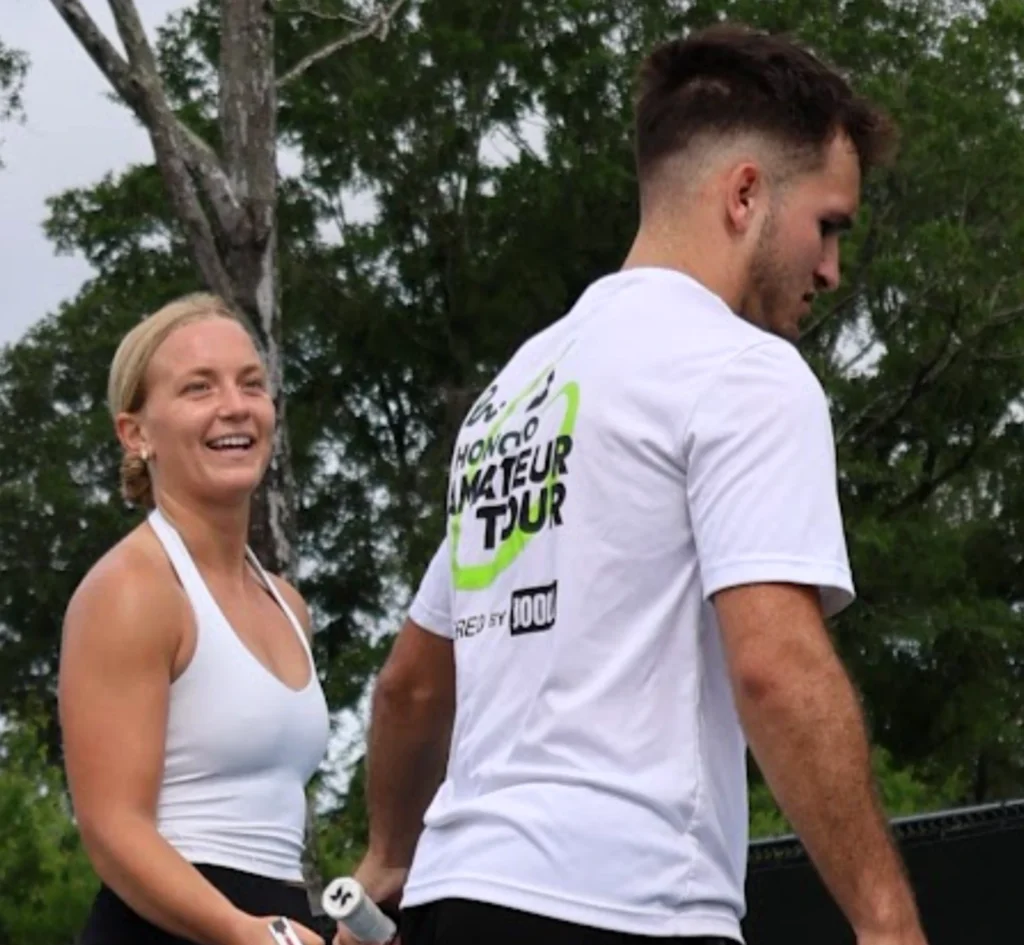
Tournaments Should Not Become Public Exams
This is the part I especially want my son to hear.
A tournament is serious. You paid money. You trained. You showed up. You want the medal. You want the rating bump. You want proof that the work is working.
I understand all of that.
But if every tournament feels like a public exam, you will start playing like someone trying not to get caught being imperfect.
That is a miserable way to compete.
A better tournament goal is not “make zero mistakes.” That goal is imaginary.
A better tournament goal is:
Compete hard, reset quickly, enjoy the battle, and stay in the rally long enough to make the right decision.
That does not make tournaments casual. It makes them playable.
When something goes your way, let yourself feel it. When your partner hits a great ball, celebrate it. When you survive a nasty hands battle, smile for half a second before you go back to work.
Many high-level players punish mistakes loudly and celebrate successes silently. Flip that ratio a little. You do not need fake hype. You need emotional balance.
If the only thing you feel during a tournament is relief or frustration, the game will eventually start charging rent on your spirit.
What Great Athletes Understand About Imperfection
This problem is not unique to pickleball.
Every serious athlete eventually meets the same monster: the gap between who they are and who they think they should already be.
Roger Federer once pointed out that even in an incredible career, he won only a little more than half the total points he played. Pickleball translation: you do not need to win every rally to play winning pickleball. You need to stop one lost rally from becoming a three-point emotional spill.
Michael Jordan built part of his legend on missed shots, failed chances, and coming back anyway. Pickleball translation: a miss is not proof that you should stop taking the right shot. If the decision was sound and your body was committed, you keep training it.
Novak Djokovic has talked often about thoughts and emotions showing up under pressure. Pickleball translation: doubt can ride in the passenger seat, but it does not get to hold the paddle.
Stephen Curry plays with visible joy in one of the most pressure-packed sports environments in the world. Pickleball translation: loose does not mean lazy. Loose means your body is free enough to execute the shot you trained.
Elite athletes do not avoid imperfection. They build a better relationship with it.
Translation for your next match: you are allowed to lose points. You are not allowed to lose your next decision.
Pickleball Blueprints: Different Personalities, Same Lesson
Pickleball is still young compared to older sports, but the mental patterns are already visible.
Ben Johns often looks like he has a delete button for mistakes. Miss, reset, next ball. The useful part is not the stoic face. The useful part is the short memory.
Use it: After your next miss, physically turn away, reset your grip, and make your next decision boring on purpose.
Catherine Parenteau shows how competitive fire and visible joy can live in the same body. That matters because some players think seriousness requires misery.
Use it: After a good reset, smart leave, or patient rally, let yourself acknowledge it. A tiny paddle tap to your partner counts. Your brain needs proof that good choices matter.
Zane Navratil has talked for years about the mental side of performance, systems, ownership, and quieting the critic.
Use it: Replace “I am playing terrible” with “What is my system for the next point?” That one sentence moves you from identity panic to useful action.
Tyson McGuffin brings more visible fire, but the useful lesson is controlled energy. Intensity is not the enemy. Uncontrolled reaction is.
Use it: Keep the fire, but give it a job. Move your feet. Communicate louder. Attack the right ball. Do not let fire become eye rolls, rushed speedups, or frozen hands.
Four different personalities. Same core message.
You do not need a perfect temperament. You need a repeatable reset.
Common Mental Mistakes That Cost Competitive Players Points
- Trying to fix mechanics mid-match: Save the detailed technical work for film study and drilling.
- Playing the rating instead of the ball: Lower-rated opponents can still punish scared decisions.
- Treating every miss the same: Separate blunders from normal inaccuracies.
- Ignoring good decisions: If you only emotionally register mistakes, the game starts feeling miserable.
- Using frustration as proof that you care: You can care deeply and still stay composed.
- Turning rec play into a courtroom: Give casual games a purpose instead of defending your image.
- Letting one point leak into the next: The best players are not mistake-free. They are leak-stoppers.
- Refusing to pre-accept chaos: If every bad bounce shocks you, every match becomes an emotional ambush.
- Confusing judgment with correction: Criticizing yourself is not the same as giving yourself a useful cue.
Questions Competitive Players Keep Asking
Separate your environments. Practice is where you chase precision. Rec play is where you experiment. Tournaments are where you compete with the game you currently own. Fun at a high level is not silliness. It is staying loose, curious, and engaged enough to keep playing boldly under pressure.
Trying to improve is good. Demanding perfection on every point is not. It creates tension, smaller shot choices, and slower decisions. Perfection can guide practice, but during competition it turns into pressure. The goal is not to care less. The goal is to compete with simpler cues.
Reset fast and give your brain a job. If you do nothing, the mistake will choose your next shot for you. Turn away, exhale, loosen your grip, say “Next ball,” and pick one simple intention for the next rally. Do not hold court with the mistake.
Because your standards rise faster than your emotional recovery skills. As you improve, normal mistakes start to feel unacceptable. That creates pressure, tension, and overreaction. The solution is not better shots alone. It is learning how to reset quicker between points.
Use your rating as feedback, not identity. DUPR can measure results, but it should not control your decisions, schedule, or confidence. Players who chase rating often play safer and improve slower. Track behaviors you control, not just the number.
Simplify your decisions and pre-accept mistakes. Do not try to fix mechanics mid-match. Pick bigger targets, commit to your shot, and expect some misses. Tension usually comes from surprise and judgment. Remove both, and your body can perform.
Give every session a purpose. Instead of protecting your reputation, choose one skill or behavior to work on and judge success by that. Rec play should be a testing ground, not a performance review.
“Next ball.” It works because it interrupts the spiral and redirects your attention. The power is not in the words. It is in what they force you to do: leave the past point and re-engage the present one.
Because it feels like more than a miss. It can feel like a threat to your rating, progress, reputation, or identity. That is why the reaction is so strong. The fix is to treat the miss as feedback you can use, not a verdict on who you are.
Enjoyment is not lowering standards. It is staying emotionally available to the match. Compete hard, recover quickly, and allow yourself to feel good about strong decisions. If every point is judged like a final exam, performance usually drops.
Turn This Into Points: A Five-Session Plan
For your next five sessions, do not just track wins and losses.
Track the leak.
- Session 1: Count how many points you lose immediately after an obvious mistake.
- Session 2: Use a reset cue after every miss, even small ones: “Next ball,” “reset and re-enter,” or “that point is gone.”
- Session 3: Pick one rec play theme and judge the session by that theme.
- Session 4: Track good decisions, not just good shots.
- Session 5: After each game, ask: “Did I recover faster than usual?”
Your scoreboard metric:
How many times did one mistake become multiple lost points?
Reduce that number, and your game gets better fast.
The Message I Want My Son to Hear
I want my son to chase the pro level.
I want him to drill hard, compete hard, study the game, solve the puzzle, and build every tool he needs.
But I do not want him to confuse excellence with misery.
The point of pickleball was never to become a perfectly programmed ball-returning appliance with court shoes.
He started because the game was fun. Because it gave him movement, challenge, competition, friendships, frustration, laughter, and that strange little addiction all of us understand when we say, “One more game.”
That joy is not something to outgrow.
It is fuel.
So if you are chasing a higher level, remember this:
You do not become great by demanding a clean scorecard from a messy game.
You become great by noticing the mess, taking the lesson, and stepping back into the rally with your eyes up.
Perfect is for practice. You can be a Parfait without trying to be perfect.
Resilient is for competition.
And the next ball is still waiting.




Unbelievable take on real experiences. No matter what level you are. Thanks for working this. Bravo.