

The Facebook Ad Every 3.5 Player Falls For: Here’s the Real Truth
An honest OnAce pickleball insoles review looking at whether they are legit, who may benefit, where the marketing overreaches, and how OnAce-style insoles compare with stock insoles and VKTRY.
Quick Verdict: Are OnAce Insoles Legit?
Yes, OnAce appears to be a legitimate aftermarket insole brand, but the bigger question is whether the marketing matches what pickleball players should realistically expect.
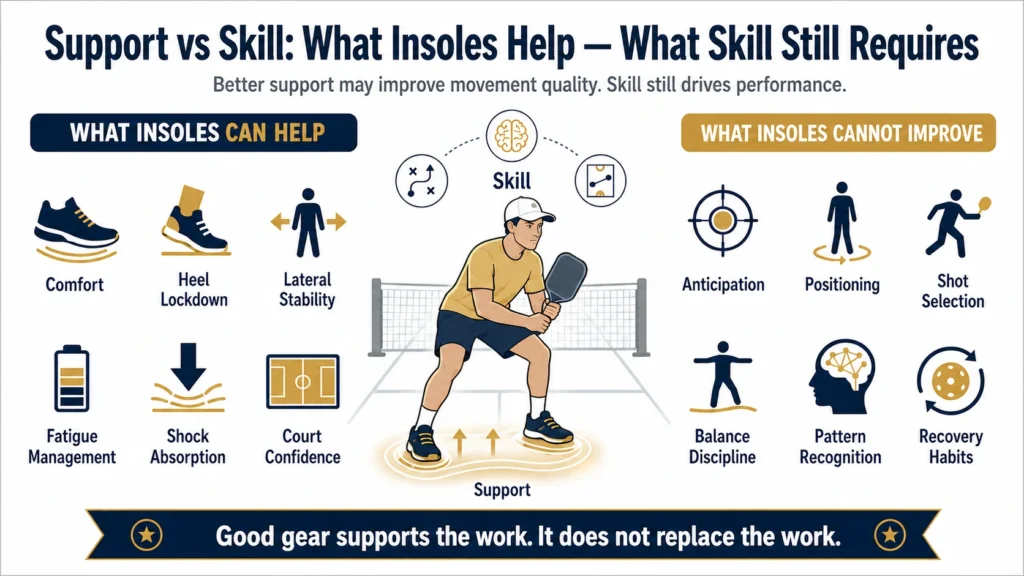
Performance insoles may help with comfort, heel lockdown, lateral stability, foot fatigue, and confidence during long sessions on hard courts. That can matter for pickleball players who play several times a week.
But OnAce insoles will not magically create better anticipation, positioning, balance discipline, court IQ, or the movement habits needed to jump from 3.5 to 4.0.
The honest answer is this: good insoles may support better movement, but they do not replace learning how to move.
🎧 Prefer listening? Hear a summary of Coach AJ’s take on the Onace Insoles marketing:
OnAce Insoles Review Summary
If you searched for OnAce pickleball insoles reviews, here is the short version: OnAce-style insoles make the most sense for players who want more support and comfort than the thin stock inserts that come in many court shoes.
They are not a hidden shortcut to better pickleball. Their real value is more practical: helping your feet feel more stable, supported, and less fatigued during longer playing sessions.
| Category | My Take |
|---|---|
| Best For | Frequent pickleball players dealing with foot fatigue, heel movement, or long-session discomfort |
| Biggest Benefit | Support and comfort, not instant performance improvement |
| Biggest Concern | The advertising can make insoles sound like a bigger skill solution than they really are |
| Better Than Stock Insoles? | Potentially, especially if your stock insoles feel flat, thin, or unstable |
| Better Than VKTRY? | Not necessarily. VKTRY is stiffer and more explosive; OnAce-style insoles appear more comfort-oriented |
| Worth Considering? | Yes, if your goal is support and fatigue reduction rather than a magic 3.5-to-4.0 shortcut |
Who This Helps
- Players searching for honest OnAce pickleball insoles reviews before buying
- Players asking whether OnAce insoles are legit or just clever marketing
- 3.5 players trying to understand why 4.0 feels just out of reach
- Players who saw the OnAce pickleball insole Facebook ad and wanted a more realistic breakdown
- Players comparing OnAce-style insoles with VKTRY carbon-fiber insoles
- Players dealing with foot fatigue, heel slippage, sore joints, or late-session movement drop-off
- Players who want better support without confusing gear with skill development
OnAce Insoles Pros and Cons
Pros
- May provide better support than basic stock insoles
- May help reduce foot fatigue during long pickleball sessions
- Could improve heel lockdown and underfoot stability
- Likely more comfort-oriented than very stiff carbon-fiber insoles
- Useful for players who spend a lot of time on hard courts
Cons
- Will not fix poor footwork, late split-steps, or bad court positioning
- Marketing can make the performance benefit sound too simple
- May not suit every arch type or shoe fit
- Not the same kind of explosive feel as VKTRY carbon-fiber insoles
- Players expecting an instant rating jump will probably be disappointed
A few weeks ago, somewhere between Facebook reels of hands battles, paddle launch videos, and the usual flood of “unlock more power instantly” pickleball ads, I got stopped cold by one of the smartest pieces of pickleball marketing I’ve seen in a long time.
Not because it was loud.
Because it understood something almost every serious rec player has felt at some point.
The ad kept showing up in my Facebook feed for days before I finally sat down and read the whole thing. And honestly? The reason it spread so effectively is because parts of it felt uncomfortably real.
It told a familiar story: a frustrated 3.5 player stuck for nearly two years, a local “Dave” with awkward mechanics who somehow keeps winning, a wise coach identifying movement as the missing link, and a simple thumb test that makes stock insoles suddenly look useless.
It is a great piece of storytelling.
But great storytelling is not always the same thing as complete truth.
Still, what made the ad fascinating was not just the product itself.
It was how accurately it captured a very specific feeling that lives inside competitive rec pickleball.
The Dave Problem: Why Cleaner Mechanics Do Not Always Win
If you’ve played long enough, you know the feeling.
At first improvement comes fast. Your serves get deeper. Your drops stop floating. Your dinks become more controlled. Players compliment your game more often. You start winning matches that used to feel impossible.
Then one day the climb slows down.
Now you are in that strange middle ground where you are clearly not a beginner anymore… but you also are not breaking through the way you expected.
You drill.
You watch instructional videos.
You buy another paddle.
You tweak your grip.
You play four times a week.
And somehow there are still players beating you who do not even look cleaner technically.
That is where the ad sinks the hook.
Because every pickleball community has a Dave.
Dave is the player whose mechanics look questionable right up until the scoreboard appears. His backhand seems late. His speedups feel reckless. His footwork does not exactly scream “teaching pro.”
And yet somehow Dave keeps winning.
He gets to balls earlier than expected. He absorbs pace better than he should. He survives chaotic exchanges that look unwinnable. Meanwhile you walk back to the baseline wondering why your cleaner-looking mechanics are not producing cleaner results.
That frustration is real.
Not the frustration of losing.
The frustration of confusion.
The feeling that there must be some hidden variable separating players who plateau from players who quietly keep climbing.
Coach Sid Take: The ad works because it does not start with foam. It starts with the feeling that somebody with uglier mechanics keeps solving a problem you cannot see yet.
That emotional tension is the real engine underneath the entire ad. And whether people want to admit it or not, the copywriting is extremely effective because it taps into something authentic.
Why the 3.5 Player Is the Perfect Target
Strategically, the ad targets exactly the right audience: the frustrated 3.5 player trying to become a 4.0.
And honestly, that is probably one of the single largest and most emotionally invested groups in pickleball.
Not beginners.
Not elite tournament players.
Players stuck in the middle.
Beginners still expect improvement to feel messy. They know they are learning fundamentals. Every week still brings obvious progress: better serves, cleaner contact, fewer balls into the net.
Advanced players usually understand the game differently. They know improvement becomes incremental and subtle. They are less likely to believe one piece of equipment suddenly explains everything.
But 3.5 players live in a strange psychological middle ground.
They have enough skill to care deeply.
Enough experience to plateau.
Enough court awareness to recognize that better players are doing something different.
But not always enough clarity to identify exactly what that difference is.
That creates a powerful kind of frustration.
Because now improvement stops feeling obvious.
The game becomes more nuanced:
- positioning
- recovery
- anticipation
- balance
- decision making under pressure
- recognizing patterns earlier
Those things are harder to see, harder to measure, and much harder to market.
And that is exactly why “missing link” marketing becomes so effective at this level.
Key Insight: For a stuck 3.5 player, 4.0 does not just feel like a rating. It feels like validation.
It feels like validation.
Proof that all the work is finally translating into real progress.
That is why the ad works so well.
It does not sell insoles first.
It sells the possibility that the thing keeping you from 4.0 finally has a name.
The Missing-Link Pitch: Dead Foam and Faster First Steps
The ad eventually pivots toward pickleball-specific insoles.
Not paddles.
Not coaching.
Not drilling systems.
Insoles.
According to the pitch, the real difference between many 3.5 and 4.0 players is not mechanics at all. It is what is happening underneath their feet.
The story talks about “dead foam,” delayed first steps, lost energy transfer, inefficient movement, and players unknowingly wasting movement efficiency every time they push off the court.
And before everyone immediately dismisses this entire conversation, let me say something important:
I do not think the entire premise is nonsense.
Actually, part of why the ad works so well is because parts of it are rooted in reality.
Most stock insoles are cheap.
Most court shoes prioritize outsole grip, upper support, and lateral structure far more than the removable insert sitting directly under your foot.
And if you play pickleball multiple times a week on hard courts, your feet, knees, calves, hips, and lower back absorb an incredible amount of repetitive stress from split steps, abrupt stops, lunging, recovery shuffles, and awkward balance corrections.
Movement matters in pickleball far more than many players realize.
But this is where the ad becomes genuinely interesting.
Because it slowly transforms a legitimate physical concept into something much larger emotionally: the idea that your breakthrough might be hiding underneath your shoe.
That is a very different claim.
Key Insight: The ad starts with a real issue: tired feet and poor support can affect movement. The leap happens when that real issue gets framed as the missing explanation for an entire skill plateau.
Stock Insoles vs Performance Insoles: What Actually Changes?
One thing the ad gets right is that most factory insoles are not designed for heavy court-sport punishment.
They are usually lightweight foam liners built to:
- reduce manufacturing cost
- provide basic comfort
- fit a wide range of foot shapes
- survive general recreational use
Stock insoles often use softer foam that can compress and lose rebound over time, especially under repetitive hard-court stress.
Performance insoles typically aim to improve:
- structural support
- rebound consistency
- lateral stability
- heel lockdown
- fatigue management
Some use denser foams. Others use rigid support structures. Carbon-fiber systems like VKTRY take rigidity and energy return even further.
| Feature | Typical Stock Insole | Performance Insole |
|---|---|---|
| Foam Density | Softer | Denser / more structured |
| Long Session Support | Moderate | Higher |
| Lateral Stability | Basic | Improved |
| Heel Lockdown | Minimal | Stronger |
| Shock Absorption | Moderate | Depends on design |
| Energy Return Feel | Low | Moderate to high |
| Court Feel | Softer | More responsive or rigid |
| Longevity | Compresses faster | Usually holds structure longer |
That does not mean aftermarket insoles magically create athleticism.
But they may reduce the “energy tax” your body pays during long sessions on hard courts.
And for older players, heavier players, or players grinding multiple sessions weekly, that matters.
A lot.
Where the Ad Has a Point
Not because insoles turn people into 4.0 players overnight.
But because movement comfort and movement efficiency are connected.
If your feet slide inside your shoes…
If your arches collapse late in sessions…
If your calves tighten after two hours…
If your knees ache after hard stops at the kitchen…
…better support underneath your foot can genuinely help.
That is real.
And honestly, I think this is why the ad resonates so deeply with people.
Because many rec players do feel physically slower late in sessions.
They do feel heavy-footed after two hours.
They do feel their recovery speed decline.
The ad simply takes that real sensation and packages it into one clean explanation:
“Dead foam is holding you back.”
That is powerful marketing because it converts a complicated performance problem into a simple physical solution.
Humans love simple explanations.
Especially when they are frustrated.
The Coach Framing: Expert Testimony or Marketing Narrative?
One of the smartest parts of the ad is the way it introduces the coach figure, specifically name-dropping Mike Ramos and highlighting his background working with legendary players like the Bryan brothers.
The story frames Mike Ramos as a high-level insider, somebody connected to elite training environments who supposedly identifies “dead foam” as the hidden issue most rec players never think about.
And whether intentional or not, that kind of authority framing changes how people process advice.
Players naturally trust information more when it appears connected to pro-level environments.
So I got curious and tried to verify some of the background presented in the story:
- the coaching credentials
- tournament affiliations
- whether there was any visible relationship with the insole brand itself
And honestly, I could not find enough public confirmation to treat that part of the story as verified.
That does not automatically mean the coach is fictional.
He may absolutely be real.
But I could not independently verify the specific credentials or brand affiliation presented inside the ad, which means I think readers should treat that portion of the story more as marketing narrative than confirmed expert testimony.
Consumer Due Diligence Note: This does not prove the coach figure is fake. It simply means the authority claim should not carry the same weight as independently verified expert testimony.
And from a consumer perspective, that distinction matters.
Because one of the easiest ways modern advertorials build trust is by borrowing credibility from:
- elite athletes
- coaches
- tour environments
- “inside knowledge” most players feel excluded from
That does not make the product fake.
But it does mean readers should separate:
- emotionally compelling storytelling
- independently verifiable evidence
Where the Ad Overreaches
Here is where we need to separate biomechanics from fantasy.
Good insoles can improve:
- stability
- heel lockdown
- movement confidence
- comfort during long sessions
- overall court feel for certain players
What they do not magically create is:
- anticipation
- positioning
- shot selection
- balance discipline
- pattern recognition
- transition awareness
- decision making under pressure
Ironically, the ad accidentally points toward a real truth: movement efficiency matters enormously in pickleball.
But movement efficiency is not the same thing as buying movement.
That distinction matters.
Because the real jump from 3.5 to 4.0 is usually hiding inside smaller, less glamorous things:
- earlier preparation
- cleaner recovery
- better spacing
- balance before contact
- smarter positioning
- recognizing patterns faster
- arriving set instead of arriving rushed
Those things are harder to market because they require practice, awareness, and repetition.
Coach Sid Take: Foam is easier to sell than discipline.
The Real 3.5 to 4.0 Gap
Most players think the jump from 3.5 to 4.0 is about hitting better shots.
Usually it is not.
It is about arriving balanced before contact.
It is about recovering faster after your previous shot.
It is about reading patterns earlier.
It is about wasting less movement.
That is why “Dave” keeps winning.
Not because he looks prettier technically.
Because efficient players often look calmer than they really are.
They are earlier to the spot.
Earlier to balance.
Earlier to recognition.
Earlier to recovery.
And that extra half-second players obsess over?
It often starts in positioning and preparation long before the foot even touches the ground.
Key Insight: The 3.5-to-4.0 jump is usually less about one miracle shot and more about being balanced, ready, and recovered before the next ball arrives.
The Movement Audit: What to Fix Before Blaming Your Shoes
Before assuming equipment is the missing link, ask yourself a few uncomfortable questions.
Think of this section as the software side of the problem.
Your shoes, insoles, and support system are the hardware. They can affect comfort, stability, and how well your body holds up through long sessions.
But your habits, timing, recognition, and recovery discipline are the software.
If the hardware is failing, the software can start to lag.
But if the software is messy, no insole is going to clean it up for you.
Software vs. Hardware: Insoles may help your feet hold up longer. They cannot fix late reads, lazy recovery, or bad split-step timing.
Are You Watching the Ball Too Long?
Many plateaued players stare at the ball instead of reading the opponent’s paddle face and body positioning earlier.
Try this:
Watch the “V” formed by your opponent’s wrist and paddle.
If the V opens and the paddle face tilts up, expect a softer ball: a dink, reset, or drop.
If the V closes, flattens, or turns forward, prepare for a speedup or firmer attack.
You are not trying to become a mind reader.
You are trying to steal a half-second before the ball leaves their paddle.
Are You Split-Stepping Too Late?
A surprising number of players are still moving while opponents are making contact.
That destroys balance.
Try this:
Think of the split-step as a heavy land, not a jump.
Your heels should barely leave the ground.
You want to land wide, low, and athletic exactly as your opponent makes contact.
If you jump too high, you are floating while the ball is already coming.
That is not readiness.
That is a tiny vacation at the worst possible time.
Are You Recovering After Every Shot?
Many players admire their own shot too long.
Good players recover immediately.
Try this:
Mentally race your own shot to the kitchen line.
Your goal is to be stationary and balanced before your ball crosses the net.
The instant your paddle finishes the swing, trigger:
“Recover now.”
Not after you see whether your shot was good.
Not after you admire the angle.
Immediately.
Are You Losing Movement Quality Late in Sessions?
This is where insoles may genuinely help.
If your feet feel unstable, heavy, or fatigued after extended play, better support underneath you may help preserve movement quality deeper into sessions.
That is the honest bridge between gear and skill.
You cannot buy movement skill.
But you can buy conditions that allow you to practice movement longer, more comfortably, and with less fatigue.
That matters too.
Carbon Fiber vs Foam: The Tradeoff Nobody Explains Well
I actually own VKTRY insoles myself.
And to be fair, they impressed me.
You absolutely feel more responsiveness underneath aggressive push-offs and explosive directional changes.
There is real spring-like feedback compared to softer stock foam.
But there is also a tradeoff most social media ads conveniently leave out:
VKTRY insoles are significantly stiffer than traditional insoles.
Over long sessions, that rigidity becomes part of the fatigue equation too.
You gain:
- responsiveness
- explosiveness
- firmer push-off energy
You also gain:
- more stiffness
- less natural flex
- harsher impact feel during long sessions
That tradeoff may be perfect for:
- explosive younger athletes
- singles grinders
- aggressive movers
- players already accustomed to carbon-plated shoes
It may be less ideal for:
- players with sensitive joints
- comfort-first players
- older rec grinders
- players prioritizing cushioning over explosiveness
That is not “good versus bad.”
That is matching equipment to the player.
Who OnAce May Actually Help
Based on the claims and positioning, products like OnAce appear to be aimed at players who want more support and comfort than a stock insole without jumping all the way into the stiffness of a carbon-fiber system.
That matters because not every pickleball player wants the same thing underfoot.
Some players want bounce.
Some players want cushion.
Some players just want to finish a three-hour session without their feet, knees, or lower back barking at them in the parking lot.
OnAce-style insoles probably make the most sense for players who:
- feel foot fatigue during long sessions
- want more support than stock foam
- feel unstable laterally
- need better heel lockdown inside their court shoes
- want a more comfort-oriented structure
- do not want an extremely rigid carbon feel
- play mostly doubles or long rec sessions where comfort matters as much as explosiveness
They may be less appealing for players who:
- already love the feel of carbon-fiber insoles
- want maximum spring and push-off response
- prefer very minimal court feel
- expect an insole to fix positioning, timing, or decision making
- are only buying because the ad made 4.0 sound like a footwear problem
The biggest mistake players make is expecting:
“This will unlock my next DUPR level.”
That is not how this works.
What these products may do is:
- reduce fatigue
- improve comfort
- improve support
- improve movement confidence
- help your shoes feel more stable late in sessions
Those are meaningful benefits.
They are just not magical ones.
If the insole helps you stay fresher, recover cleaner, and move with less pain, that is valuable. Just do not confuse feeling better underfoot with suddenly understanding the game better above the shoulders.
Final Decision Matrix: What Should You Actually Look For?
| If You Feel… | You Should Prioritize… | Example Direction |
|---|---|---|
| Heavy-footed or slow reacting | Responsiveness / energy return | Carbon fiber systems like VKTRY |
| Foot or joint fatigue | Cushioning / shock absorption | Dense foam performance insoles |
| Heel slippage | Heel lockdown / structure | Rigid support shanks |
| Calf fatigue from stiffness | Softer flexibility | Traditional structured foam |
| Instability during lateral movement | Arch and lateral support | Court-specific insoles |
| Long-session discomfort | Fatigue reduction | Comfort-focused systems |
The Bigger Lesson Behind the Ad
This conversation ultimately becomes bigger than one Facebook ad or one insole brand.
The lesson is not “never trust pickleball gear.”
The lesson is to notice when a real physical issue gets turned into a total performance explanation.
Yes, support matters.
Yes, comfort matters.
Yes, tired feet can make your movement worse late in sessions.
But when an ad suggests that one overlooked product explains your entire plateau, that is when the little alarm bell should start ringing.
Coach Sid Take: Good gear should help your body do the work. It should not replace the work.
Final Thoughts
Good support underneath your feet absolutely can matter.
Especially if:
- you play frequently
- your joints hurt
- your stock insoles feel dead
- your feet slide inside your shoes
- long sessions leave you physically cooked
But there is also a difference between:
- improving comfort
- buying mastery
The real breakthrough usually is not hiding underneath your shoe.
It is usually hiding inside movement habits, recovery discipline, positioning, anticipation, and repetition.
Still, if better support helps you stay healthier, move more confidently, and practice longer with less fatigue?
That matters too.
Just do not mistake support for skill.
And Dave probably still is not beating you because of foam.
