Pickleball Fitness: Play Pain-Free, Perform at Your Peak
Pickleball Fitness: Play More, Hurt Less, Last Longer
Pickleball Fitness is the strategy behind sustainable play. It helps players perform better, hurt less, and stay on the court longer, without overtraining themselves into oblivion.
I want to play every day. Not just once a week. Not when life allows, every single day. But lately, my body has been kicking back. My shoulder aches. Knees bark. And some mornings, I shuffle to the bathroom like I’m 30 years older than I am.
That’s the paradox. Pickleball makes me feel alive… until I push too far and it makes me feel broken. Play more to feel better, but play too much and I’m sidelined entirely. Sound familiar?
If you’re in that same Catch-22, where your heart’s on the court but your joints are screaming “uncle”, this is for you. You’re not alone. Let’s talk about a smarter, more sustainable path: one that turns sweat into longevity, not regret.
What Exactly is Pickleball Fitness?
- Pickleball Fitness blends strength, flexibility, endurance, and recovery tactics specific to the sport.
- It addresses common frustrations like joint pain, burnout, and recurring injuries that steal court time.
- Players can use warmups, strength training, stretching, and technique fixes to protect their bodies.
- This matters because more players are getting injured trying to play more, and most don’t realize it until it’s too late.
Navigate This Guide
- Who This Helps
- What Pickleball Demands From Your Body
- Common Injuries & Why They Happen
- Warning Signs, Recovery & Overtraining
- Warm-Up & Cool-Down Rituals
- Off-Court Training Program
- Essential Gear & Court Safety
- Technique That Protects You
- FAQ
Who This Helps: If You’re Reading This, It’s Probably You
This article is perfect for:
- Recreational players who want to play more often but are constantly sore or battling nagging injuries.
- Older adults navigating joint stiffness, slower recovery, and the fear of injury from backpedaling or lunging wrong.
- Competitive players looking to outlast and outmaneuver others with endurance and resilience, not just raw skill.
What Pickleball Demands From Your Body: More Than a Walk in the Park
You think you’re just playing a game. But your body? It’s juggling a circus of demands you didn’t sign up for, explosive footwork, rotating torque, joint stress, and endurance grinding through three games in a row.
Pickleball might look gentle, but it’s a wolf in sheep’s clothing. Beneath the bounce and banter, it’s testing your anaerobic power, your aerobic engine, your core strength, your lateral quickness, all at once. If you don’t train for this chaos, something eventually gives: knees, shoulders, or your will to keep going.
Why does my body feel fine mid-match but wrecked the next morning?
Because you’re over-relying on adrenaline, not conditioning. Pickleball Fitness smooths out that rollercoaster so you don’t pay for one good rally with three days of Aleve.
Energy Systems in Pickleball: Sprint, Recover, Repeat
This sport isn’t just short bursts or just long rallies, it’s both. Your body has to flip between anaerobic sprints (reacting to a smash) and aerobic endurance (surviving a 10-shot kitchen exchange). Neglect either system, and fatigue sneaks in like a thief, stealing your form and exposing you to injury.
- Anaerobic: Covers fast footwork, explosive smashes, reactive blocks.
- Aerobic: Fuels sustained movement, court coverage, and recovery between points.
Agility, Balance & Coordination: Don’t Trip Over Your Own Feet
Pickleball is played in micro-moments, short steps, tight turns, rapid resets. Agility training lets your brain and feet sync so you don’t move late or plant awkwardly. Coordination and balance are what let you reach for that last-second dink without twisting an ankle.
Strength & Power: The Invisible Shield
You don’t need a six-pack. You need hips that don’t lie, glutes that fire, and shoulders that don’t burn out after your third game. Strength isn’t about domination, it’s about injury prevention. Every time you move explosively, your muscles absorb force. If they’re weak, that force hits your joints instead.
- Upper body: Serves, smashes, and resets rely on shoulder stability and rotator cuff strength.
- Core: Generates paddle speed through rotation, not just from your arms.
- Lower body: Glutes and quads drive explosive movement and reduce knee stress.
Mobility & Biomechanics: Your Range = Your Safety Net
Ever felt your knee or back “tweak” just reaching for a dink? That’s poor mobility waving a red flag. Pickleball involves spinal rotation, hip hinging, knee flexion, and shoulder extension, sometimes all in one point. If your range is limited, your body compensates somewhere else, usually with pain.
Mobility isn’t yoga for old people. It’s the difference between reaching the ball and rupturing something that ends your season.
Cardiovascular Demands: The Truth Behind That Sweat
Studies show average heart rates in pickleball hover between 108–111 BPM, roughly 70–75% of your max. That’s moderate-to-vigorous intensity. It might not feel like a treadmill sprint, but your heart’s doing the work. VO₂max improves. Blood pressure drops. But only if your body isn’t constantly playing catch-up from poor recovery.
Quick Takeaways:
- Pickleball taxes both explosive and endurance systems.
- Mobility, balance, and strength aren’t optional, they’re armor.
- The sport’s movement demands are greater than most players realize.
Summary: Pickleball demands a full-body toolkit, power, mobility, cardio, and control. Train all four, or your weakest link will cost you the most, often leading to a pattern of injury that isn’t the sport’s fault.
The Real Injury Threat: It’s Not the Sport, It’s the Pattern
Pickleball isn’t the enemy. It’s how most of us approach it that’s the problem. We jump into games cold, grind through back-to-back days, and then act surprised when our shoulder explodes mid-overhead or we can’t walk the next morning. The injuries? They’re not bad luck. They’re math.
The older we get, the less margin for error our bodies allow. So if you’re over 50 and still playing like you’re 30 without any off-court work? You’re rolling loaded dice every time you step on the court.
Why do I keep hurting the same spots over and over?
Because you haven’t changed what’s causing them. Repetitive stress plus poor prep equals the same pain, on loop. Pickleball Fitness breaks that cycle.
Acute vs Overuse Injuries: Know Your Enemy
- Acute: Happens fast, a fall, a tear, a snap. Often from poor footwork or risky movement patterns like backpedaling.
- Overuse: Creeps in quietly, elbow tendinitis, shoulder impingement, Achilles tightness. Repetition + bad recovery = breakdown.
Top Pickleball Injuries by Body Part: Your Body’s Complaint Department
Common Pickleball Injuries by Body Part
| Body Part | Common Injuries | Primary Causes |
|---|---|---|
| Ankle | Sprains, Achilles strain/tendonitis | Lateral movement, pivoting, poor footwear, abrupt starts/stops |
| Knee | Meniscus tears, ACL/MCL sprains, patellar tendinitis | Twisting, lunging, unstable footing, deceleration |
| Hip | Muscle strain, labral tears | Lunging, lack of flexibility, arthritis flares |
| Lower Back | Strain, sciatica | Rotation + poor core control, reaching dinks, lack of mobility |
| Shoulder | Rotator cuff strain, impingement | Repetitive overheads, poor warm-up, weak scapular muscles |
| Elbow | “Pickleball Elbow” (lateral epicondylitis) | Overuse from swings, poor paddle grip, tight forearms |
| Wrist | Sprains, FOOSH fractures | Falling backward while backpedaling; unstable paddle control |
| Feet | Plantar fasciitis, bruised heels, blisters | Hard surfaces, poor arch support, worn-out shoes |
The FOOSH Problem (Fall On Outstretched Hand): Don’t Be a Statistic
Backpedaling is the #1 cause of serious falls. You’re tracking a lob, feet tangled, and boom, you’re on the ground with a busted wrist or shoulder. Learn to pivot and run. It’s that simple. That important.
Injury Demographics: Age and Gender Don’t Lie
- 91% of all injuries occur in players over 50.
- Most common fracture location: wrist (29%).
- Women have higher risk of fracture; men have higher risk of high-impact falls.
- Players aged 60+ have slower reaction times and lower bone density, both amplify injury risk.
The moment you stop warming up or start backpedaling is the moment your season is one wrong step from being over.
Chronic Doesn’t Mean Hopeless: Rebuild, Don’t Rest Forever
Just because an injury didn’t happen all at once doesn’t mean you have to live with it. Tendonitis, plantar fasciitis, even mild rotator cuff strain, all of them respond to strength, mobility, and recovery work. You don’t fix these by resting forever. You fix them by rebuilding better patterns.
Quick Takeaways:
- Acute injuries often come from movement errors (like backpedaling).
- Overuse injuries signal poor recovery or imbalanced strength.
- Most injury risk in pickleball is preventable, with prep, fitness, and form.
Summary: Injuries don’t just happen, they build, they warn, and then they explode. Smart players read the signals and train the antidotes.
Recovery Isn’t Weak, It’s Your Long-Term Weapon
This sport doesn’t reward stubbornness. It rewards awareness. You can either listen to the whispers, the tight calf, the stiff elbow, the weird mood dip, or you can wait until your body screams. That scream might cost you a tournament. Or six weeks.
The biggest mistake most players make? They think pain means they’re “just getting old.” No. Pain means you missed the early signals. The good news? You can retrain your instincts, and your recovery system, before it’s too late.
Soreness vs. Pain: Know the Difference, Save Your Game
- Soreness (DOMS): Achy muscles 24–48 hours after a tough session. It fades. It’s a sign of adaptation.
- Pain: Sharp, persistent, or worsening discomfort. Doesn’t improve. Often localized. Can linger or escalate.
The Micro-Fatigue You Ignore: Your Body’s Quiet Alarm
Before pain comes something subtler: micro-fatigue. You feel stiff when you wake up. You’re a half-second late on resets. You get snippy over a missed lob. That’s not mood, it’s your nervous system saying, “I’m cooked.”
- Stiffness even after stretching.
- Decreased paddle speed or power.
- Slower decision-making mid-point.
- Low motivation to train or warm up.
- “Off” feelings, fuzzy brain, emotional tilt, gut fatigue.
The 10-Day Rule: Your Personal Check Engine Light
This is your check engine light. Look back over the last 10 days. Count how many involved hard play, not light dinking or feeding drills, but real effort.
- 7–10 days played hard: Back off. You’re flirting with burnout.
- 5–6 days: Maintain or reduce intensity slightly.
- 3–4 days: You’re in a safe zone to push harder.
Track this alongside your mood, sleep, hydration, soreness, and performance. That’s your body’s dashboard. Don’t drive blind.
When to Seek Help: Don’t Be a Martyr
You don’t need to be in a hospital to talk to a pro. Physical therapists, sports medicine docs, and athletic trainers can catch breakdowns early. Don’t wait until you can’t lift your arm or bend your knee. Get ahead of it.
Playing through pain doesn’t make you tough, it makes you short-sighted. Longevity starts with knowing when to say “not today.”
Rest or Play? Here’s Your Table for Smart Decisions
When to Rest or Play based on Symptoms
| Symptom | What It Means | Action to Take |
|---|---|---|
| General muscle soreness | Normal DOMS | Light active recovery, hydration, stretch |
| Lingering stiffness after stretching | Micro-fatigue | Scale back intensity, hydrate, rest |
| Sharp localized pain | Injury warning | Stop playing, consult a professional |
| Swelling, bruising, or warmth | Inflammation | RICE protocol, get evaluated |
| Reduced performance + low mood | Overtraining onset | Rest multiple days, address sleep/nutrition |
Hydration & Sleep: The Cheap Magic Pills
Dehydration mimics injury: stiff joints, delayed reaction time, cramping. Track urine color. Aim for 16–24 oz of fluid per pound lost in sweat. As for sleep? 8+ hours isn’t lazy, it’s science. Deep sleep = tissue repair + skill consolidation.
Quick Takeaways:
- Delayed soreness is normal. Sharp or lingering pain is not.
- Micro-fatigue is a pre-injury state, respect it.
- The 10-Day Rule gives you a simple way to monitor play volume and recovery balance.
Summary: Don’t wait for a breakdown to believe your body. It’s telling you things. Listen early, recover smarter, and play longer.
B.S. Beliefs That Keep You Broken
- “I’ll just stretch more.”, Mobility without strength is just fancy weakness.
- “Playing more is my cardio.”, Not when you spend half the point standing still.
- “Rest days are for the lazy.”, No, they’re for players who want a season, not a surgery.
No coach should let you believe those lies. And if you do, your next injury’s already on the calendar.
Warm-Up to Win, Cool Down to Stay In the Game
Pickleball isn’t a stroll around the block. It’s short-burst chaos with joint-jolting moves and lightning-fast reactions. Showing up and hitting balls cold? That’s like launching a rocket without a systems check, you might get off the ground, but something’s gonna blow.
And afterward? You don’t just walk off and call it good. You’ve got to restore what the game took. That’s how you stay in the game long-term, not by luck, but by ritualized recovery.
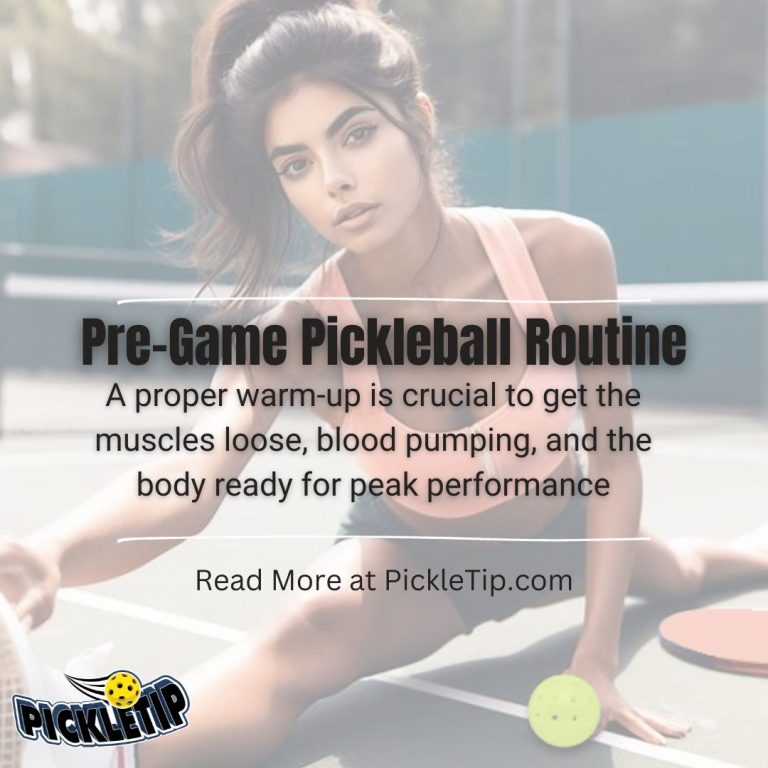
Dynamic Warm-Up: 8 Minutes That Save Your Season
This is what you should be doing before every match, not optional, not “when I feel tight,” but always.
- 2–3 min of light cardio: Jog, jump rope, fast feet, or high knees to get your blood moving.
- Arm circles (forward + backward): Loosen up shoulder capsules and prep rotator cuffs.
- Torso rotations: Fire up your core and spine, you’re going to twist a lot.
- Leg swings (front/back + side-to-side): Prime hips, hammies, and glutes for quick steps and lunges.
- Lateral lunges: Mobilize adductors, knees, and ankles.
- Bodyweight squats: Activate glutes and hips; find your ready position.
- Inchworms or toe-touches to plank: Combine shoulder prep with hamstring and core wake-up.
- Split-step bounces or paddle shadowing: Simulate court movement + build neuromuscular readiness.
A good warm-up makes you faster, sharper, and safer, and it only takes 5–8 minutes. That’s the cheapest insurance policy you’ll ever buy.
Static Cool-Down: What Winners Do After the Match
Finishing the game isn’t the end. It’s the beginning of recovery. Do this routine while your muscles are still warm, you’ll move better tomorrow and reduce your risk next week.
- Hamstring stretch: Reach for your toes or try lying leg lifts, hold 20–30 seconds.
- Quadriceps stretch: Standing quad grab or couch stretch, loosen your knee chain.
- Calf + Achilles stretch: Lean into a wall or drop heel off a step.
- Hip flexor stretch: Kneeling lunge or standing runner’s pose.
- Torso twist: Lying supine twists or seated spinal twist.
- Wrist & forearm stretch: Palm-down and palm-up extensions with pressure.
- Shoulder crossover + triceps overhead stretch: Open up paddle muscles.
- Child’s Pose + Cobra: Reset your spine and decompress lower back.
Hydration: Rebuild Your Inner Court
- 16–24 oz of water per pound lost, weigh pre and post if you’re playing in heat.
- Add electrolytes if you sweat a lot or play more than an hour.
Recovery Fuel: Eat Like You Want to Come Back
- Protein (15–30g): Muscle repair (e.g., eggs, Greek yogurt, shake).
- Carbs (30–60g): Replenish energy stores (e.g., fruit, oatmeal, sweet potato).
- Ideal window: within 60 minutes of play.
Sleep: The Recovery Cheat Code You’re Ignoring
Nothing, I repeat, nothing, outperforms good sleep. 7–9 hours minimum. If you played hard, aim for 8+. Sleep is when your tissues rebuild, your nervous system resets, and your pickleball brain hardwires new skills.
Quick Takeaways:
- Dynamic warm-ups increase performance and cut injury risk in half.
- Stretching after play reduces soreness, improves mobility, and prevents tightness-based injury.
- Hydration, food, and sleep complete your recovery, skip one and your next match will remind you.
Ready to protect your joints, and your season?
Skip to the off-court training plan →
Summary: Your warm-up primes performance. Your cool-down builds longevity. Skipping either isn’t tough, it’s short-sighted.
The Off-Court Training Plan for Staying on the Court
If you only train by playing, your body’s one bad step from sidelined. Match play doesn’t build the durability you think it does, it exposes weaknesses you haven’t fixed yet. That’s why smart players treat off-court training like insurance: it doesn’t just make you better, it keeps you available.
This isn’t CrossFit. You’re not trying to deadlift a kayak. You’re building joints that survive five straight games, and a nervous system that stays fast in game 3, not just point 1. If your knees buckle after a lunge, don’t blame the court, blame your glutes.
It’s the difference between holding your own at match point or gasping while your rival closes it out.
How Often Should You Train Off-Court? The Minimum Dose for Maximum Gain
- 2–4 days per week: Split between strength, mobility, agility, and cardio.
- Start with 30 minutes: Focus on movement quality, not max weight or speed.
- Build consistency first: Progression comes after pattern mastery.
Periodization 101: Train Like You’re in a Season (Because You Are)
- Foundation Phase (4–6 weeks): Basic strength, joint mobility, cardio base.
- Power Phase (3–4 weeks): Add speed, explosiveness, and plyometrics.
- Recovery Week (every 4th): Reduce load 50–70%, emphasize foam rolling + stretching.
Core Strength: Your Rotational Engine
Without core stability, your hips and shoulders lose power, and your back pays the price. Build it with:
- Dead bugs.
- Front and side planks.
- Lunge twists with a med ball.
- Bird dogs and superman holds.
- Anti-rotation band holds (Pallof press).
Lower Body: The Brakes and the Boost (Don’t Skip Leg Day)
Your legs absorb landing forces and drive every movement, but they’re often the weakest link.
- Goblet squats.
- Walking lunges.
- Step-ups (weighted or bodyweight).
- Romanian deadlifts for hamstring balance.
- Single-leg glute bridges or hip thrusts.
- Calf raises + ankle dorsiflexion work.
Upper Body & Shoulders: Power Without Pain (Earn Your Overheads)
Most shoulder injuries in pickleball are preventable. But that means you’ve got to earn your overheads.
- Resistance band rotator cuff work (internal/external).
- Shoulder taps + push-ups (scapular stability).
- Face pulls and rows (posture muscles).
- Overhead carries (shoulder endurance).
- Dumbbell presses, but only if your shoulder mobility is solid.
Agility and Reaction: Movement That Matters (Stop Being Slow)
- Ladder drills: Two-foot hops, lateral steps, in-and-out.
- Cone drills: T-drill, triangle pattern, zig-zags.
- Plyometrics: Skater bounds, box jumps, lateral hops.
- Split-step + shadowing: Simulate in-game prep.
- Reaction ball drops or partner callouts: Train decision speed.
Cardio & Endurance: Your Recovery Between Points (Don’t Gas Out)
Pickleball’s cardio isn’t linear, it’s stop-go-sprint-breathe. Your training should reflect that.
- HIIT circuits: 20s work / 40s rest x 6–10 rounds.
- Shuttle runs: Short bursts replicate on-court movement.
- Low-impact options: Rowing, cycling, elliptical for joint-friendly stamina.
- Active recovery: Walks, hikes, or swimming for base endurance.
Flexibility & Mobility: The Longevity Multiplier (Stop Being Stiff)
Weak + tight is a dangerous combo. Flexible + strong? That’s the holy grail.
- Daily foam rolling (quads, IT band, calves, thoracic spine).
- Hip openers (90/90s, pigeon pose).
- Dynamic hamstring flows.
- Wrist, shoulder, and forearm stretches.
- Neck and ankle mobility drills.
Cross-Training: Build Balance, Not Burnout (Break the Monotony)
Pickleball is a fantastic game, but its asymmetrical and repetitive movements can lead to imbalances and overuse injuries. Cross-training isn’t just a side hobby; it’s the backbone of longevity in pickleball. It builds well-rounded resilience by addressing what pickleball exposes, not just what it builds. Think of it as your secret weapon.
Incorporate activities like:
- Yoga or Pilates for improved mobility and core control.
- Swimming for joint-friendly cardio and overall conditioning.
- Strength circuits using tools like TRX or kettlebells to build functional strength.
Even just two sessions a week of smart off-court work can make you faster, stronger, and more resilient on the court. It’s about protecting your body so you can play more, not less.
The Bottom Line: Your body is your ultimate paddle upgrade. Consistent, smart off-court training in strength, agility, endurance, and mobility helps you avoid injuries and transforms your body into a bulletproof asset for endless pickleball enjoyment. Prioritize proactive self-care, like foam rolling and mobility work, as a ritual, not a reaction – it’s the armor your game depends on.
Gear That Keeps You in the Game, Not in a Sling
Too many injuries don’t start on the court, they start in your closet. The wrong shoes. A paddle with the wrong grip. A court you didn’t bother to check for slick spots. That’s how broken seasons begin.
You wouldn’t drive on bald tires at 90 mph. Why play on worn-out soles and hope your ankle holds?
Footwear: Where Prevention Starts (Stop Wearing Running Shoes)
Running shoes are a trap. They’re built for forward motion, not side steps, not stops, not split steps. That’s why players twist ankles and strain knees. Court shoes are non-negotiable.
- Look for: Pickleball-specific or tennis court shoes with lateral support, durable soles, and stable heel counters.
- Avoid: Soft foam bottoms that roll under pressure, shoes with uneven wear, or anything that “needs to be broken in.”
- Replace: When tread is gone, heels are crushed, or support is shot, usually every 6–12 months for regular players.
Paddle Fit: Grip Size = Joint Survival (Don’t Choke Your Paddle)
Your paddle isn’t just your weapon, it’s also your liability if it doesn’t fit your hand. A grip that’s too big or small changes your wrist mechanics and overloads your elbow. Hello, “pickleball elbow.”
- Check your grip: Use the index-finger test, you should fit one finger between your fingertips and palm when gripping the paddle.
- Too small: Over-gripping leads to wrist strain and inflammation.
- Too large: Reduces control and forces tension into the elbow.
- Bonus: Consider a Hesacore grip if you’ve had wrist/elbow issues.
Protective Eyewear: Not Just for Show (Protect Your Eyes)
That plastic ball can smash your retina at 40+ mph. It’s not common, until it is. One glance to your left mid-point, and suddenly you’re hit in the eye. Happens fast. Hurts worse. Wear protective pickleball glasses.
- Use: Shatterproof, anti-fog, wraparound lenses, clear or tinted.
- Applies to: Everyone. But especially those playing mixed doubles, fast hands battles, or tight kitchen exchanges.
Braces, Supports & Tape: Use When Earned (Don’t Be a Martyr)
Injured players aren’t weak, they’re recovering. The smart ones use knee braces, wrist supports, or kinesiology tape proactively to stabilize weak links. The dumb ones call it “toughing it out” until they pop something.
- Knees: Use compression sleeves or braces if you’ve had sprains, instability, or meniscus problems.
- Wrists: Support bands for post-fall trauma or chronic strain.
- Elbows: Counterforce bands or forearm straps can reduce tendinopathy stress.
Court Safety: Don’t Be Casual About the Surface (Your Season Depends on It)
A slick court isn’t just annoying, it’s a lawsuit waiting to happen. One slip can end your season. Check your surface every time.
- Look for wet spots, sand, debris, cracks, loose lines (indoors), or poor lighting.
- Dry it, sweep it, tape it, or walk away.
- No game is worth a torn MCL.
If your gear doesn’t support you, it’s sabotaging you. The best players don’t just train smart, they equip smart.
Quick Takeaways:
- Wear shoes built for side-to-side, not jogging.
- Use paddles and grips that match your hand size and play style.
- Always check your court. Always. That puddle is not your warm-up.
Summary: Your gear is either your armor or your enemy. Get it right, your joints, vision, and future rallies depend on it.
Form First, Then Fire: How Technique Saves Your Body
You’ve heard “play smarter, not harder.” But here’s the part they don’t say: playing smarter starts with how you move. Not just what shots you choose, but how you split step, plant, pivot, swing, and communicate.
Technique isn’t just about winning more rallies. It’s about surviving them. Every time you backpedal instead of turning, or flick with your wrist instead of rotating your hips, you’re adding miles to the wrong parts of your body. And those miles come with a bill.
Footwork Fixes: Stop Backpedaling, Start Turning (Seriously)
Most wrist fractures happen when someone chases a lob by backpedaling, and eats the floor. Don’t do it. Ever.
- Rule #1: When the ball goes over your head, pivot and run, don’t shuffle backward.
- Use the split-step: Hop lightly as your opponent contacts the ball to stay balanced and reactive.
- Practice resets + lateral shuffles: Build directional control, not just raw foot speed.
Grip & Paddle Mechanics: Stop Choking Your Gear (Your Elbow Will Thank You)
Too many players grip their paddle like they’re holding onto a rollercoaster bar. That death grip sends tension straight to your forearm, and boom: elbow issues.
- Relax your grip: 3–4 out of 10 pressure on resets, slightly firmer on drives.
- Use proper grip size: Too small → overgrip and torque. Too big → wrist compensation.
- Use neutral or continental grip: Reduces strain on wrist and elbow for both dinks and volleys.
Power from the Hips, Not the Elbow (Unleash the Kraken, Safely)
If your power’s coming from your arm, you’re doing it wrong, and you’re on the path to rotator cuff misery. Real power starts from the ground up.
- Use your hips: Rotate through the core and hips to initiate all big swings (serves, drives, overheads).
- Sequence matters: Hips → torso → shoulder → arm → paddle, that’s your kinetic chain.
- Slow motion drills: Film your form, check for over-rotation or arm-first striking.
Collision Prevention: Talk Before You Tumble (It’s Not a Solo Sport)
You’re not playing alone. Doubles disasters often come from two players chasing the same ball, and colliding in the kitchen.
- Call “Mine” early and loud.
- Establish shot zones with your partner pre-match: Who takes the middle? Who covers lobs?
- If you’re both going for it, someone back off immediately.
Take a Lesson, Not a Fall (Invest in Your Game, Save Your Body)
This may sound harsh, but it’s honest: if you’ve never had a movement or form assessment, you’re playing with risk you don’t understand. One session with a good coach can fix dozens of small inefficiencies that cost you points now, and months of rehab later.
The best injury prevention isn’t ice or tape, it’s movement quality. Form is your shield. Build it like your game depends on it. Because it does.
Quick Takeaways:
- Never backpedal. Always turn and sprint.
- Grip light. Power from the hips. Let your body flow, don’t force it.
- Talk early, move smart, and invest in coaching, it’s cheaper than physical therapy.
Summary: Good form isn’t just pretty, it’s protective. If you want to keep playing, clean up how you move.
FAQ: Pickleball Fitness & Injury Prevention (No More Excuses)
Warming up before pickleball is crucial for injury prevention and longevity on the court. It prepares your body for the dynamic movements of the game, helping you avoid strains and stiffness.
Think of it as tuning your instrument before a performance. A few minutes of dynamic prep now saves you months of regret and sidelines later. If you want to keep playing vigorously in your 60s, 70s, and beyond, a proper warm-up is non-negotiable.
Even 15 minutes, three times a week, of targeted off-court pickleball workouts can significantly enhance your game and reduce injury risk. Consistency trumps long sessions.
The key is efficiency. Focus on functional movements, core strength, and mobility exercises that directly support your pickleball performance. That’s where the real wins live, allowing you to build resilience without feeling overwhelmed.
You might be overtraining for pickleball if you experience persistent joint soreness, declining mood, or a noticeable drop in performance despite consistent play. Listen to your body’s subtle warnings.
A good rule of thumb is the “10-day rule.” If you’ve played hard on 7 or more of the last 10 days and your body feels chronically fatigued, your joints ache more than usual, or your enthusiasm for the game is tanking, it’s a clear signal to pull back and prioritize recovery. Tracking your activity can be your best friend here.
The primary causes of pickleball injuries are falls (especially from backpedaling) and repetitive stress due to inadequate recovery and poor physical preparation.
Many players underestimate the physical demands of pickleball. Without proper pickleball fitness, including balance training, strength for quick movements, and consistent recovery practices, the cumulative stress on your body, particularly from rapid changes in direction and constant paddle motion, leads to common injuries. Prioritizing your pickleball fitness directly addresses both these root causes.
Putting Strategy Into Action: Your First Step.
You’ve read the insights, now it’s time to play smarter. Pick one drill. Do it today, not because it’s easy, but because your knee won’t wait. And if you skip it tomorrow, ask yourself: what’s the cost of missing two months with a torn calf?
Dive Deeper:
- Pickleball Recovery Strategies
- Pickleball Fatigue
- Benefits of Playing Pickleball
- Pickleball Rest and Recovery
Your Game, Unleashed. Your Body, Protected.
You’ve now got the playbook. This isn’t just about reading; it’s about doing. Pick one thing from this Pickleball Fitness guide, one warm-up drill, one off-court exercise, one recovery ritual, and commit to it today. Your body is your ultimate equipment, and its longevity on the court depends on the choices you make off it. Stop just playing pickleball; start mastering the art of playing it sustainably, powerfully, and pain-free for years to come. The game is waiting for the best version of you.