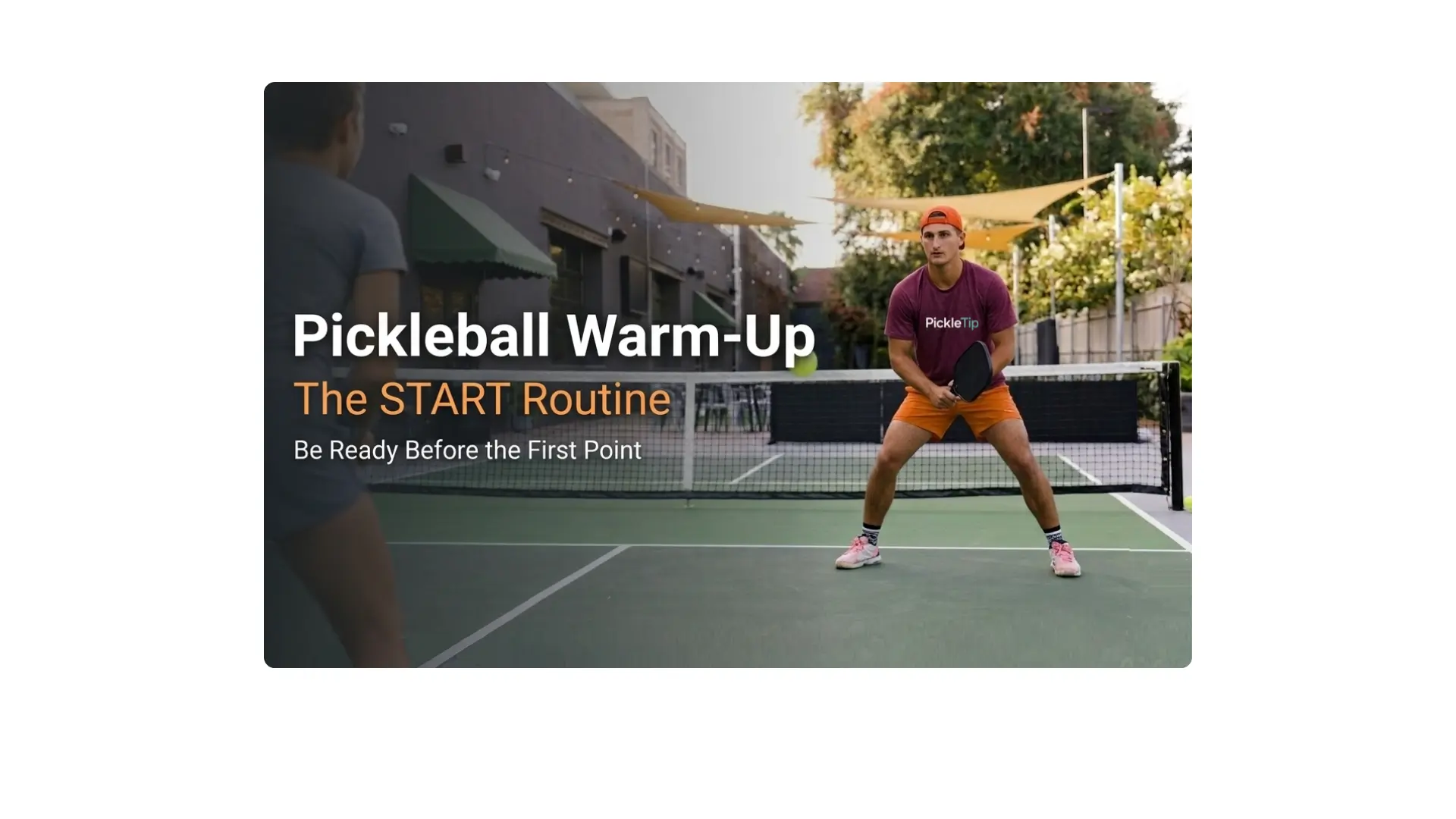
Pickleball Warm-Up Routine: The START Method
One tournament morning at Pelican Park gave me a cleaner example of why I stopped treating the first game as disposable warm-up time. AJ lost his first game 9–11, then won the next two. What stood out was not simply the results. In the later games he took more time between points, communicated more clearly and looked less rushed.
That does not prove a better warm-up caused the change. It did fit a pattern I had seen with AJ at other tournaments: his first match could look like the warm-up he never got, then his feet, hands and decisions would catch up. A player can bring the same skills to the court and still look different once movement, timing, contact and attention have settled. A slow start is not always one problem, and the first missed ball is not always the first thing that was late.
I built START around that distinction and the categories I kept seeing players skip. The goal is not to manufacture confidence or fix a technical weakness before the match. It is to arrive at the first point already moving, already seeing the ball and already connected to one simple job. START works before tournament matches, league play, open play, lessons or any session where the first game tends to become the warm-up.
Pickleball Warm-Up: The START Routine
Get the body moving, move the joints through comfortable ranges, wake up the feet, find the ball and finish with one job for the first few points. A standard routine can take about 10 to 15 minutes. A short version can fit into five.
The first game should test your pickleball. It should not have to finish warming it up.
The PickleTip START Routine
START keeps you from warming up only the part of your game you happen to think about first. It wakes up the body, then the joints, then the feet and hands, and leaves you with one job when the score starts.
START begins when you start warming up and ends when the first point begins. It is not tournament planning, technical practice or a between-point mental routine. If the larger tournament day is the problem, use the READY tournament plan. Here, the job is simpler: wake up the game you already brought.
| Step | Main job | What you should feel |
|---|---|---|
| S — Start Moving | Raise general readiness | Warmer and less stiff |
| T — Turn On the Joints | Move through comfortable ranges | More comfortable movement through the ankles, knees, hips, upper back, shoulders and wrists |
| A — Activate Pickleball Footwork | Rehearse balance, split steps and court movement | Feet responding before the ball speeds up |
| R — Rehearse Ball Contact | Progress from soft contact to the first-match patterns | Hands finding the ball |
| T — Take One Match Cue | Choose one simple reminder | Attention with one clear job |
I organized START this way because players tend to skip entire categories. They hit a few dinks without waking up their feet, loosen the shoulders without seeing a ball, or start banging hard enough to feel ready while their touch gets worse. The order matters more than the exact number of repetitions.
What Most Warm-Ups Skip
| Common warm-up habit | What START does differently |
|---|---|
| Stand at the kitchen and dink immediately | Wake up general movement and the feet before relying on touch |
| Speed up until the hands feel awake | Build from soft contact without turning warm-up into a hands battle |
| Hit whichever shots come to mind | Move through a deliberate order |
| Carry several technical thoughts | Finish with one useful match cue |
| Stop only when court time ends | Stop when movement, contact and reactions feel ready |
S — Start Moving
Begin with easy movement and let the pace rise gradually. You are trying to feel warmer and more coordinated, not prove your conditioning before the first rally. If your legs are already burning or your breathing becomes the story, you kept going too long.
With AJ, I had seen the same thing before: sometimes the first problem was not the shot at all. His body still looked stiff and his feet were a beat behind.
- Walk or use a light jog.
- Add easy side steps and direction changes.
- Let the arms move naturally.
- Build toward the pace you expect in the first few rallies.
A warm-up should raise readiness, not create fatigue.
T — Turn On the Joints
Move the joints pickleball is about to ask something from: ankles, knees, hips, upper back, shoulders, wrists and forearms. Nothing aggressive. You are checking the range, not trying to set a stretching record.
Dynamic Movement or Static Stretching?
For this part of START, think movement before deep stretching. Get warm first, then use controlled circles, swings, rotations and easy reaches. Dynamic movement takes a joint through a comfortable range without staying in one position. Static stretching means moving into a position and holding it.
If a tight calf, hip or shoulder benefits from a brief held stretch, do it after the body is warm and keep it comfortable. This is not the time to force range or spend several minutes in a deep stretch. Save longer flexibility work for after play or a separate session.
| Area | Examples | What to avoid |
|---|---|---|
| Ankles and calves | Ankle circles, heel-to-toe rocking and easy calf movement | Forcing painful range |
| Knees and legs | Easy marching, shallow bodyweight bends and controlled sit-back movement | Deep or twisting movement before the legs feel ready |
| Hips | Controlled leg swings, hip circles and comfortable marching | Fast ballistic movement before the body feels ready |
| Upper back | Gentle torso rotation and reaching | Twisting aggressively |
| Shoulders | Arm circles and controlled cross-body movement | Forcing a painful shoulder position |
| Wrists and forearms | Wrist circles, gently opening and closing the hands, and a few relaxed paddle movements | Aggressive pulling or forcing wrist range |
Safety note: A warm-up cannot make an injury safe. Stop if movement causes pain, dizziness or unusual symptoms. Players returning from injury or managing a medical condition should follow individualized guidance from an appropriate healthcare professional.
That basic order also matches general guidance from the American Heart Association and the American Academy of Orthopaedic Surgeons: raise activity gradually, warm the body before stretching, and keep movement controlled rather than painful or bouncing.
A — Activate Pickleball Footwork
Before the hands speed up, remind the feet what pickleball movement feels like. Keep the range small at first and build toward the patterns you expect to use.
- Ready position and balance.
- Split-step timing.
- Short lateral shuffles.
- Crossover recovery when the court pulls you wide.
- Forward transition and controlled stopping.
- One or two shadow patterns without a ball.
The first real movement should not feel like an emergency. Use just enough footwork to make the split step, the first push and the stop feel like movements you have already made today.
That is the part I now look for when a player starts slowly. The missed ball is often the last thing that happened. The useful clue is whether the feet were ready before the paddle had to solve the problem.
A return can miss long because the swing was bad, but it can also miss because the player was still drifting, reached the ball without balance and asked the paddle to rescue the feet. START is meant to wake up that earlier part of the rally before the score begins.
R — Rehearse Ball Contact
Start soft enough to find the paddle, then work toward the shots the first few points are likely to demand. Do not begin with a speed-up contest just because both players are standing at the kitchen. Give the early-match shots priority: touch, reactions, serves, returns and one transition pattern.
| Order | Contact | Main purpose |
|---|---|---|
| 1 | Dinks | Find touch, balance and the center of the paddle |
| 2 | Resets | Connect the hands to softer transition contact |
| 3 | Volleys and counters | Wake up reaction timing without chasing speed |
| 4 | Drives or drops | Feel one normal transition pattern |
| 5 | Serves and returns | Rehearse the first two shots of the match |
The number does not matter. Stop when soft contact no longer feels delicate, faster contact no longer feels surprising, and your serve and return feel like shots you have already hit today.
Do not try to win the warm-up. Give your partner enough predictable contact to find touch, timing and the middle of the paddle. Add speed after both players look ready, not after one player gets bored.
In doubles, I want the warm-up to wake up the partnership too. I have watched teams practice thirds, resets and counters before tournaments without really practicing the calls and shared decisions that the match was about to demand. A few normal calls and one shared first-game priority can be more useful than squeezing in three more minutes of random shots.
T — Take One Match Cue
Finish with one physical or tactical reminder. Do not carry five swing thoughts into the first game. Choose a cue that changes a behavior, not one that describes the result. “Win the first three points” is not a cue. “Finish the split step” is.
- Finish the split step.
- Deep return, then move.
- Soft hands in transition.
- See the ball before choosing speed.
- Use margin on the first few points.
- One ball at a time.
If pressure, rushed breathing or one lingering mistake is the real issue, more physical warm-up probably is not the answer. Finish START, then deal with the problem that is actually following you into the match.
Once the first point begins, START has finished its job. Use the cue and play. If nerves take over or one mistake starts following you around, deal with that between points instead of trying to keep warming up.
How to Know You Are Warmed Up
You are ready when the ball looks normal. Your body is warmer but not tired, your first step happens without negotiation, soft contact is predictable, and a faster ball no longer feels like it appeared from nowhere. You do not need to feel perfect. You need the first rally to stop feeling like an introduction.
- Your body feels warmer, but your breathing and legs still feel available.
- Your split step and first movement happen without a reminder on every ball.
- You can find the middle of the paddle on both soft and firmer contact.
- Your serve and return feel normal instead of steered.
- You have chosen one useful cue for the first few points.
Keep the Order, Adjust the Volume
A beginner and an advanced tournament player may not use the same shots or the same number of repetitions, but the order still works: move, loosen, wake up the feet, find the ball and choose one job. Change the volume before you change the sequence.
| Player or situation | How to adjust START |
|---|---|
| Newer player | Use simpler footwork and spend more time seeing the ball cleanly on dinks, volleys, serves and returns |
| Experienced tournament player | Use fewer repetitions but rehearse the patterns most likely to appear early in the match |
| Player who needs a gentler start | Reduce range, speed and volume while keeping all five categories; never force painful movement |
| Doubles partners | Give each other predictable contact first, then agree on one shared first-game priority |
START prepares the game you brought.
A 12-Minute START Template
With about 12 minutes, this is roughly how I divide the time. Treat the clock as a template, not a test. If you feel ready sooner, stop.
| Time | Step | What to do |
|---|---|---|
| 0–2 minutes | Start Moving | Walk, light jog, side steps and gradual direction changes |
| 2–4 minutes | Turn On the Joints | Comfortable ankle, knee, hip, upper-back, shoulder and wrist movement |
| 4–6 minutes | Activate Footwork | Split steps, lateral shuffles, crossover recovery and transition steps |
| 6–10 minutes | Rehearse Contact | Dinks, resets, volleys, counters, serves and returns |
| 10–12 minutes | Take One Match Cue | Rehearse one pattern and choose one simple reminder |
A Five-Minute START Fallback
I have watched players turn one wrong entrance or a slow check-in into their entire warm-up. If five minutes is what you have, do not panic and do not invent a new routine. Keep the START order and cut repetitions. Five minutes will not make every player fully ready, but it is enough to give each part of the game a wake-up call.
| Minute | START step | Focus |
|---|---|---|
| 1 | Start Moving | Walk, side step and change direction until the body feels warmer and movement feels easier |
| 2 | Turn On the Joints | Use comfortable ankle, knee, hip, upper-back, shoulder and wrist movement |
| 3 | Activate Footwork | Split steps, short shuffles, one transition and a controlled stop |
| 4 | Rehearse Contact | A few soft contacts, then one serve and return each if court space allows |
| 5 | Take One Match Cue | Rehearse one likely first-game pattern and choose one simple reminder |
No Court or No Warm-Up Partner?
You can still cover most of START without a court. Move, loosen the joints and rehearse footwork normally. Then use controlled shadow swings, a wall if one is available and appropriate, or a few gentle self-feeds to reconnect the eyes, hands and paddle. You will not reproduce match contact, but you can avoid walking onto the court completely cold.
- Walk, side step and change direction.
- Use comfortable ankle, knee, hip, upper-back, shoulder and wrist movement.
- Shadow the split step, first move, transition and controlled stop.
- Rehearse compact volleys, drops, drives, serves and returns without chasing swing speed.
- Finish with one cue you can carry onto the court.
Warm-Up Mistakes That Leave You Less Ready
| Avoid | Why |
|---|---|
| Hard conditioning | Strength and endurance are built through training, not in the minutes before a match |
| New exercises | The warm-up should use familiar movement |
| Aggressive stretching into pain | Pain is not proof that the routine is working |
| Mechanical rebuilding | The first game is not the place to test a new swing identity |
| Power contests | Chasing speed can disconnect timing and create fatigue |
| Hitting until tired | If the warm-up took something out of your legs, it took too much |
When a Warm-Up Is Not the Real Problem
| What is happening? | Best next step |
|---|---|
| The tournament day itself is disorganized | Use the READY tournament plan |
| Pressure changes breathing, tension, tempo or attention | Use the CLEAR pressure routine |
| One mistake keeps following you between points | Use the PACE next-ball reset |
| You keep starting below your established level across sessions even after using a reasonable warm-up | Use TRACE to examine the sustained decline instead of adding more warm-up |
| A shot or movement pattern remains technically unreliable | Move the problem into purposeful practice; START should not rebuild mechanics |
| Movement causes pain or unusual symptoms | Stop and address the physical issue appropriately |
The PickleTip START Card
START MOVING:
Am I warmer without being tired?
TURN ON THE JOINTS:
Can I move comfortably through the ranges I need?
ACTIVATE FOOTWORK:
Do my split step, balance and first movement feel awake?
REHEARSE CONTACT:
Have I found soft contact, reactions, serves and returns?
TAKE ONE CUE:
What is my one job for the first few points?
Questions Players Ask About Warming Up
There is no universal warm-up length. About 10 to 15 minutes is a practical full START window when time allows, but the better stopping point is readiness without fatigue: movement feels available, contact feels familiar and the first rally no longer feels like an introduction.
Warm the body first, then use mostly controlled dynamic movement before play. If a specific area benefits from a brief held stretch, keep it comfortable and do it after you are warm. Save longer flexibility work for after play or a separate session. A warm-up cannot make an injury safe.
Keep the START order and cut repetitions. Move, loosen the joints, wake up the feet, make a few useful contacts and finish with one cue. Five minutes is not a guarantee that every player will be fully ready, but it is better than letting the first game do the warming up.
You are ready when your body feels warmer without feeling tired, your first movement happens without hesitation, soft contact feels predictable, faster contact is no longer surprising, and your serve and return feel like shots you have already hit today. You do not need to feel perfect; you need the first rally to stop feeling like an introduction.
Reduce the range, speed and volume and continue only with comfortable movement. Do not force painful positions or assume more intensity will solve the problem. If stiffness is unusual, persistent, worsening or accompanied by pain or other concerning symptoms, stop and address the physical issue appropriately.
Cover the movement, joint and footwork steps normally. Then use controlled shadow swings, a suitable wall when available or gentle self-feeds to reconnect the eyes, hands and paddle before finishing with one match cue. You cannot reproduce live contact, but you can avoid starting completely cold.
No. A warm-up prepares the game you already brought to the court. It should wake up movement, contact, reactions and attention without rebuilding mechanics or creating fatigue. If a shot or movement pattern needs correction, move that problem into a separate practice session.
Yes. Tournament preparation covers the larger day: event details, arrival timing, packing, food, weather, partner planning and other logistics. START is the immediate physical, movement, ball-contact and attention sequence used once the warm-up begins and ends when the first point starts.
Be Ready Before the First Point
You do not need the perfect routine. You need one you trust enough to repeat when the court assignment is rushed, the weather is cold or the other team is already hitting hard. START gives you an order so the opening points do not have to reveal what the warm-up skipped.
The first game should test your pickleball. It should not have to finish warming it up.