

How the DUPR Algorithm Works: Why Your Rating Went Up or Down
How does the DUPR algorithm work now? DUPR compares the score you produced with the score it expected from the matchup. Score above that expectation and your rating can rise. Score below it and your rating can fall. Match type, recency, and match volume help determine how much the result influences each player.
That is why a win can lower your DUPR and a loss can raise it. The bracket records who won. DUPR is trying to decide whether the score suggests the players were stronger or weaker than their current ratings predicted.
Coach Sid’s quick answer: Ratings create the expectation. The score creates the signal. Context shapes the update.
Most people do not look up the DUPR algorithm because they suddenly became interested in rating mathematics. They look it up after a number moves in a direction that feels wrong. This page is for that question: why did this recorded match move my DUPR the way it did?
If you need the beginner explanation first, start with What Is DUPR in Pickleball?
Source note: DUPR changes its algorithm and product features over time. This article was reviewed on August 4, 2026, against DUPR’s current How It Works page, July 8, 2025 algorithm update, June 2026 calculation guide, DUPR Impact documentation, and Reliability Score guide. DUPR’s public pages explain how Reliability works but do not currently promise one permanent public update schedule.
- What changed in July 2025
- The four published rating factors
- The PickleTip Match-Movement Chain
- How to diagnose a surprising change
- Doubles team ratings and partner movement
- Expected score versus actual score
- Match type, recency, and volume
- Reliability versus rating movement
- Forecast versus DUPR Impact
- When a recorded result shows up
- What DUPR has not disclosed
- DUPR algorithm FAQ
What Changed in the July 2025 DUPR Algorithm Update?
On July 8, 2025, DUPR changed the rule that determines the direction of rating movement. Before that update, the winning side moved up and the losing side moved down. Beginning July 8, either side could move in either direction based on performance versus the expected score.
| Before July 8, 2025 | Beginning July 8, 2025 |
|---|---|
| The winning team moved up | Either team can move up |
| The losing team moved down | Either team can move down |
| Win or loss controlled the direction | Performance versus expected score controls the direction |
| A win protected the rating from dropping | A win can still produce a drop when the team scores fewer points than expected |
| A loss guaranteed a decline | A loss can produce a rise when the team scores more points than expected |
DUPR described this as a return to performance-versus-expectation logic, not simply a restoration of every detail from an older formula.
A bracket and a rating are keeping different books. The bracket records who won. DUPR asks whether the score made sense for the ratings involved.
A trophy rewards the result. A rating interprets the performance.
Whether that design is fair is a separate argument. Here, we are only figuring out what happened to the number. For the policy debate, read Should DUPR Reward Performance Instead of Wins?
The Four Factors DUPR Says Affect Your Rating
DUPR’s current public explanation identifies four main factors.
| Factor | What it means | Question to ask |
|---|---|---|
| Performance versus expectation | The algorithm compares the actual score with the score expected from the ratings | Did your team score more or fewer points than predicted? |
| Type of match | Club and tournament results influence the rating more than self-posted recreational results | Was the result submitted through a club or tournament, or self-posted? |
| Match recency | Newer matches have more influence than older matches | How well does this result reflect your current game? |
| Match volume | More match history generally produces a more accurate and stable estimate | Is DUPR still learning your level, or does it already have a deep sample? |
Those four factors tell us what DUPR considers. They still do not reveal the full formula.
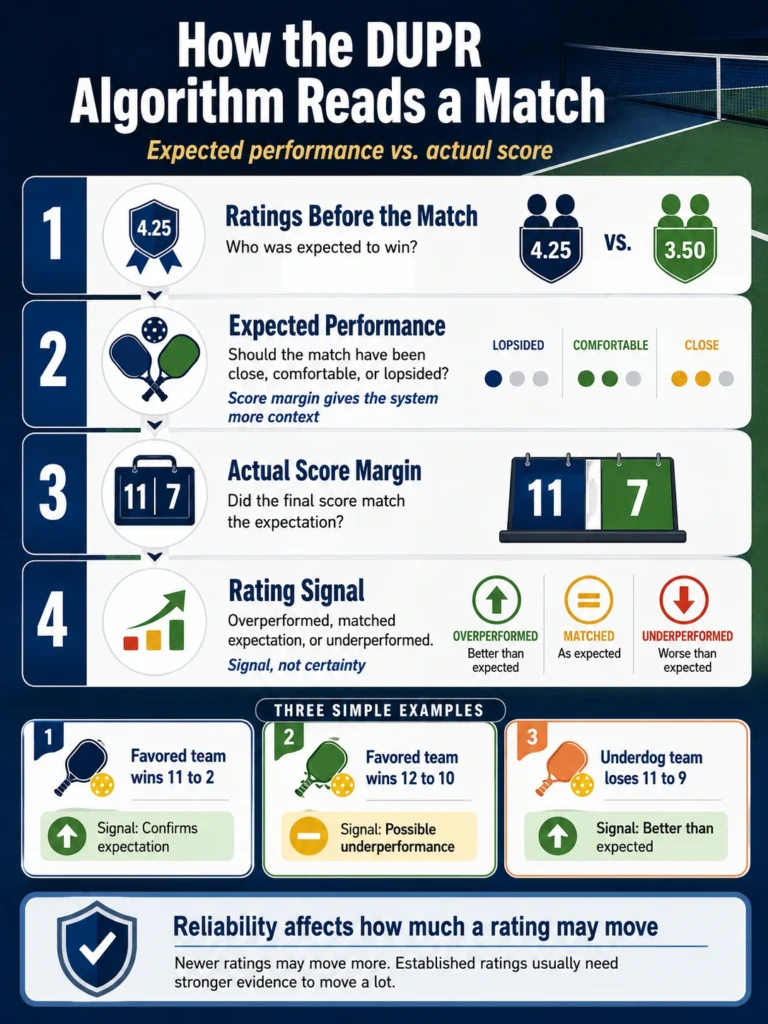
The PickleTip DUPR Match-Movement Chain
Start before the first serve. DUPR already has an expectation for the matchup. Everything that happens next is measured against it.
- Player ratings define the matchup. In doubles, the partners’ ratings are averaged to form team ratings.
- The matchup produces an expected score. The stronger team is expected to score more points.
- The final score supplies the performance signal. DUPR compares actual points with expected points.
- Match type changes the influence. Club and tournament results carry more weight than self-posted recreational matches.
- Recency and volume shape each player’s adjustment. Newer results matter more, and players with different match histories can move by different amounts.
- The new number becomes part of the next expectation. Future matchups are built from the updated ratings.
PickleTip principle: Ratings create the expectation. The score creates the signal. Context shapes the update.
How to Check a DUPR Movement That Looks Wrong
Do not begin with the size of the decimal change. Begin with the information DUPR was reacting to. As a registered DUPR coach, I hear this question from players regularly. The first thing I check when someone says their partner moved more is whether the two players had anything close to the same match history. Most of the time, they are comparing the decimal change before comparing the evidence behind it.
- Find the expected score. Check Forecast when the matchup is available, or at least identify which team was favored and by how much.
- Compare the expectation with the recorded score. The final margin may explain the direction even when the win or loss does not.
- Confirm the result source. A club or tournament result has more influence than a self-posted recreational match.
- Compare the players’ histories. Partners can share one result while bringing very different amounts of recent match evidence into it.
- Separate rating movement from Reliability. A rating can move while Reliability remains low, and Reliability can change without telling you that the rating should move up or down.
- Read Impact as the prediction DUPR shows for that exact setup. Make sure the players, ratings, format, and scoreline match the result you are trying to explain.
Without the correct pre-match ratings, final score, result source, and each player’s history, nobody looking at one screenshot should confidently claim they can reproduce the exact change to the decimal.
How DUPR Builds the Expected Score in Doubles
DUPR says it averages the two partners’ individual doubles ratings to create a team rating. The two team ratings are then used to determine the expected score.
| Team | Player ratings | Simple team average |
|---|---|---|
| Team A | 4.10 and 3.90 | 4.00 |
| Team B | 3.60 and 3.40 | 3.50 |
Team A should be favored. DUPR does not publish the equation that converts that team-rating gap into an exact expected score.
Why Partners Can Move by Different Amounts
The match gives DUPR one team result. The four players still arrive with different histories. DUPR says each player’s adjustment depends on how many matches that player has recorded and how recent those matches are.
A newer player with a thin history may move more because the result supplies a larger share of the available evidence. A player with a deep, recent history may move less because one match has to compete with a much larger sample.
The same score can be important new evidence for one partner and only one more data point for the other.
Expected vs. Actual: Illustrative Match Examples
Example note: The first two scorelines below come from DUPR’s July 8, 2025 algorithm announcement. The remaining rows are simplified illustrations of the published logic, not exact DUPR calculations for specific ratings.
| Match situation | Expected score | Actual score | What the score signals |
|---|---|---|---|
| Official DUPR doubles example: favored team | Win 11–3 | Win 11–8 | The favorite won but scored fewer points than expected; its players can move down |
| Official DUPR singles example: 3.5 versus 4.0 | Lose 5–11 | Lose 9–11 | The underdog lost but scored more points than expected; the 3.5 can move up |
| Illustrative: evenly rated teams | Close match | Close match | The score roughly matched the prediction, so limited movement is plausible |
| Illustrative: evenly rated teams | Close match | Blowout | The blowout suggests the teams were not as evenly matched as their ratings predicted |
| Illustrative: favored team | Comfortable win | Comfortable win | The score matched the prediction closely, so it may create less movement than a major overperformance or underperformance |
The win still counts in the bracket. DUPR reads the margin as evidence about whether the rating gap was too wide, too narrow, or about right. One close loss does not prove a new level, but it can provide evidence that the current number is too low.
How Match Type, Recency, and Volume Shape the Update
Club and Tournament Matches Carry More Influence
DUPR’s current guidance says club and tournament results influence the rating more than self-posted recreational results.
| Match source | Published treatment | What to remember |
|---|---|---|
| Club or tournament result | More influence | Organized results provide stronger evidence inside the current public framework |
| Self-posted recreational result | Still counts, but with less influence | The match remains useful without carrying the same published influence |
DUPR does not publish the exact current weight for every result source on its primary How It Works page. Older DUPR pages may describe earlier formulas or fixed multipliers, so current official guidance should take priority.
Newer Matches Matter More
DUPR gives newer matches more influence so the rating can respond to current performance. Older matches remain part of the history, but they should not speak as loudly as recent evidence forever.
More Matches Usually Mean More Stability
A player with only a few results gives the system less evidence. Each new match can therefore carry more informational value. A player with a deep history usually has a more stable rating because one result must compete with a much larger body of evidence.
A normal rating update is different from the optional DUPR Reset, which used a defined eligibility period and separate match requirements. Read How the 2026 DUPR Reset Worked for that separate process.
Reliability Does Not Decide the Direction of Movement
| Number | What it describes |
|---|---|
| DUPR Rating | The system’s estimate of your current playing level |
| Reliability Score | How established and current the evidence behind that estimate appears to be |
DUPR displays Reliability from 1% to 100% and identifies 60% or higher as reliable. A low score can reflect insufficient or outdated data. A higher score means DUPR has stronger reason to believe the rating reflects the player’s current level.
Reliability depends on factors such as match count, recency, and opponent variety. Those ideas overlap with the information that can make a rating more stable, but DUPR’s current calculation guide does not describe the displayed Reliability percentage as a direct multiplier inserted into each rating update.
Reliability does not tell you which direction the rating should move. It tells you how firmly the current number stands.
For event entry, Reliability requirements, and which profile number an organizer may use, read Which DUPR Rating Counts?
DUPR Forecast vs. DUPR Impact
| Tool | What it shows | What it does not do |
|---|---|---|
| DUPR Forecast | Favorite, underdog, win probability, and expected score for a simulated matchup | It does not guarantee the actual score |
| DUPR Impact | DUPR’s predicted rating movement for adjustable scorelines inside Forecast | It is not a separate rating or an eligibility number |
DUPR introduced Forecast in 2025. DUPR Impact followed in 2026 and lets players change possible scorelines to preview predicted rating movement.
Forecast and Impact let players see something that used to be hidden: against the same opponents, 11–2 and 11–9 are not remotely the same performance. DUPR presents Impact as the predicted movement for the matchup and scoreline shown. It is still a forecast rather than the final processed result, so make sure the players, ratings, format, and scoreline being compared are the same.
When Does a Recorded DUPR Result Show Up?
DUPR’s current How It Works page says the rating updates automatically with each result. The visible change still depends on the result being entered, confirmed when required, transmitted by the submitting platform, and processed.
- The tournament or club platform may not have transmitted the result yet.
- A self-posted result may still need confirmation.
- The score or players may have been entered incorrectly.
- The result may be duplicated or under review.
DUPR’s public documentation does not promise one universal processing time for every tournament platform, club integration, and self-posted result. Check the submitting platform or organizer when a result is missing.
Reliability is a separate profile measure from the rating itself. DUPR’s current public pages explain what Reliability measures, but they do not clearly promise one permanent update schedule. If new matches have appeared but Reliability has not changed, check the current DUPR app or support material for the latest cadence.
What Actually Makes a DUPR Rating Rise?
Over time, your DUPR rises when your recorded scores keep beating the expectations attached to your current number.
- Play opponents who give the system a realistic picture of your level.
- Record accurate scores.
- Build recent match history.
- Perform above expectation consistently instead of chasing one favorable result.
“Play up” is not a magic shortcut. Losing badly to stronger players does not automatically help. The score still has to exceed what the algorithm expected from that matchup.
What DUPR Publishes, and What It Keeps Proprietary
| Publicly explained | Not fully public |
|---|---|
| Performance versus expected score | The complete expected-score equation |
| Team rating is based on the partners’ average in doubles | Every coefficient and adjustment curve |
| Club and tournament matches have more influence than self-posted matches | The exact current weight for every result source |
| Newer matches matter more | The full recency-decay formula |
| Match volume affects stability and individual adjustment | Every volume threshold and movement cap |
| Forecast and Impact show predicted outcomes | The full production model behind every prediction |
That is where responsible explanation has to stop. DUPR publishes enough to explain the logic and likely direction of movement. It does not publish enough for an outsider to reproduce every rating change to the decimal.
DUPR also cannot fully measure injuries, experimentation, unusual conditions, partner chemistry, or the tactical reason a particular score occurred. Those limitations are part of the broader question of where DUPR ratings still fall short.
When the number controls tournament access or partner choices, the argument stops being purely mathematical. I cover that problem in Can Pickleball Ratings Be Trusted?
DUPR Algorithm FAQ
Your team may have scored fewer points than expected for the rating matchup. A narrow win when DUPR expected a comfortable win can be treated as underperformance.
Partners share one match result but can have very different match histories. DUPR says each player’s adjustment depends on match volume and recency, so one partner may move more than the other.
DUPR presents Reliability as a measure of how established and current a rating is. Its public calculation guide does not describe the displayed Reliability percentage as a direct multiplier controlling the direction of each update.
Forecast shows the expected matchup, including favorite, underdog, win probability, and expected score. DUPR Impact lets players adjust possible scorelines and preview predicted rating movement for the simulated result.
DUPR says the rating updates automatically with each processed result. The visible timing depends on entry, confirmation when required, platform transmission, and processing. DUPR explains Reliability separately but does not currently publish one permanent update schedule across its main public pages.
Not exactly from public information. DUPR explains the main logic and factors, but it does not publish the complete expected-score equation, every weighting, recency curve, volume threshold, or movement cap needed to reproduce every decimal.
Most surprising DUPR changes become easier to explain once you stop looking only at the win or loss. Find the expected score, compare it with the actual margin, and then check the result source and the amount of recent evidence each player brought into the match.
The rule worth keeping: The result belongs to the bracket. The performance signal belongs to the rating.
Beat the expectation and the rating can rise. Fall short of it and the rating can drop. The public framework explains the logic and likely direction. DUPR’s proprietary model still controls the exact amount.