Pickleball Court Coverage: How Doubles Partners Move Together
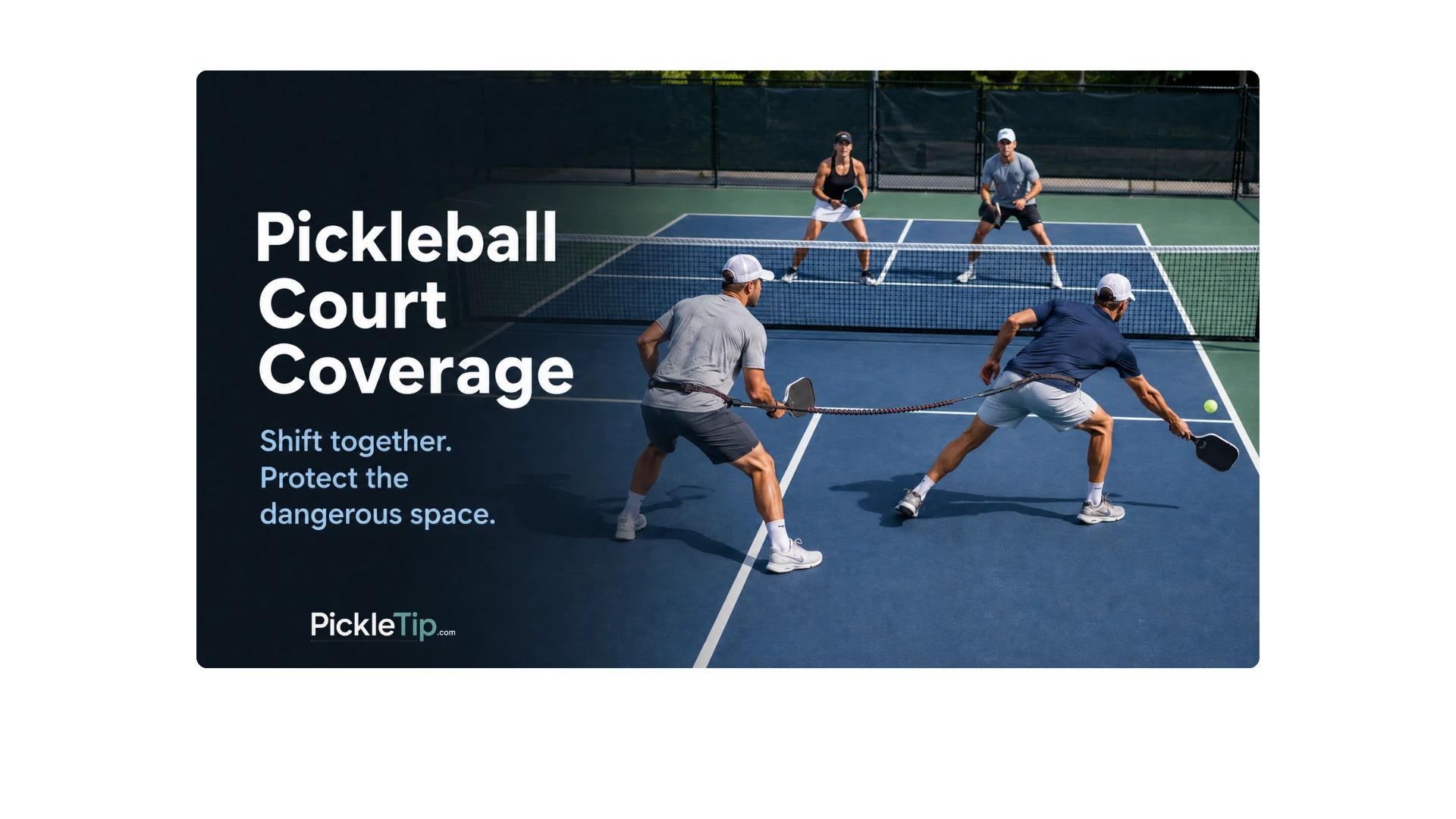
Pickleball court coverage is not about each partner guarding one fixed half of the court. It is about two players shifting together so the most dangerous space stays protected as the ball moves.
When the ball moves wide, both partners adjust. When one player gets pulled outside the sideline, the other protects the inside gap. When one partner advances, the other should not remain stranded several steps behind without a reason.
I see doubles teams make the same court-coverage mistake every week. They divide the court down the middle, guard their assigned boxes, and assume anything crossing that imaginary line belongs to the other person.
That sounds organized until the ball starts moving.
One opponent gets pulled wide. Your partner follows the ball toward the sideline. You stay planted on your half. Suddenly, the opening through the middle is wide enough to drive a truck through.
Good court coverage does not protect equal pieces of court. It protects the most dangerous space created by the ball.
What Is Pickleball Court Coverage?
Pickleball court coverage is the shape two doubles partners create together as the ball moves. It includes the team’s width, shared depth, and the gaps that open when the ball pulls one player out of position.
During the rally, the read is simple: find the ball, identify the space the opponent can hurt, and close it together. Your side of the court is not a piece of real estate. It moves every time the ball moves.
Coach Sid’s Bungee-Cord Test
Imagine a short bungee cord connecting you and your partner. When the ball pulls one player wide, the cord should slide the other player toward the newly opened middle. It can stretch during a scramble, but it should not stay stretched across half the court.
The cord should leave enough room for the outside player to work, but not so much that the partner is guarding a sideline nobody can attack. If both players stay on their original sidelines while the ball moves wide, the cord is not stretched. It is broken.
Court Coverage Has Two Dimensions
| Coverage dimension | Question to ask | Common breakdown |
|---|---|---|
| Width | Did both partners shift when the ball shifted? | An open seam, an unprotected middle, or both partners crowding the same ball. |
| Depth | Are both partners defending the same next ball? | One player at the kitchen and one near the baseline with a diagonal opening between them. |
The bungee cord works in both directions. It slides sideways when the ball moves wide, and it can angle slightly when one partner is moving forward or backward. What it should not do is stretch from the kitchen line to the baseline while both players pretend they are still defending as a team.
The Ball-Side Rule: Shift Toward the Ball
Wherever the ball goes, your team shape has to lean with it. When the ball moves toward one sideline, both partners should usually shift in that direction.
The player closest to the ball becomes the ball-side player. The partner closer to the middle becomes the inside player.
| Role | Main responsibility | Common mistake |
|---|---|---|
| Ball-side player | Protect the line, handle the immediate ball, and avoid being beaten through the closest angle. | Overcommitting toward the sideline and leaving no recovery path. |
| Inside player | Close the seam, protect the newly opened middle, and prepare for the redirected reply. | Staying on the far sideline while the middle opens. |
Closing the middle does not mean surrendering the nearest sideline. The ball-side player protects the closest angle while the inside player closes the space behind that play.
Do not turn the shift into two players chasing the same ball. The outside player needs room to work. The partner away from the ball is sliding over to close the hole left behind.
Picture a dink pulling your partner outside the right sideline. Your partner handles the ball. You do not follow all the way behind. You slide right far enough to protect the middle. If the opponent redirects the next ball through the seam, you are already in the lane instead of reaching across half the court after it.
Court Coverage and Positioning Are Different
Pickleball positioning helps an individual player decide where to stand. Court coverage looks at the shape both partners create together. Positioning evaluates one player’s location; court coverage evaluates the relationship between both players.
Good coverage gets both partners close enough to protect the dangerous space. Deciding who actually takes a middle ball still depends on forehands, handedness, balance, ball direction, and middle-shot responsibility.
This guide does not decide who takes every middle ball, teach individual footwork, or replace zone-specific positioning. It teaches how both partners preserve a workable team shape while those decisions unfold.
From the Baseline, Do Not Defend Like Two Singles Players
From the baseline, you have more time to see the ball travel, but you also have more court behind and beside you. That extra space tempts partners to spread out like two singles players guarding separate alleys.
When a return or defensive ball pulls one player wide, the inside partner should close toward the center instead of protecting the far sideline by habit. Do not mistake extra reaction time for permission to drift apart. From deeper in the court, that diagonal hole gets bigger because the ball has more room to drop between you.
How Far Should Partners Shift?
There is no single number of feet that works for every ball. A wide ball should pull the team shape toward the ball. A balanced opponent contacting high usually requires the inside player to close the seam more aggressively than an opponent reaching below the net.
- Ball near the middle: Stay balanced and leave enough room for both paddles to work.
- Opponent contacts a high ball: Tighten the seam and prepare for speed through the middle or into the body.
- Opponent contacts below the net: Stay balanced. The opponent has fewer clean attacking lanes, so there is no reason to overreact.
- Opponent is off balance: Do not give away the far side before a clean angle exists.
Coach Sid’s Spacing Test
You are probably too far apart when a ball through the middle makes both players reach but neither player move. You are probably too close when both paddles are fighting for the same ball.
I see the late shift more than anything else when I am coaching doubles. One player gets pulled wide to take a dink near the sideline, but the partner stays planted in the middle of the original box. The opponent does not need a great shot. They roll the ball through the seam, and both partners recognize the opening only after it has already beaten them.
When I stop the point and move both players into better position, the adjustment is usually smaller than they expect. The wide player recovers a step toward the middle, the partner slides over with them, and the easy lane disappears. They are not standing on top of each other. They are simply connected again.
The opposite problem shows up too. Some partners hear “move together” and crowd so tightly that both paddles end up in the same space. That leads to hesitation, paddle collisions, or both players letting the ball go because each thought the other had it.
Do not memorize a distance. Keep the space between you small enough that the opponent cannot attack it easily, while leaving enough room for both players to swing and react.
Court Coverage at the Kitchen Line
At the kitchen, the ball moves quickly enough that a late shift gets exposed. The player away from the ball should begin closing the seam as the ball travels wide, not after the opponent has already redirected it.
A wide dink does not mean both players should chase the sideline. Let the outside player work while the partner slides behind the play. If the opponent is reaching below the net, stay balanced. If the ball is sitting high in front of a balanced opponent, tighten the seam and get ready for speed through the middle or into the body.
This is where I see the late shift become expensive. Both players may have their toes at the kitchen line and still leave a middle seam big enough to lose the point. Court position can look correct while the team shape is already broken.
Who takes the middle ball still depends on forehands, handedness, balance, ball direction, and Respect the X. Good coverage makes that decision easier because the gap is already smaller before the opponent hits. Stacking and left-handed partners can change whose forehand owns the middle, but they do not change the basic rule: protect the space the ball has opened.
Why Partners Need Compatible Depth
Shifting side to side solves only half the problem. Partners can close the middle and still be split from the kitchen line to the baseline.
When one player reaches the kitchen while the partner remains near the baseline, the team no longer has one defensive line. It has two separate players trying to protect different rallies.
- The opponents can attack the deeper player’s feet.
- The ball can pass through the diagonal gap between partners.
- The front player may intercept balls the back player expected to handle.
- The back player may drive through the partner standing in front.
- Neither player can shift laterally as a connected unit.
Partners do not need their toes on the same exact line. They need compatible depth—close enough that both players are defending the same phase of the rally.
Compatible depth matters when you are moving backward too. If one partner retreats several steps to defend a lob, overhead, or hard attack, the other may need to give ground. You do not have to mirror every step. Just do not leave your partner alone on an island with a diagonal lane running between you.
I see the depth split most often around the third shot. One player charges toward the kitchen, turns around, and realizes the partner who hit the ball is still near the baseline. The front player thinks they are applying pressure, but they are actually standing alone with open court behind and beside them.
From the opponent’s side, that gap is easy to recognize. They can drive at the deeper player’s feet, roll the ball through the diagonal space, or force the front player to guess whether to intercept. That is usually when partners start blaming communication, even though the real problem is their depth.
When I stop the point, I usually tell the front player, “You are not wrong for moving forward. You are just early compared with your partner.” Sometimes the better adjustment is to pause in transition and help protect the next ball. Other times the deeper player needs to move through the shot instead of standing at the baseline to admire it.
The same thing happens in reverse when one player gets pushed back by a lob or overhead. Their partner stays glued to the kitchen, and suddenly the team is defending two completely different rallies. Giving up a step or two may feel passive, but it keeps both players connected and removes the diagonal lane.
You do not need matching footprints. You need to be close enough in depth that the same ball does not look playable to one partner and impossible to the other.
One-Up, One-Back Is an Emergency Position
The one-up, one-back formation is sometimes unavoidable. The mistake is treating it like home instead of an emergency position you are trying to escape.
- The deep player’s feet are exposed. That player has less reaction time and more court to cover.
- The diagonal seam opens. The partners are separated both sideways and front-to-back.
- Space opens behind the front player. A ball can pass the kitchen player but still land well in front of the deeper partner.
The front player should stop trying to rescue every ball. The back player should look for a neutral shot that buys time. Survive the next ball, shrink the gap, and get both partners defending the same part of the rally again.
How Mismatched Third-Shot Reads Break Team Shape
| Third-shot read | Team movement |
|---|---|
| Both players see a safe ball | Compress forward while maintaining compatible depth. |
| Both players see pressure | Hold or give ground together so a diagonal gap does not open. |
| One advances and one stays deep | Pause the front player or move the deeper player through the shot before the team splits into two defensive lines. |
| One player is pushed backward | The partner adjusts enough to protect the newly opened middle instead of continuing forward alone. |
The quality of the shot should decide whether you move forward. Once that decision is made, both partners need to read it the same way. Use the transition-zone guide for moving through midcourt, the reset guide for neutralizing pressure, and the third-shot strategy guide for deciding which balls earn movement forward.
Good spacing will not rescue a bad reset, but it gives both partners a chance to survive the next ball.
Move forward together when the ball earns it. When it does not, stop and defend together.
How to Recover After a Wide Ball
Once one player gets dragged wide, the middle belongs to the partner. Leave it alone and the next ball has a very inviting place to go.
- The ball-side player handles the wide ball.
- The inside player shifts toward the vacated middle.
- Both players judge the quality of the reply.
- The wide player recovers only as quickly as the rally allows.
- Both players shrink the gap before returning to their normal spots.
The partner in the middle should not chase behind the wide player toward the same sideline. That doubles the team’s coverage in the least dangerous area while abandoning the center.
The wide player should not sprint blindly back to the original spot while the opponent is contacting the next ball. Recover under control, stop before contact when possible, and defend the position the rally has created.
No spacing rule works perfectly during a scramble. Sometimes your only job is to defend the next ball from the ugly formation you already have.
When Should Partners Switch Sides?
Not every wide ball requires a switch. Sometimes the displaced player can recover while the partner temporarily protects the middle. Other times, returning to the original sides would take too long and expose the court.
| Situation | Better response | Why |
|---|---|---|
| Player is pulled slightly wide but remains near the kitchen | Stay | The player can recover without crossing behind the partner. |
| Player chases a lob across the center | Switch | The partner can fill the open side faster than the chasing player can return. |
| Poach carries a player fully across the middle | Switch | The original sideline is now exposed. |
| Wide dink creates only a temporary stretch | Stay | A full switch may create more confusion than the original movement. |
| Scramble leaves both players on unexpected sides | Hold the temporary formation | Reorganizing during active pressure may open the court again. |
The pickleball doubles communication guide covers the timing of “switch” and “stay” calls. The movement comes first: once the court has flipped, the call confirms what both players should already see.
During a scramble, the best side is often the side you are already on. Cover the next ball first. Reorganize when the rally gives you time.
Common Pickleball Court Coverage Mistakes
Diagnose the Breakdown With Two Coverage Checks
After the rally, diagnose the breakdown with two questions:
Width: Did both partners shift when the ball shifted?
Depth: Were both partners defending the same next ball?
Most court-coverage problems begin when the answer to one of those questions is no.
| Mistake | What it creates | Better adjustment |
|---|---|---|
| Guarding a fixed half of the court | A large seam when the ball moves wide | Shift as a connected pair toward the ball. |
| Protecting the far sideline too early | An easy opening through the middle | Prioritize the dangerous inside gap until the line attack is available. |
| Both players chasing the same wide ball | An uncovered opposite side | Let the ball-side player work while the partner fills behind. |
| One player advancing alone | A diagonal one-up, one-back gap | Move from the same read and maintain compatible depth. |
| Trying to recover during opponent contact | Off-balance movement and late reactions | Stop, defend the current position, then recover when time returns. |
| Switching when staying would work | Unnecessary confusion and crossed movement | Use temporary coverage until the displaced player can recover. |
| Staying when the court has already flipped | A permanently exposed sideline | Switch and accept the new formation. |
Three Drills for Better Doubles Court Coverage
I teach court coverage in three steps: learn the movement without a ball, add a predictable wide feed, then make both partners read live shot quality. I care less about who wins the drill ball than whether both players move before the opening becomes obvious.
1. Shadow Shift Drill
Both partners begin at the kitchen line without hitting a ball. A coach or feeder points left, middle, or right. The partners shift together while maintaining a workable seam.
Watch for: The player away from the ball should move toward the middle without crowding the ball-side player. Neither partner should stay frozen on a sideline.
2. Wide Ball and Recover Drill
A feeder sends one partner wide, then directs the next ball through the middle. The inside partner must close the seam while the wide player recovers under control.
Watch for: The inside player should not follow the first ball. The wide player should not sprint back while the feeder is contacting the next shot.
3. Compatible Depth Drill
Begin both partners at the baseline. Feed third-shot drops, drives, and attackable balls. Both players must read the shot and call whether the team advances, holds, or defends.
Watch for: Score the team on whether the partners finish the movement at compatible depth, not whether they win the rally.
Questions About Doubles Court Coverage
Not rigidly. Each partner may begin on a general side, but both players should shift as the ball moves. The player near the ball protects the closest attack while the inside partner slides over to close the middle.
You are probably too far apart when a middle ball makes both players reach but neither player can move comfortably into the lane. You are probably too close when both paddles compete for the same ball.
Switch when one player has crossed far enough that returning to the original side would expose the court. After a smaller wide movement, the inside partner can usually protect the seam temporarily while the displaced player recovers.
Stacking changes where partners begin and may change which forehand controls the middle, but the basic coverage principle remains the same. Both players still shift with the ball and protect the seam as the rally develops.
Protect the court the lob chaser has left behind. If the chasing player crosses the center and cannot recover quickly, switch sides and defend the next ball before trying to return to the original formation.
Cover the Court as a Pair, Not as Two Halves
Shift toward the ball. Let the ball-side player handle the closest danger while the inside player closes what opened behind the play. Stay at compatible depth, and after a wide ball, lob, poach, or scramble, cover the next shot before worrying about getting back to your favorite side.
The court does not belong to two separate players. It belongs to the shape they create together.