DUPR Algorithm: Why Your Rating Dropped After You Won
Why DUPR’s New Algorithm (Finally) Gets It Right
I remember standing courtside two years ago after yet another DUPR update dropped. We’d just wrapped a local rating session, sweaty, tired, and confused. One guy played lights-out all night but somehow lost rating points. Another won sloppy and got a bump. I muttered, “This system’s broken,” and meant it. We’d built trust in a platform that kept yanking the rug out. But this July 2025 DUPR algorithm update? This one’s different. And yeah, I’m saying that as someone who’s torn DUPR apart before.
In short: The new DUPR algorithm rewards how well you play relative to expectations, not just whether you win or lose, finally putting skill, effort, and consistency ahead of scoreboard flukes.
Quick Summary
- This article breaks down DUPR’s July 2025 update and why it actually makes sense.
- Many players hate losing points after a win, but this update shows why that can be fair.
- You can now climb even in losses if you outplay expectations, finally a rating system that gets the nuance.
- This shift could be the turning point for meaningful, honest ratings in competitive pickleball.
What You’ll Learn: Understanding the New DUPR Algorithm
- Why Every Point Matters Now
- How the New Algorithm Works
- Why People Hate It (and Why They’re Wrong)
- How to Protect Your Rating in Tough Matches
- Long-Term Impact on Clubs & Tournaments
- FAQ
Who This Helps
This article is perfect for:
- Intermediate players who keep losing rating points despite solid performances
- Competitive rec and club organizers trying to build fair, balanced matches
- Underdogs with grit who want a shot at earning credit when they rise to the occasion
Why Every Point Matters Now, And Why That’s a Good Thing
This new update makes your performance matter more than the scoreboard. That’s going to sting a lot of egos. But it’s also the most honest evolution pickleball has seen yet. 🧠
For years, we watched players coast to wins against weaker opponents and brag about climbing DUPR. Meanwhile, others played their hearts out, lost 11–9 to a 4.5 team, and dropped points. That wasn’t fair. That was a player sandbagging and gaming the rating system.
Now, if you’re a 3.5 team and you hold a 4.0 pair to 11–9, you get rewarded. Even in a loss. That’s not “soft.” That’s truth. It’s what rating systems like Elo and TrueSkill have done in chess, esports, and tennis for decades. Think of it like a seasoned pro golfer draining a 30-foot putt after a terrible drive, it’s about the save, not just the score. 🧠
- Quick Takeaway: Your rating isn’t just about results anymore, it’s about how those results stack up against what was expected.
- Play well, and your DUPR can rise, even after a loss.
- Play lazy, and you’ll pay for it, even after a win.
How the New Algorithm Works, In Plain Language
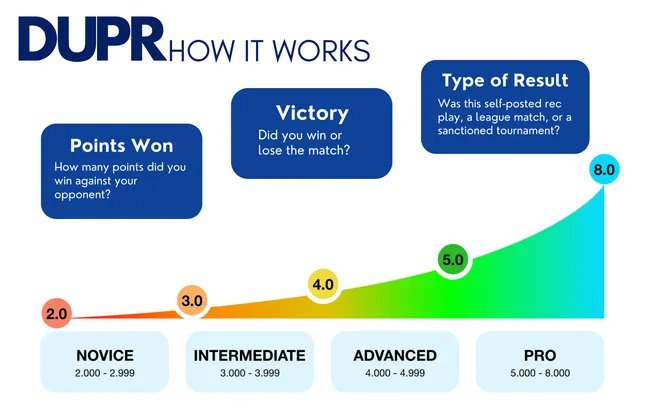
Each match now has an “expected score” based on the average ratings of both teams. Think of it like Vegas odds. If your team is a heavy favorite and barely scrapes by, that’s underperformance. If you’re a big underdog and keep it close, that’s a win in the algorithm’s eyes, even if you lost the match.
Key variables now include:
- Performance vs. expectation: Outperform it? Rating goes up. Underperform? Rating drops.
- Match type weight: Tournaments matter more than rec games.
- Recency bias: New matches carry more weight than old ones.
- Match volume smoothing: The more you play, the more stable your rating becomes.
This mirrors a concept I explored years ago in a local prototype system I called SUPR, where time decay, performance slope, and opponent strength mattered. It’s good to see DUPR leaning into similar logic, finally. Still, it’s not rocket science; it’s just about recognizing the grind. Funny enough, this mirrors the same slope-and-decay model I cooked up with SUPR back when everyone was still obsessed with raw wins.
- Quick Takeaway: Winning or losing matters less than how well you performed against expectations.
- This prevents gaming the system and promotes fair, honest ratings.
“But I Won, Why Did My Rating Drop?”
This is the emotional wall most players hit first. It feels wrong. It feels like math is betraying effort. But here’s the kicker: winning isn’t always impressive. If Ben Johns barely beats a 3.0, he should drop. That 3.0 should rise. If your win looked like a struggle against someone rated far below you, then you didn’t win by enough. You just survived, like a squirrel dodging a truck.
This isn’t about punishment. It’s about precision. And ego’s going to have a hard time adjusting.
- Quick Takeaway: The algorithm doesn’t care about your W column, it cares how well you played relative to expectations.
- That’s not cruelty. That’s accuracy.
How to Protect Your Rating in Tough Matches
This is where your mindset really matters. Under the old system, once you were up 7–1, you could relax. Now? Garbage time is gone, and so is pity. You let that lower-rated team rack up a few points and your DUPR takes a hit. That means if you start to feel bad for the other team and slack off, it will absolutely affect your rating. So what’s the fix?
- Don’t coast, finish strong. Blowout wins have to stay blowouts.
- If you’re down, don’t fold. Even grabbing a few extra points late can help improve your DUPR. Every single point you fight for now truly counts, based upon your true performance.
- Partners matter more than ever. Carrying a weaker partner still costs you if expectations were higher. That’s life. You pick your partner; you own the outcome.
Let’s break it down with a few examples that show how your rating can shift, even when the outcome seems clear.
| Match Result | Expected Score | Actual Score | Rating Impact |
|---|---|---|---|
| You win vs. much lower team | 11–3 | 11–8 | Drop |
| You lose to a stronger team | 5–11 | 9–11 | Rise |
| You win as expected | 11–7 | 11–7 | Neutral |
| You lose 11–3 to equal team | 10–11 expected | 3–11 | Drop |
- Quick Takeaway: Play with urgency and consistency, start to finish.
- Every point now has value, even when you’re behind or ahead.
What This Means for Clubs, Tournaments, and the Pickleball Ecosystem
This change isn’t just about fixing individual ratings, it’s about maturing the sport. Pickleball is no longer a casual backyard game. Leagues, clubs, tournaments, they all depend on fair matchups. Ratings that don’t reflect real skill damage everything.
By adopting a performance-based model, DUPR just stepped into grown-up territory. This gives organizers the tools to build better brackets, set better pairings, and reward real growth, not easy wins. This is how you stop the sandbaggers and lift the legitimate grinders. 🔗
- Quick Takeaway: Expect more competitive events and fewer 11–2 mismatches.
- This update empowers clubs and directors to create fairer, more meaningful play.
Coach’s Take: If you’re mad that your rating dropped after a win, ask yourself, did you actually play better than expected, or did you just squeak by?
On This Page: Why It Matters | How It Works | Pushback | Match Strategy | FAQ
What Is the New DUPR Algorithm?
DUPR’s July 2025 algorithm is a performance-based rating system that adjusts your score based on how well you perform relative to expectations, not just whether you win or lose. It helps players earn accurate ratings by rewarding effort, consistency, and competitiveness across all levels.
DUPR Algorithm FAQ
If you’re wondering why your rating dropped after a win, or whether you can gain points in a loss, these answers break it down fast.
The DUPR algorithm can penalize wins when a player or team underperforms against their expected outcome. Because not all wins are created equal, if you barely beat a team you were supposed to crush, the system sees that as a red flag. It’s telling you to raise your game, not just collect a cheap W.
Yes, your DUPR rating can increase even after a loss if you perform better than expected against a higher-rated opponent. If you were expected to get smoked and you manage to keep it tight, the algorithm rewards you for that grit. That’s how you truly prove you’re playing above your rating, even when the scoreboard doesn’t show a ‘W.
To minimize DUPR rating drops in doubles, focus on performing consistently well relative to expectations in every match. Play clean, keep those expectations in mind, and don’t try to just carry a weaker partner for a “safe win.” If the match is supposed to be easy, the system expects dominance, no excuses. Play your game with purpose from first serve to last, or your rating will definitely reflect it.
Yes, recreational matches can and should be logged for DUPR, although they typically carry less weight than tournament or digital club matches. Don’t skip them thinking they don’t matter; logging them contributes to the overall volume and stability of your rating (Reliability Score), which helps provide a more accurate representation of your skill over time. If you want your rating to truly reflect your peak play, make sure all your toughest matches, even rec ones, are counted. This isn’t about hiding from the grind; it’s about embracing it for an honest rating.
Turn Strategy Into Action
This update might sting, but it’s what the sport needed. Ditch the ego and embrace the grind. Every point you earn now has meaning. If you’re serious about improvement, this is your shot to prove it, one tough match at a time. 📲 Stick with this system, and your rating won’t just rise, it’ll finally mean something.
Dare: Go play a team rated above you. Compete. Keep it close. Watch your DUPR go up, loss or not. Then tell your buddies you earned it.
Weigh In: Has the New DUPR Algorithm Helped or Hurt You?
Let’s be real, we’ve all had matches that felt great but looked bad on paper, or wins that felt hollow. Now that every point counts, how has this update affected your rating?
- Did your DUPR drop after a win?
- Did you finally gain after a close loss?
- Are you seeing more fair matches at your club?
Sound off in the comments. The more players who understand what’s really going on, the better we all compete, and the better the system reflects the truth.