Build Offense Before You Attack in Pickleball
Tomorrow, August 28th, AJ is playing in the YSAP Moneyball tournament at The Exchange.
There are going to be some very good players on those courts, and over the last few weeks I’ve spent quite a bit of time watching film with him and talking about his game.
The funny thing is, the biggest thing I want him thinking about tomorrow has almost nothing to do with learning another shot.
He already has plenty of shots.
Actually, that may be part of the problem.
AJ drills a lot. His drive has gotten better. His speedups are better. He can roll balls that he couldn’t attack as comfortably before. His hands are faster. He has more ways to create offense than he did a year ago.
But sometimes a player’s shots improve faster than his decisions about when to use them.
That’s the stage I think he’s in right now.
Last weekend at the tournament at Stacks, I watched it show up in competition.
AJ and Mickey found themselves in some tough spots because AJ was trying to create too much offense too soon. We didn’t go back and review film from that tournament. I was there watching the matches, and when AJ and I talked about the results afterward, he saw the same thing I did. He felt like he had been too aggressive and was going for too much.
And in doubles, that’s not only your problem. Sometimes you force an attack, the other team handles it, and your partner is the one who has to deal with the ugly ball that comes back.
I see some version of that with developing players all the time.
The better your offensive weapons become, the more tempting it is to use them before the point has actually earned them.
When Better Shots Create a New Problem
Early in a player’s development, shot selection is sometimes easy because there aren’t that many choices.
You can’t speed up that ball because you don’t have the shot yet.
You don’t try the aggressive topspin roll because you haven’t developed it.
You don’t drive through a tiny opening because you don’t trust the drive.
Then you start drilling.
Suddenly those shots become available.
That’s progress.
But now every decent ball starts looking like an invitation to use one of them.
That can create a strange stage of development where your paddle has more answers than the rally is asking for.
You see a ball and think:
I can attack that.
Maybe you can.
But that’s not quite the right question.
The better question is:
What has this ball actually earned?
I’ve been seeing that distinction both on film and standing beside the court watching AJ play.
The mistake isn’t usually that he doesn’t possess the right shot.
Sometimes he simply asks the shot to do too much too soon.
My broader guide to shot selection in pickleball gets into how the ball, your balance, opponent position and the next shot should influence the choice. But there’s one piece of shot selection I keep coming back to when I watch AJ:
the difference between building offense and forcing offense.
Not Every Ball Has to Win the Rally
This may be the biggest lesson I want AJ carrying into the tournament.
Not every ball needs to win the point.
Some balls just need to make the next ball better.
A good dink might move somebody six inches farther than they wanted to move. A reset might get you balanced again. A roll volley might make somebody reach. A ball into the body might jam a paddle. A wide dink might pull someone off their base.
None of those shots has to end the rally.
But every one of them can change it.
We tend to notice the ball that finally wins the point.
Film often shows me that the important ball happened one or two shots earlier.
The winner was just the receipt.
Building Offense vs. Forcing Offense
I don’t think the choice is really between being aggressive and being patient.
That’s too simple.
The question is whether you’ve actually created an advantage yet.
Building offense
You are building offense when each shot makes the opponent’s next contact a little more difficult.
Maybe you:
- move a player outside his normal base;
- make someone reach or lean;
- force contact below the net;
- jam the body;
- make somebody change direction;
- open space in the middle;
- get both opponents worried about different possibilities;
- or simply recover your own balance before asking for more.
You haven’t won the rally yet.
But the rally is moving in your direction.
Forcing offense
You are forcing offense when you decide you’re ready to attack even though the rally hasn’t given you much of an advantage.
That’s when I see players:
- speed up a ball from below the net;
- drive while falling backward;
- attack while still moving through the transition zone;
- try to hit through two balanced players at the kitchen;
- take a low-percentage sideline because they see three inches of open court;
- or attack a perfectly neutral dink because the rally has lasted about three balls longer than their patience did.
By neutral, I mean neither side has created enough advantage yet that the next ball needs to become an attack. Neutral doesn’t mean harmless. It just means the rally hasn’t tipped far enough in your favor yet.
And in doubles, forcing offense can create a second problem. You may be the one who chooses the bad attack, but your partner may be the one who gets the counter coming back at his feet or body. That’s part of what I thought AJ and Mickey ran into at Stacks.
The paddle may be capable of hitting the shot.
That doesn’t make it the right shot.
Having the ability to attack a ball is not the same as having a reason to attack it.
Patience Doesn’t Mean Waiting Around
I think we confuse aggressive players when we keep telling them to “be patient.”
That can sound like we’re asking them to stop creating offense.
That’s not what I want from AJ.
I don’t want him standing at the kitchen thinking, I’ll just dink until somebody screws up.
I want him trying to make the other team uncomfortable the entire time.
Move them. Change the height. Make somebody reach. Test the middle. Get one opponent leaning one way and send the next ball somewhere else. Make one player hit a ball he would rather his partner hit.
That is offense.
It just isn’t necessarily fast offense.
My Smart Pickleball Shot Patterns article goes deeper into creating those sequences instead of treating every shot as an isolated event.
Pressure doesn’t have to happen all at once. You can build it one uncomfortable ball at a time.
You don’t always have to cash it in immediately.
Sometimes the most offensive shot you can hit is the one that makes your next offensive shot easier.
The High Ball Usually Has a History
When someone finally pops a dink up, we tend to look at the popup.
That wasn’t necessarily where the point changed.
What happened before it?
Maybe the previous dink stretched the player wide.
Now he’s recovering, and the next ball goes toward his inside foot.
He can’t get completely organized. His contact rises six inches.
Now you have a real attack.
The attack may get the highlight.
The first two balls created it.
This is one reason I’m becoming more interested in reviewing sequences instead of individual errors when I watch pickleball match footage.
If I freeze the video on the final attack, I might ask whether AJ’s mechanics were right.
If I rewind three balls, I may discover a much more useful question:
Did he create this attack, or did he manufacture one in his own head?
Those are very different coaching problems.
That’s also what I’d tell anyone reviewing his own match footage: don’t just freeze the winner or the error. Rewind two or three balls and look for the moment the rally changed. Did the eventual attacker move somebody first? Force a reach? Catch somebody recovering? Or did he simply decide it was time to attack?
The last shot tells you who won the rally. The sequence often tells you why.
Confidence Can Make Shot Selection Harder
I’ve noticed another problem that can show up as a player’s game gets better: confidence starts changing what looks attackable.
Confidence is normally a good thing.
I don’t want AJ second-guessing every drive or getting scared to speed up a ball he should attack.
But confidence can expand what a player believes is attackable faster than it expands what is actually high percentage.
If you know you can make a difficult shot, there is always a temptation to prove it.
And every once in a while, you do.
That’s where this gets tricky. Spectacular results are easy to remember.
You remember ripping the low speedup through the middle.
You forget the other three that got countered.
You remember the ATP down the sideline.
You don’t remember that the middle of the court was open and would have given you a much bigger target.
And this is why the scoreboard can lie to you a little.
A bad decision can still produce a winner.
If you judge the decision only by whether the ball landed in, you can accidentally reward yourself for exactly the habit you’re trying to fix.
The problem isn’t confidence.
The next stage of development is learning to make that confidence more selective.
Great offense isn’t confidence turned all the way up. It’s confidence with standards.
Drilling the Shot Isn’t the Same as Drilling the Decision
This may be the piece I want to work on with AJ most after this tournament.
He drills constantly.
That’s helped build the arsenal.
But drilling can create a strange bias if we’re not careful.
Suppose we’re working on speedups.
For 20 minutes, the entire purpose of the drill is to speed up the ball.
Naturally, you start looking for speedups.
Then you go play.
The rally doesn’t know what you drilled.
Sometimes the correct decision is to use the shot you’ve been practicing.
Sometimes the correct decision is not to use it.
That’s why a skill isn’t completely transferred into competition until you can recognize when it belongs.
That’s also why I think decision-making has to become part of the drill instead of something we hope magically appears when the game starts.
Make the drill choose the shot too
One simple way to do that is to stop feeding only the ball you’re practicing.
If you’re working on speedups, mix in balls that are clearly attackable, balls that are neutral and balls that should probably be left alone. Now the player doesn’t get credit just for hitting a good speedup. He has to recognize whether the speedup belongs there in the first place.
I may start scoring the decision separately from whether the shot actually worked.
- Right ball, good attack: good decision.
- Right ball, missed attack: still may have been the right decision.
- Wrong ball, spectacular winner: bad decision with a good result.
- Wrong ball, player passes on it and keeps building: that’s progress too.
That last one may be the hardest to learn because nobody claps when you choose not to hit the shot you’ve been practicing.
But sometimes improvement is demonstrated by the shot you don’t hit.
My Intentional Play approach is built around that transition from practicing a skill to recognizing it inside an unpredictable rally.
The progression isn’t simply:
Can I hit the speedup?
It becomes:
Can I identify the right ball for the speedup?
And eventually:
Can I pass on the wrong ball even though I really want to use it?
The One Question I Want AJ Asking Tomorrow
I don’t want AJ walking into a Moneyball tournament with 14 coaching thoughts.
That’s usually a great way to make an athletic player play like he’s taking a written exam.
So if I could give him one thought tomorrow, it would be this:
Don’t ask this ball to do more than it has earned.
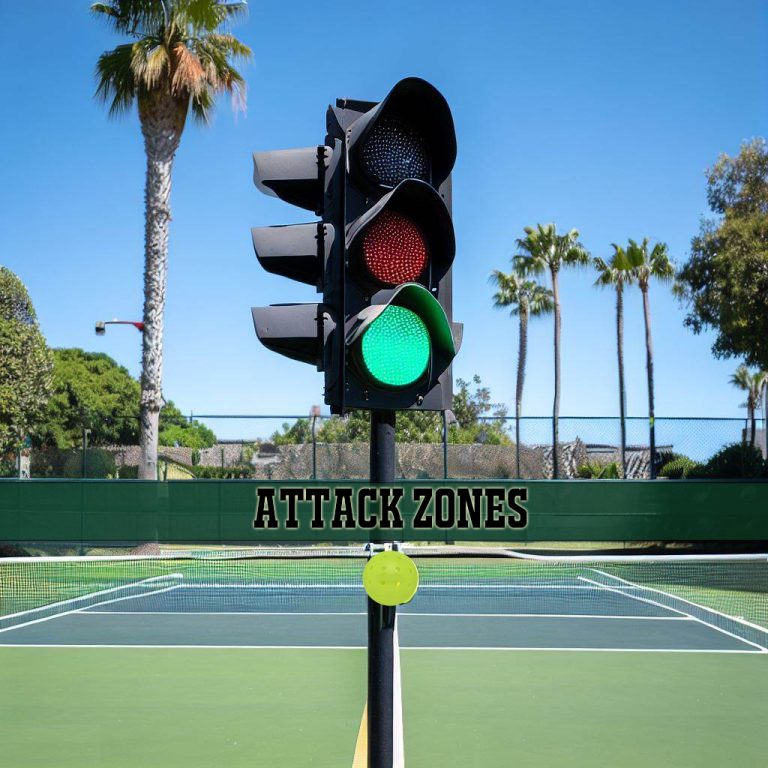
If the opponents are balanced at the kitchen, the ball is below the net, and you’re moving while you hit it, you probably haven’t earned very much offense yet.
Make the next ball better.
If you’ve moved somebody wide, caught someone leaning, created space, forced a reach, gotten the ball above the net or put yourself in a strong balanced position?
Now go.
That’s where I want the aggression.
Not less aggression.
Better-timed aggression.
I’ve written more about recognizing those green-light situations in my guide to patience in pickleball. But before you can recognize the green light, you have to create one.
That’s what I’m after here: creating the advantage instead of demanding one.
What I’ll Be Watching at the YSAP Moneyball
I’m obviously going to care whether AJ wins tomorrow.
I’m his dad.
I’m not going to pretend the score doesn’t matter.
But after what I watched at Stacks last weekend, one of the things I’ll be paying closest attention to at The Exchange is how many points he tries to finish before they’re ready to be finished.
Not just the attacks he misses.
The attacks he makes.
Because, again, a bad decision can still produce a winner.
That’s what makes this hard to diagnose from the scoreboard.
I want to see whether he can use all of these new weapons without feeling obligated to show them on every point.
Can he hit one more ball?
Can he make an opponent move first?
Can he recognize neutral?
Can he reset without feeling like he surrendered?
Can he create pressure without immediately converting it into pace?
Can he avoid putting Praveen in a bad spot because he asked too much from the ball before the advantage was there?
And when he finally gets the right ball, can he trust all that drilling and attack without hesitation?
That’s the balance I care about.
Don’t Become Less Aggressive. Become Harder to Rush.
I definitely don’t want AJ playing scared tomorrow against strong competition.
I want the opposite.
I want him confident enough that he doesn’t need to prove what he can do on every ball.
There is a point in player development where adding another shot produces less improvement than making better use of the shots you already have.
AJ may be reaching that point. A lot of players do.
Your drive gets good enough. Your speedup gets dangerous enough. Your rolls start dipping. Your hands start winning exchanges.
Now comes the harder part:
deciding when all of it belongs.
The goal isn’t to attack every ball you can attack.
It’s to keep moving the rally in your direction until the attack becomes harder and harder for the other team to survive.
A lot of points get easier when you stop asking every ball to finish the job.
Sometimes one ball moves them.
The next makes them reach.
The next gets the popup.
Then you finish.
That’s still aggressive pickleball.
You just started the attack three shots earlier.