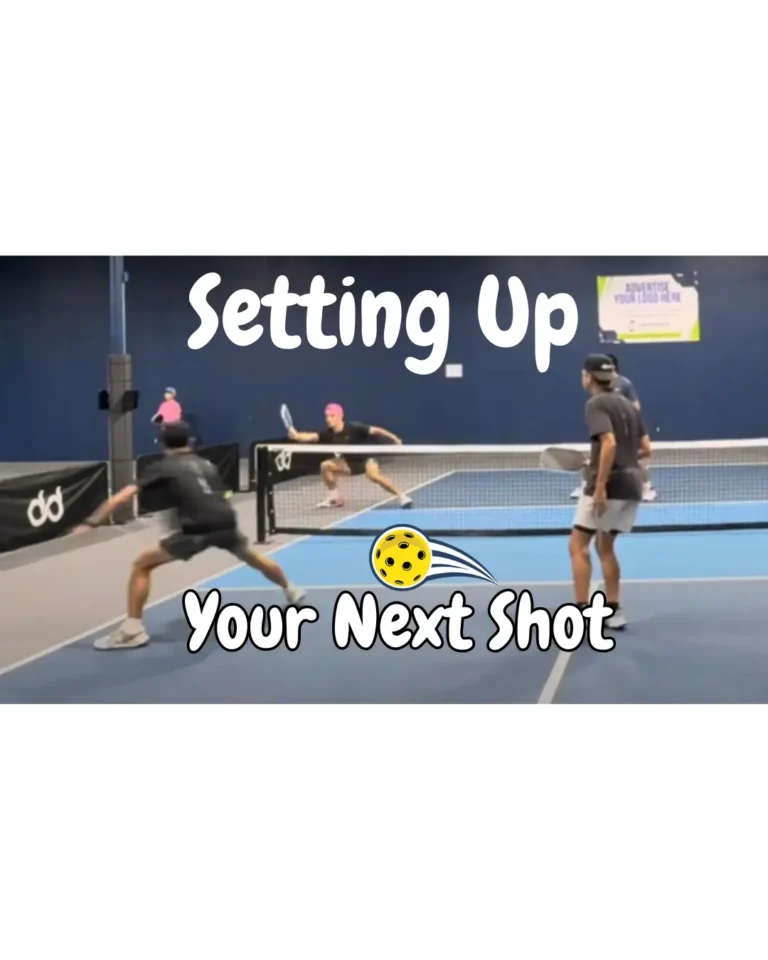

Shot Selection in Pickleball: How to Choose the Right Shot
Most points are not lost because you “don’t have the shot.” They are lost because the shot you chose did not fit the ball, your position, the opponents, or what needed to happen next.
That is what shot selection in pickleball really is: matching the shot to the rally you actually have instead of the shot you wanted to hit before the ball arrived.
Quick answer: Choose the shot that fits four things: the ball you received, the opponents’ position, your own balance, and the job of the next ball. Attack when the rally gives you an advantage. Neutralize when it does not. Your best choice is usually the one that improves the next contact instead of trying to finish the point from a bad one.
The same decision process works whether you are dinking at the kitchen, scrambling through transition, defending pace, or deciding whether a ball is actually attackable.

What Is Shot Selection in Pickleball?
Shot selection in pickleball is the process of choosing the shot that best fits the current ball, court positions, player balance, and desired next-ball outcome.
Technique asks, “Can I hit this shot?” Shot selection asks, “Is this the right shot here?” Those are different questions.
You may know how to drive, dink, lob, reset, counter, or speed up. The harder skill is recognizing which tool the rally is asking for before contact. Better players do not simply own more shots. They use the shots they own in better order.
Coach Sid rule: Do not choose a shot because you like it. Choose it because the ball, the court, and the likely next ball give it permission.
The 4 Filters for Better Pickleball Shot Selection
Before you decide what to hit, run four fast filters. The order matters because a clever tactical idea does not rescue a ball you cannot control.
1) Read the Ball: What Can This Contact Actually Support?
The incoming ball sets the ceiling for your options. Height, depth, speed, spin, and how early you reach the contact all affect what you can do safely.
- High and comfortable: more offensive options become available.
- Low or below net height: the rally usually asks for more margin and less ambition.
- Deep or heavy: your available time and contact quality shrink.
- Short or floating: you may be able to take time away or improve court position.
- Skidding, dipping, or spinning away: respect the contact before trying to create offense.
The important question is not “What shot do I want?” It is “What shots does this ball allow me to execute cleanly?”
2) Read the Opponents: What Are They Ready to Do Next?
Shot selection is incomplete until you look through the ball and read the people across the net. The same contact can call for a different choice depending on whether the opponents are balanced, moving, reaching, split, pinched toward the middle, or recovering.
- Set and balanced: expect a stronger next shot. Do not confuse available pace with available advantage.
- Moving or reaching: pressure becomes more valuable because their contact quality is already compromised.
- One player out of position: keep the rally focused on the weakness instead of changing direction just because you can.
- A visible gap opens: decide whether the gap is truly available or whether using it creates a bigger counterangle.
A shot is not good because it crosses the net. It is good because of what it makes the opponents do next.
3) Read Yourself: Are You Balanced Enough for the Shot?
This filter saves a lot of donated points. If you are reaching, drifting, leaning, late, jammed, or still moving through contact, your usable shot menu gets smaller.
- Balanced and early: you can use more direction, pace, spin, and disguise.
- Moving but organized: use enough margin to stay in control and recover.
- Stretched or late: stop trying to prove what shots you own. Solve the emergency first.
- Recovering from the previous ball: choose something your feet can support, not something your imagination can support.
Simple rule: The worse your balance, the more your shot selection should protect the next contact.
When is a ball actually attackable? A high ball gives you permission to consider offense. It does not make the decision for you. You still need a contact you can control, enough balance to support the attack, and an opponent who is not already sitting on the next ball.
4) Choose the Job: What Must Your Shot Accomplish?
Now decide what the rally needs. Most smart choices have one primary job:
- Attack: take time away or force a weak next ball because you have earned an advantage.
- Pressure: make the next contact uncomfortable without needing to end the rally now.
- Neutralize: remove the opponent’s advantage and get the rally back toward even.
- Buy time: give yourself or your partner space to recover.
- Move the opponent: change their contact point, balance, or court position.
- Protect the next ball: use margin when the worst outcome would be a free miss or easy put-away.
This is where risk belongs in the framework. Score, confidence, wind, partner position, and recent error patterns can change how much margin you want, but they should not override the first three filters. A bad ball does not become a good attack because the score is 9–9.
A version I see in lessons: A player tells me, “My thirds are all over the place.” When we isolate third-shot drops after a deep return, the pattern often gets more specific. The drop may be fine on a shorter return, then turn short or chest-high when the player gets pushed backward. On video, the player may still be moving at contact or changing the target at the last second.
That is not one generic “bad drop.” One player may need better spacing. Another may need to arrive balanced. Another may simply be changing the decision too late. Same ugly result. Different fix. I break that diagnosis down further in Improving Pickleball Consistency.
Your own game matters too. Two good players can read the same rally correctly and choose different answers because one owns a reliable roll, counter, lob, or reset that the other does not. Shot selection is not about finding one universal “correct” shot. It is about choosing the best available answer from your game for the rally in front of you.
Match the Job to the Kind of Shot You Need
Run those four reads and several bad choices usually disappear. What remains is the kind of ball the rally can actually support.
| Rally job | Shot families that may fit | What you are trying to create |
|---|---|---|
| Keep a neutral kitchen rally stable | Dink, controlled volley | A difficult-to-attack next ball |
| Attack an earned ball | Speed-up, roll, attacking volley, drive | A rushed contact, pop-up, or predictable counter |
| Absorb pressure | Reset, block, defensive dink | Time and a lower opponent contact |
| Change court position | Lob, angle, deep pressure ball | Movement before the opponent’s next contact |
| Apply pressure from a bounce | Drive or shaped groundstroke | Reduced time and a compromised next ball |
| Neutralize from deeper court | Drop, reset, higher-margin neutral ball | A safer path into the rally |
These are options, not automatic answers. A drive can be smart on one ball and reckless on the next. If the ball is specifically the serving team’s third shot, use Third Shot Strategy. If you need the mechanics of the shot itself, use the drive or drop-shot lesson.
The Same Ball Can Need a Different Shot
Your decision process stays the same, but the information changes quickly. Good shot selection means updating the answer instead of staying loyal to the plan you had one ball ago.
At the Kitchen: Do Not Attack Just Because You Can Reach the Ball
Kitchen exchanges are full of almost-attackable balls. Read height, opponent readiness, your balance, and partner readiness before changing the tempo. A patient dink may be the correct choice on one ball; a speed-up, roll, or counter may be correct on the next.
Same-looking ball, different decision: Imagine two dinks that both rise to roughly the same height. On the first, you are balanced, your opponent is reaching, and your partner is ready. That ball may have earned a speed-up or roll. On the second, you are stretched and the opponent is square with the paddle waiting. The height looks tempting, but the rest of the rally says dink again.
That is why “attack high balls” is not enough. The ball opens the option. Opponent position, your balance, and the next-ball job decide whether you should spend it.
The leak I see over and over in developing players is impatience arriving before the feet are ready. After two or three decent dinks, the hand wants to speed the point up. If the ball is still below the net or the player is reaching, that “attack” often becomes a lift into a prepared counter. In my dinking guide, I make the same point from the soft-game side: many pop-ups and panic speed-ups begin with balance, spacing, or patience before the paddle ever becomes the obvious problem.
The universal rule is simple: earn the attack before you spend it. For the detailed attack decision, use When and How to Execute Speed Ups in Pickleball.
Under Pressure: Stop Trying to Win From a Losing Contact
When the opponent has you stretched, jammed, late, or defending pace, the job often changes from “create offense” to “remove their offense.” That may mean blocking, resetting, adding height, or using a safer target.
If this is happening while you move through mid-court, the dedicated midcourt movement lesson is Pickleball Transition Zone. For reset technique itself, see Resetting in Pickleball.
When the Opponent Attacks: Decide Whether to Block, Counter, or Survive
An incoming attack does not automatically deserve an attack back. If you are set and the ball enters a comfortable counter window, you may be able to redirect the pressure. If you are late or jammed, trying to counter can turn defense into a pop-up.
That decision still runs through the same filters: ball, opponent, balance, job. For the power-defense playbook, use Countering Bangers in Pickleball.
On the Third Shot: Read the Return Before You Commit
The third shot uses the same four reads. A deeper return can shrink your contact quality and keep the opponents comfortably established at the kitchen; a shorter return can give you more time, balance, and offensive options. Read the return before you decide what you wanted to hit. For the actual drive-vs-drop decision and when your team should move, use Third Shot Strategy.
5 Common Shot Selection Mistakes
Mistake #1: Deciding Before the Ball Arrives
Fix: Have patterns and preferences, but make the final decision from the actual contact. “I’m driving this one” or “I’m speeding up the next dink” becomes dangerous when the next ball does not cooperate.
Mistake #2: Treating Every High Ball as a Winner
Fix: Height is permission to consider offense, not permission to ignore balance, opponent position, or the next counter. If the opponent is loaded and waiting while you are reaching sideways, the “high ball” may be bait you created for yourself.
Mistake #3: Choosing the Shot but Ignoring the Target
Fix: Shot type and target are one decision. A safe dink to the wrong location, a hard ball into a prepared paddle, or a reset that gives away the middle can still lose the next exchange.
Mistake #4: Attacking While Off-Balance
Fix: Let your feet vote. When your base gets worse, shrink the ambition of the shot until you recover control. A ball can be attackable in theory and still be the wrong attack from the body position you actually reached it from.
Mistake #5: Judging the Choice Only by Whether You Won the Point
Fix: Judge the decision by the quality of the next ball it was likely to create. A low-percentage winner can hide a bad choice. A smart neutral ball can be correct even if the opponent later wins the rally.
I use this distinction when reviewing mistakes: a correct attack on an earned ball can miss by two inches and still have been the right decision. A low-ball speed-up can catch the tape, dribble over, and win the point without becoming a shot you should repeat. As I put it in Learning From Pickleball Mistakes, a lucky winner can teach the wrong lesson, and a correct miss can teach the right one.
Better review question: “Did my shot improve, preserve, or surrender our position in the rally?”
A Simple Shot Selection Drill
You can train decisions without turning practice into a lecture. When I coach a miss, I separate the decision from the execution before I start changing the stroke. You can apply that same idea directly to shot selection: play normal points, but require the hitter to call the job of the shot before contact: “attack,” “pressure,” “neutralize,” “buy time,” or “move.”
- Round 1: Call the job only.
- Round 2: After the rally, identify which of the four filters most influenced the decision.
- Round 3: Track bad decisions separately from execution errors.
A missed shot and a bad decision are different problems. Practice gets a lot more useful once you know which one you are fixing. If you keep diagnosing every miss from where the ball landed, use my PickleTip ERROR check to trace the problem back before rebuilding the stroke.
Read the Rally Before You Pick the Shot
Better shot selection is not memorizing a giant list of rules. It is learning to read the rally in the same order every time:
- Read the ball.
- Read the opponents.
- Read your balance.
- Choose the job of the next ball.
Then choose the kind of shot that fits. The four reads will not give every player the same answer. They keep you from forcing a favorite shot onto a rally that is asking for something else.
The goal is not to hit your best shot more often. The goal is to make the best decision for the ball you actually received.
Related Reading
- Pickleball IQ — recognition, decision timing, and using the shots you own in the right order
- Learning From Pickleball Mistakes — separating good decisions from good outcomes
- Improving Pickleball Consistency — diagnosing balance, movement, decision, and execution problems
- Pickleball Third Shot Strategy — which third to hit and when to move
- High Percentage Pickleball Shots — margin, patience, and risk management
- Speed Ups in Pickleball — when to change tempo at the kitchen
- Resetting in Pickleball — neutralizing pressure
- Countering Bangers in Pickleball — block and counter decisions against pace
- Lob or Drop in Pickleball — the dedicated lob decision
- Pickleball Transition Zone — movement and survival through mid-court
- How to Hit a Pickleball Drive — drive mechanics and control
- Pickleball Drop Shot — drop mechanics and consistency