Patience in Pickleball: How to Stop Forcing the Attack
The Rally Did Not Become Attackable Because You Got Tired of Waiting
You are seven or eight balls into a kitchen exchange. Nothing has popped up, but the rally feels long. You decide somebody has to do something, so you reach for a low ball from slightly behind your body and speed it up anyway.
The opponents did not force that attack. The ball did not ask for it. You attacked because you were tired of waiting.
Patience is not measured by how many balls you hit before attacking. It is measured by whether the ball you attacked deserved it.
Pickleball Patience Is About the Ball, Not the Wait
Patience means keeping the same attack standard even when the rally starts getting on your nerves. Until the opening is real, play a ball that improves your balance, your court position, or the opponent’s next contact.
Patient Players Do Not Wait a Set Number of Shots
A patient player is not automatically slower, quieter, or more defensive. A patient player may attack the first ball of the rally when the opening is obvious.
An impatient player may dink six times and then attack the worst ball because they have decided the rally has lasted long enough.
The better question is not how long you have been waiting. It is whether the ball in front of you has actually earned aggression.
Patience Is Not Passivity
Patient play still has a job. It may move an opponent, regain court position, protect a bad contact, change the direction of the rally, or create a weaker next ball.
| Patient play | Passive play |
|---|---|
| Uses the ball to improve something | Returns the ball without changing the rally |
| Regains or protects court position | Leaves the opponents comfortable and balanced |
| Moves, stretches, or jams an opponent | Waits for an unforced error without creating pressure |
| Protects margin while preparing offense | Avoids attacking obvious opportunities |
| Stays ready when the opening appears | Floats neutral balls because attacking feels risky |
Patient play still asks the opponents a question. Passive play just sends the ball back and hopes something good happens.
Patience Is Not Hesitation
A patient player has already made a decision: this is not the ball, so I am choosing the best neutral or pressure option available.
A hesitant player starts one decision, doubts it, and changes late.
- Starting a speed-up and then trying to turn it into a dink.
- Changing the paddle angle during contact.
- Freezing on a middle ball.
- Adding a bigger backswing because the decision came late.
- Waiting until the ball jams the body.
When the paddle is prepared early, you can see the ball before deciding what to do with it. Move the feet before reaching, leave enough space for contact, and let the ball enter a usable window. That is not slow play. It is early preparation.
Patience delays the attack. Hesitation delays the decision.
The PickleTip EARN Test
One of the most common mistakes I see is a player noticing that the ball is a little higher and treating height as automatic permission to attack. The ball may be up, but the player is reaching, drifting, falling backward, or leaving the paddle in no position to handle the counter.
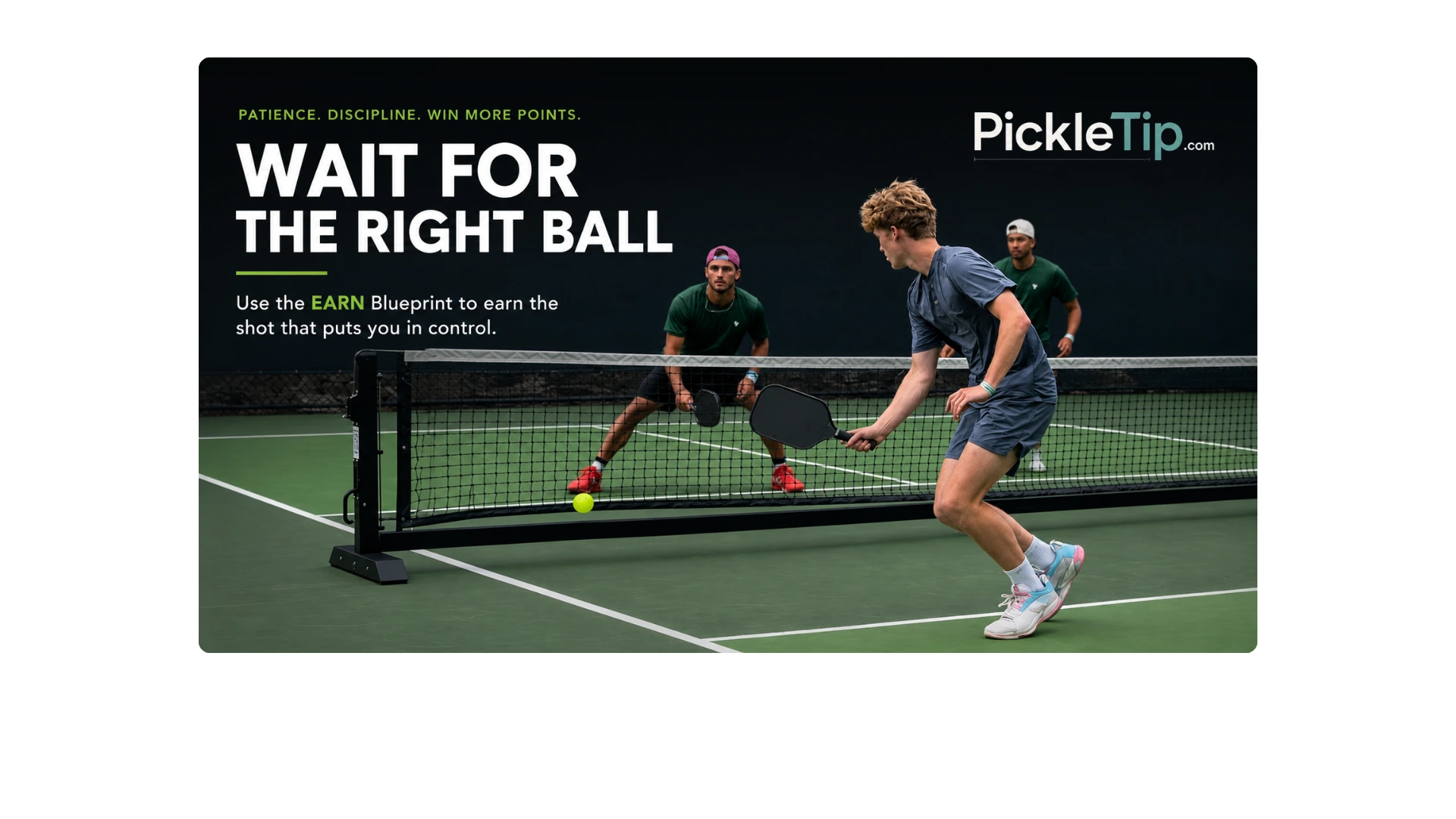
That is why I use the PickleTip EARN test. Before accelerating, decide whether the ball has actually EARNed offense.
| Letter | Question |
|---|---|
| E | Elevation: Is the ball high enough for a controlled attack? |
| A | Alignment: Is your body organized behind the ball? |
| R | Recovery: Can your team handle the next ball if it comes back? |
| N | Net and opponent position: Does the court picture reward acceleration? |
What Usually Fools Players
A ball can be slow without being attackable. Slow gives you time. It does not automatically give you balance, clean spacing, a vulnerable opponent, or a safe recovery.
EARN is not a four-step checklist you should slowly recite while the ball is moving. Use it in practice until the four reads begin showing up as one court picture.
E — Elevation
Height matters because attacking from below the net usually requires lifting the ball before you can drive it forward. That reduces margin and gives the opponent more time to see the attack.
- Is contact above or below net height?
- Is the ball rising, sitting, or dropping?
- Can you drive through it instead of pulling it upward?
- Can the attack clear the net with useful margin?
A low ball can still be attacked in specific situations, but the risk climbs quickly. Elevation is only the first part of the picture.
A — Alignment: Are You Organized Behind the Ball?
A high ball from poor balance may be worse than a moderately high ball contacted from a stable base. Players often see the height and ignore that their feet and spacing are already telling them no.
- Are the feet balanced?
- Is the head stable?
- Is contact in front?
- Is there enough space between the ball and the body?
- Are you reaching desperately?
- Are you falling backward or drifting sideways?
If you have to reach outside your frame, pull the ball back across your body, or attack while falling away from the kitchen, use the contact to recover instead of trying to finish from a compromised base.
R — Recovery: What Happens If It Comes Back?
Being able to speed up the current ball is not enough.
Can our team survive the next ball if the attack comes back?
- Will the swing leave the paddle ready?
- Is your partner prepared for the counter?
- Who is most likely to receive the next ball?
- Does the attack leave the middle protected?
- Are you moving into the shot or falling away from position?
- Can you handle the opponent’s next ball?
Your speed-up belongs to both partners. If your swing leaves the paddle by your hip and your partner defending the middle alone, the attack was not recoverable just because the first ball landed.
A speed-up is not finished when it crosses the net. Get the paddle back in front and be ready for the counter.
N — Net and Opponent: Does the Court Reward Pace?
A balanced opponent with a compact paddle may be begging you to supply the pace. Against that player, an impatient speed-up can become their easiest counter.
The first opening is often not the ball you attack. It is the ball that makes the opponent reach, move, or recover late enough for the next one.
- An opponent leaning or reaching.
- A low or displaced paddle.
- A player still moving.
- An open middle.
- Disconnected partners.
- A weak recovery position.
- An opponent contacting the previous ball outside the body.
Reading those cues belongs to pickleball anticipation. Here, those reads tell you whether adding pace helps your team or simply gives a ready opponent exactly what they wanted.
The EARN Test in One Rally
A dink floats a little higher than the previous ball. It looks tempting, but you are reaching outside your body, your partner is still recovering toward the kitchen, and the opponent in front of you is balanced with the paddle already loaded.
Elevation says maybe. Alignment, recovery, and opponent position say no.
Move the ball, regain your space, and see whether the next contact gives you the whole picture. Height alone did not earn that attack.
Classify the Ball Before Choosing the Shot
Players get into trouble when they treat every ball as either defensive or attackable. There is a lot of useful pickleball between those two choices.
| Ball quality | What it looks like | Best general response |
|---|---|---|
| Defensive | You are stretched, late, jammed, or off balance | Reset, block, or buy time |
| Neutral | Neither team has a clear advantage | Protect margin and improve position |
| Pressurable | You can move or stress the opponent without forcing a finish | Change depth, direction, spacing, or contact quality |
| Attackable | The ball and court picture support controlled acceleration | Attack with a swing you can recover from |
Do not jump directly from defensive to offensive because you are tired of defending. A pressurable ball may not be ready to finish, but it can help create the ball that is.
Why Good Players Still Speed Up Bad Balls
Many forced attacks are not caused by the ball. They come from discomfort with what the rally feels like.
- The dink exchange feels too long.
- The player dislikes neutral play.
- They fear the opponents will attack first.
- They are behind in the score.
- They just passed on a better opportunity.
- They want to overpower a specific opponent.
- They mistake a slow ball for an attackable ball.
- They notice height but ignore balance and recovery.
- They become bored with point construction.
- They are still reacting emotionally to the previous point.
In lessons, the mistake usually changes as players improve. Newer players often treat any slow ball as attackable. More experienced players may recognize the height but ignore their feet or recovery. Stronger players usually see more of the court, but score pressure, matchup frustration, or the memory of a missed opening can still lower their standard.
When rushing follows an error or emotional reaction, use the PACE mental-game process to keep one point from changing the standard for the next shot.
Where Impatience Costs the Most Points
| Situation | Impatient mistake | Patient decision |
|---|---|---|
| Third shot | Trying to hit a clean winner from poor balance | Use a drop or controlled drive to improve the fifth ball |
| Transition zone | Attacking while stretched, moving backward, or between steps | Reset, stop before contact, and regain a stable base |
| Dink exchange | Speeding up because the rally feels long | Move the opponent or change the contact before adding pace |
| Hands exchange | Taking a large swing because the ball feels attackable | Prepare early and choose a compact counter, block, or leave |
| Score pressure | Forcing the first available ball or refusing every attack | Let the consequence sharpen focus without changing ball quality |
One third shot may only improve the fifth. One transition reset may only earn a more balanced contact. One dink may only pull an opponent a step wider. Those are not wasted balls when they improve what happens next.
Use the third-shot drop guide and third-shot drive guide for third-shot execution. For transition mechanics, use the Transition Zone Guide. For complete kitchen mechanics, use the pickleball dinking guide.
The score can change the consequence of the shot. It should not change whether the ball was actually attackable.
Build Pressure Instead of Waiting for a Popup
Patience does not mean sending the same harmless dink forever and hoping the opponents eventually miss. Each ball should improve the picture a little.
- Stabilize the rally when your team is in trouble.
- Regain balance and court position.
- Move an opponent away from comfortable contact.
- Create a reach, low paddle, late recovery, or open space.
- Attack when the ball and court picture support it.
- Expect the counter and recover immediately.
You do not have to win the rally with the first ball that looks tempting. Make the opponent contact outside the body. Change the depth. Pull a player off balance. Get your team established at the kitchen. Then be ready when the real opening arrives.
When to Stop Being Patient
Passing on a bad attack is discipline. Passing on every attack is fear wearing a patient-player costume.
- The ball is above your normal attack standard.
- Your feet and head are stable.
- Contact is in front with useful spacing.
- The opponent is exposed, reaching, or still moving.
- Your partner recognizes the opening.
- You can recover the paddle and protect the next ball.
- The attack fits the pattern your team has created.
A player who repeatedly refuses those balls is not being patient. They are surrendering opportunities they worked to create.
Patience should lead to a better attack. It should not remove attacking from your game.
Drills That Train Patient Decisions
EARN Callout Drill
During cooperative dinking or transition practice, call each ball defensive, neutral, pressurable, or attackable before choosing the response. After an attack, briefly identify which part of EARN supported the decision.
Best for: Players who attack first and explain the decision afterward.
What I watch for: Whether the player is only checking height or is also seeing balance, recovery, and opponent position.
Three-Neutral-Ball Constraint
During kitchen games, require three neutral contacts before either team may attack. Three is not a magic number. The restriction forces players to stay comfortable, create movement, and stop treating the first slow ball as permission to speed up.
Progression: Remove the restriction after several rounds. The decision should remain even when the rule disappears.
Attack-and-Recover Drill
The attacker only earns the point when the attack lands, the paddle returns to ready position, and the player handles the next counter. A clean speed-up followed by a late paddle does not score.
The mistake to catch: Oversized swings, players admiring the attack, and partners who were not ready for the counter.
Bad-Ball Permission Game
Award a point when a player refuses a tempting but poor attack and chooses a useful alternative instead. Players need to feel that passing on a bad speed-up was the right play, not something they failed to do.
What I watch for: Whether the replacement ball actually improves the rally. A harmless dink into the opponent’s strike zone should not earn the same credit as a ball that creates pressure or recovers position.
Long-Rally Pressure Game
Start at 8–8 and require a set number of kitchen contacts before an attack is allowed. Then remove the restriction and observe whether score pressure changes the player’s attack standard.
What I watch for: The first physical sign of rushing—reaching, a larger backswing, drifting contact, or speeding up immediately after passing on a better ball.
For broader practice planning, use the intentional play guide and the pickleball drills library.
Need Help Executing the Shot? Start Here
| Question | Best next guide |
|---|---|
| How do I execute the dink? | Pickleball dinking |
| How do I execute the reset? | Reset mechanics |
| How do I choose between a third-shot drop and drive? | Third-shot drop and third-shot drive |
| How do I read the opponent? | Pickleball anticipation |
| How do I manage rushing after a mistake? | PACE mental-game process |
| How do I build a practice session around this? | Intentional play |
Patience in Pickleball FAQs
Patience in pickleball means keeping the same attack standard even when a rally starts feeling long. Until the opening is real, use the ball to improve your balance, court position, or the opponent’s next contact.
Classify the ball before choosing the shot. Decide whether it is defensive, neutral, pressurable, or attackable, then choose a response that matches the contact instead of attacking because the rally feels long.
Patient play remains purposeful. It may recover position, move an opponent, protect margin, or create a weaker next ball. Passive play returns the ball without improving the rally or preparing an attack.
Use the PickleTip EARN test. Check the ball’s elevation, your body alignment, your team’s ability to recover, and the net and opponent position before accelerating.
Yes. Patience should create a better attack, not eliminate attacking. Repeatedly passing on balanced, recoverable opportunities becomes passive play and surrenders pressure your team worked to create.
Let the Ball Earn the Attack
Patience does not mean waiting for the opponents to miss. It means refusing to force offense before the contact, your body, and the position of all four players support it.
You do not have to win the rally with the first ball that looks tempting. Get balanced. Make the opponents hit from a worse position. Then attack when the opening is real and prepare for the ball that comes back.
The rally does not owe you an attack. Build the point until the ball earns one.