Pickleball Rules for Beginners: Basic Rules, Scoring, Two Bounce Rule
If you’ve ever thought, “Wait… do I lose a point, lose a serve, or replay it?”, you’re in the right place. This is a single, pickleball rules guide built to get you playing clean games fast, reduce arguments, and make the “weird” parts (scoring, the two-bounce rule, the no-volley zone) feel normal.
Basic pickleball rules in 90 seconds (fast version)
- Serve from behind the baseline diagonally into the opposite service box (one attempt in most standard play).
- The serve must clear the net and land beyond the no-volley zone (the no-volley zone line is out on the serve).
- Two-bounce rule: the serve must bounce, and the return of serve must bounce (then you can volley or play off a bounce).
- No-volley zone rule: you can’t volley while touching the no-volley zone or its line, and momentum carries too.
- Only the serving team scores in traditional (side-out) scoring.
- Most games are to 11, win by 2 (some formats use 15 or 21, still win by 2).
- Doubles score call is three numbers: your score, their score, server number (1 or 2).
- Most rallies end the same way: ball out, into the net, a double bounce, or a no-volley zone volley.
Coach note: If you learn just that box first, you’ll play clean games faster than 80% of “I’ve played a few times” people.
Who this helps
- Brand-new players who want the basic pickleball rules in plain English.
- Tennis converts who keep tripping over side-out scoring and the no-volley zone.
- Rec groups that want fewer “rule debates” and smoother games.
- Experienced players who want a clean refresher and a quick answer for common edge cases.
Quick Navigation
What pickleball is
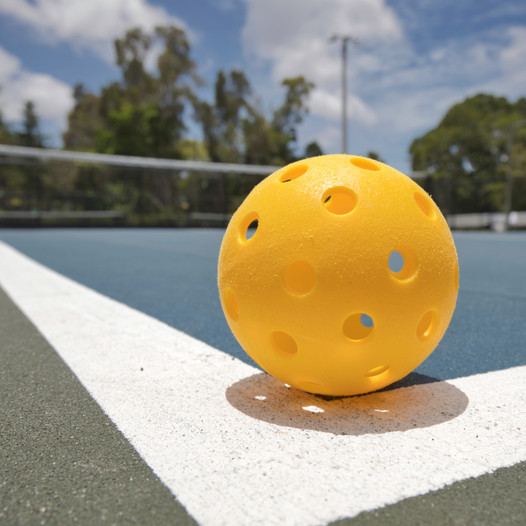
Pickleball is a paddle sport played on a smaller court with a perforated plastic ball. It blends quick reactions at the net with patient placement and a few rules that keep the game from turning into pure “power wins.” Now let’s get into the rules you actually need to play.
Court basics: lines, zones, and what they mean
Know these lines first
- Baseline: the back line you must stay behind when you serve.
- Sidelines: the long outside lines that define in/out on each side.
- Centerline: splits each side into left and right service areas.
- Service areas: the two boxes where serves must land (diagonally).
- No-volley zone: the 7-foot zone near the net on both sides. Most players call it “the kitchen.”
Coach note: If you’re brand new, physically walk the baseline and the no-volley zone line once. Your feet learn faster than your brain.
In vs out: the simplest rule
In rally play, a ball that touches any part of a line is in. The one big exception beginners should remember: on the serve, the ball cannot land in the no-volley zone, and the no-volley zone line is treated as out for the serve.
Scoring basics: singles, doubles, and how to win
How you score points
In traditional (side-out) scoring, only the serving team can score. If the receiving team wins the rally, they don’t get a point, they earn the serve. That change of serve is a side out.
How to win a game
- Most games are played to 11, win by 2.
- You may also see games to 15 or 21, still win by 2.
Doubles scoring: the system (three numbers)
In doubles, you call three numbers: your score – their score – server number (1 or 2). Example: “5–3–2” means your team has 5, opponents have 3, and your team’s second server is serving.
Doubles serving: why there are two servers (and why the first one feels odd)
Each team typically gets two servers per service turn (one per player). After the first server faults, the serve goes to their partner. After the second server faults, it’s a side out and the other team serves.
At the very start of a doubles game the opening team starts with one server only (you’ll often hear “0–0–2”). The goal is simple: don’t give the starting team a bigger advantage just because they served first.
Singles scoring: cleaner and faster
Singles uses two numbers (your score, their score). The serving position is simple: even score serves from the right, odd score serves from the left.
Lost in the middle of a game?
Don’t guess. Stop, confirm who served last, confirm which side the server should be on, then call the score clearly. Ten seconds of reset beats five minutes of “No, I’m pretty sure…”
Switching sides
In matches with multiple games, players switch ends between games. In a deciding game, many formats also switch ends at the midpoint. The purpose is simple: reduce any advantage from conditions like sun or court quirks. (If your rec group handles this differently, agree before you start.)
Common terms you’ll hear in every game
- Rally: everything that happens after the serve until the point ends.
- Side out: the serve switches to the other team (usually after the second server faults in doubles).
- Volley: hitting the ball out of the air (before it bounces).
- No-volley zone: the 7-foot zone near the net where volleys are restricted (often called “the kitchen”).
- Service box: the diagonal box your serve must land in.
- Baseline: the line you serve behind and the back boundary line during rallies.
- Dink: a soft shot that lands in the no-volley zone, usually used to force a pop-up instead of a power exchange.
- Fault: a rule violation that ends play (and changes the score/serve depending on who was serving).
Serve basics: how a rally starts
The serve in pickleball is meant to start the rally, not end it. Here’s what you need for basic play:
- Serve from behind the baseline.
- Serve diagonally into the opposite service area.
- The serve must clear the net and land beyond the no-volley zone (including its line).
- In most standard play, you get one serve attempt.
Want the full serving legality checklist (mechanics, foot faults, what’s legal vs not)? That deep dive lives here: serving legality checklist.
The two-bounce rule (double bounce) explained
The rule in plain English
- The return team must let the serve bounce before hitting it.
- The serving team must let the return of serve bounce before hitting it.
After those two required bounces (one per side), either team may hit the ball in the air (volley) or after a bounce. If you volley too early, it’s a fault.
Why it exists (the fast version)
The two-bounce rule slows the opening sequence just enough to keep the game fair. Without it, stronger athletes could rush the net immediately and end points before most players even settle into position.
Volleys + the no-volley zone rule (what’s legal, what’s not)
The no-volley zone is the 7-foot area near the net. Most players call it “the kitchen.” If you want the story and meaning behind the nickname, read: why it’s called the kitchen.
The core volley rule
- You cannot hit a volley (ball out of the air) while any part of you is touching the no-volley zone or its line.
- You can step into the zone and hit a ball that bounced first.
- Momentum counts: if you volley while outside the zone but your momentum carries you into the zone afterward, it’s still a fault.
Three common mistakes that cause arguments
- Toe on the line: even a toe on the line during a volley is a violation.
- Falling in after contact: the volley looked clean, but your body drifted into the zone.
- Jumping from inside: if you take off from inside the zone and volley before landing, it still counts as a violation.
Coach note: A “perfect” volley with a foot on the line is just a pretty fault. Clean feet win more points than clean smashes.
Faults: the most common ways rallies end
A fault is any rule violation that stops play. In side-out scoring, faults don’t always mean a point, they often mean loss of serve or side out. Here are the faults you’ll see constantly, written the way players experience them:
- Ball out: the ball lands outside the lines (or you hit it out on the fly).
- Net: the ball hits the net and doesn’t cross (or crosses but doesn’t land legally on a serve).
- Serve lands in the wrong place: wrong service box, into the no-volley zone, or on the no-volley zone line.
- Two-bounce violation: you volley the return of serve or you volley the third shot.
- Double bounce: the ball bounces twice on your side before you return it.
- No-volley zone volley violation: you volley while touching the no-volley zone/line, or your momentum carries you in.
- Touching the net: your body, paddle, or clothing contacts the net while the ball is live.
- Ball hits a player: the ball hits your body above the wrist or clothing before bouncing (that ends the rally).
Coach note: Most beginner “rules problems” are really two things: the two-bounce rule and feet drifting into the line on volleys.
Line calls: how to keep it fair (and moving)
Line calls are where rec games either stay smooth or turn sour. Keep it simple:
- Ball touching a line is in (during rallies).
- Call lines on your side of the court.
- If you’re not sure, it’s in. The benefit goes to your opponent.
- Make the call immediately so the rally doesn’t continue into chaos.
This isn’t about being “nice.” It’s about making sure nobody wins a point off a guess.
Lets, replays, and interference (high level)
In rec play, you’ll occasionally need a quick reset. Don’t over-lawyer it, just be consistent.
- Equipment or ball from another court enters your court during a rally: stop and replay the point.
- Player safety issue (someone steps in, a hazard appears): stop immediately and replay.
- Distraction and hindrance situations (noise, movement, intentional “stuff”): real topic, and also where arguments start.
If you want the clean breakdown of those gray areas, read: distraction and hindrance gray areas.
Most common beginner mistakes (and the quick fix)
- Forgetting the two-bounce rule: say “bounce-bounce-play” in your head for the first few rallies.
- Calling the score quietly: say it clearly before every serve so everyone agrees.
- Serving from the wrong side: remember: even score from the right, odd from the left.
- Volleying while drifting forward: hit the volley, then freeze your feet, don’t tumble into the line.
- Assuming every close ball is out: if you can’t call it out confidently, it’s in.
- Turning every rule into a debate: agree on replay norms before the game starts and keep the vibe steady.
Why these rules exist: fewer arguments, more fair play
A lot of “rules frustration” disappears when you understand the point of the rules: they’re not there to be picky. They’re there to keep pickleball from being dominated by one advantage (power, height, a monster serve, or gamesmanship) and to keep rec play from turning into a courtroom.
Why the opening serve sequence feels weird in doubles
Doubles often starts with one side effectively getting a single server to begin (you’ll hear it called as “0–0–2”). The purpose is fairness: it prevents the opening team from getting two full servers before the other team ever serves.
Why the two-bounce rule matters (beyond “because the rulebook says so”)
It forces both teams to play at least one controlled shot after the serve. That slows down immediate net attacks, gives both sides time to establish position, and reduces the “serve-and-crash” advantage.
Why the no-volley zone exists
Without it, players could camp at the net and end points with point-blank volleys all day. The rule creates a buffer that rewards control, placement, and patience, not just reach and reflex.
Why some “small” rules keep the peace
- Clear faults: stop rallies cleanly so teams don’t benefit after a violation.
- Line rules: consistent “line is in” reduces endless arguing over millimeters.
- Basic readiness norms: calling the score before serving and playing when both teams are set keeps play honest.
- Equipment standards: keeps games from turning into an arms race where gear wins matches.
Coach note: The best rules enforcement isn’t harsh. It’s predictable. When everyone knows what happens next, the temperature drops and the game gets better.
Edge cases & weird rules
You don’t need these on day one, but you’ll hear them sooner than you think. Here are the quick answers, without turning this page into a legal brief.
Can we switch sides with our partner during a rally?
Yes. Once the ball is in play, players can move anywhere on or off the court. Furthermore, there is no rule requiring non-serving players to stay within any specific boundaries even before the rally starts. The only person restricted by positioning is the server, who must have both feet behind the baseline and within the imaginary extensions of the sideline and centerline at the moment of contact. Everyone else, the server’s partner and the receiving team, can legally stand anywhere they choose on their respective side of the net.
Can a shot go “around the post”?
Yes. The ball doesn’t have to travel over the net, it must travel legally and land in the opponent’s court. This is referred to as an ATP.
Can my paddle cross over the net?
Your paddle may cross the plane of the net after contact as part of your follow-through, as long as you don’t touch the net. What you cannot do is strike the ball before it has crossed to your side (with a few rare exceptions when a ball spins back over due to conditions).
What about accidental double hits?
An accidental double hit is legal. According to official rules, if the ball hits the paddle twice during a single, continuous forward stroke, the ball remains in play. However, if the double hit is deliberate or the result of a second distinct swing, it is a fault.
What about wind blowing the ball back over the net?
It happens, and it’s exactly the kind of thing that causes three-minute debates in rec play. If you want the clean explanation and common scenarios, read: wind edge-case rule.
What counts as distraction, hindrance, or interference?
This is a real part of the rules, but it’s also where people get emotional fast. Start here: distraction and hindrance gray areas.
What about “targeting” rules I’ve heard people argue about?
That topic often mixes safety policy with organization-specific rules and local rec culture. If your group is debating it, use this as the dedicated reference: targeting safety policy.
FAQs: basic pickleball rules beginners ask constantly
Serve diagonally from behind the baseline, let the serve bounce and the return bounce (two-bounce rule), don’t volley while touching the no-volley zone line, and remember only the serving team scores in standard side-out scoring. That’s enough to play real games without constant stops.
Start with five: (1) serve behind the baseline diagonally, (2) both teams must let the first two shots bounce, (3) don’t volley while touching the no-volley zone line, (4) only the server scores in standard play, (5) games are commonly to 11, win by 2.
A clean top 10: (1) serve behind the baseline, (2) serve diagonally, (3) serve must land beyond the no-volley zone, (4) one serve attempt in standard play, (5) two-bounce rule, (6) volleys allowed after the two bounces, (7) no-volley zone volley + momentum rule, (8) line is in during rallies (except the serve/no-volley-zone line), (9) only the serving team scores in side-out play, (10) games are typically to 11 win by 2.
Five common “no’s” that cause most faults: (1) volley while touching the no-volley zone or its line, (2) volley the serve, (3) volley the return of serve, (4) touch the net while the ball is live, (5) hit the ball out of bounds.
Two-bounce rule, no-volley zone volley + momentum rule, “line is in” (during rallies), only the serving team scores (in standard play), and clear score calling before every serve.
Make the call you’d want made against you, especially on close lines. If you’re not sure, it’s in. That one habit keeps games fair and keeps people coming back.
During rallies, yes, any part of the ball touching the line is in. On the serve, the no-volley zone line is treated as out for that serve.
No. You can start with “behind the baseline, diagonal, clear the no-volley zone.” When you’re ready to tighten up legality (motion, contact rules, foot faults), use the dedicated hub: serving legality checklist.
Same game, same rule set, just common typos people search. If you’re here for the rules for pickleball, you’re in the right place.
Agree on the basics before you start: game to 11 win by 2, side-out scoring, replay norms for interference, and how you’ll handle uncertain line calls. Consistency beats perfection in rec play.
Next step: turn rules into wins
Now that you know the basic pickleball rules, the next jump isn’t memorizing more rules, it’s fixing the habits that quietly bleed points in beginner games.
Pickleball Tips for Beginners: Think power wins games? Think again. These no-fluff tips fix the 3 habits sabotaging your success, so you can win smarter.
Coach note: Rules keep you from losing points the dumb way. The right habits help you start taking them.