
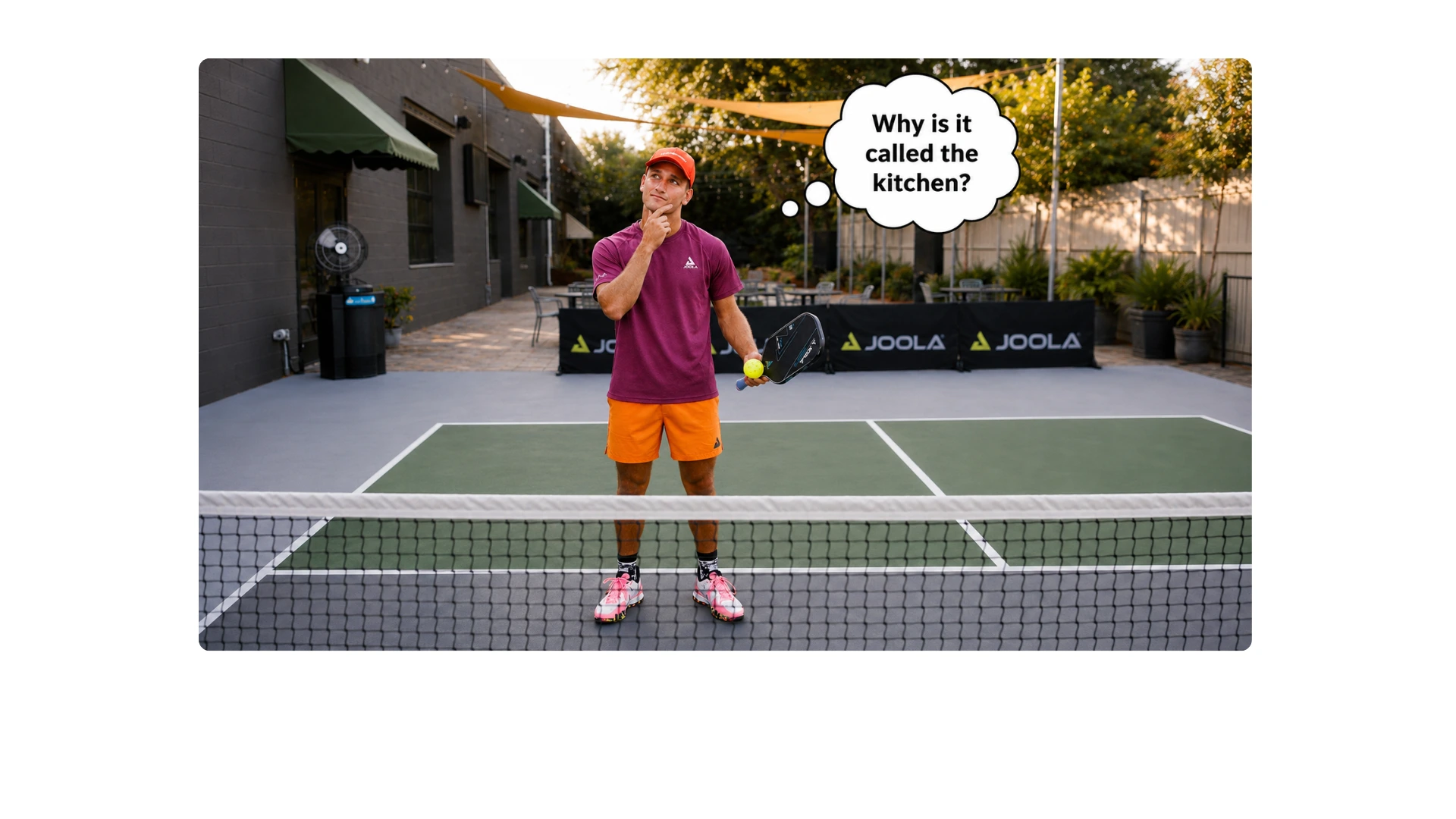
Why Is It Called the Kitchen in Pickleball?
The first time somebody barked, “Stay out of the kitchen!” I looked around like I’d missed a snack table. I learned pretty quickly that nobody was talking about lunch. “The kitchen” is pickleball’s nickname for the Non-Volley Zone, or NVZ, the 7-foot area on each side of the net.
But why call it a kitchen?
The frustrating answer is that nobody seems to have documented the moment the nickname was born. The most widely repeated explanation connects it to shuffleboard, which also uses “kitchen” for its 10-off area. That theory makes sense, but I would not present it as proven pickleball history.
The Short Answer
Why is it called the kitchen in pickleball? Nobody knows for certain. The leading theory is that pickleball borrowed “kitchen” from shuffleboard, where the term is used for the 10-off area that costs a player points. What we can say confidently is that “kitchen” became the sport’s enduring nickname for the official Non-Volley Zone.
What Does “Kitchen” Mean in Pickleball?
In pickleball, the kitchen means the Non-Volley Zone. The NVZ extends 7 feet from the net on each side of the court and runs from sideline to sideline.
“Kitchen” is the conversational name players use. Non-Volley Zone is the rules term. USA Pickleball also describes the NVZ as commonly known as the kitchen.
If you need to know exactly when you can enter, volley, touch the line, re-establish your feet, or how momentum creates a fault, use our complete pickleball kitchen rules guide. If the rules are what brought you here, that guide has them. The stranger question is how this little patch of court wound up being called a kitchen in the first place.
So Where Did the Name “Kitchen” Come From?
We do not have a definitive historical record identifying who first called pickleball’s Non-Volley Zone “the kitchen.”
Pickleball history gets messy fast. Repeat a good story long enough and pretty soon everybody remembers it as fact.
The beginning of the sport itself has a much cleaner paper trail. Joel Pritchard, Bill Bell, and Barney McCallum developed pickleball on Bainbridge Island, Washington, beginning in 1965. You can dig deeper into that story in our history of pickleball. The word kitchen does not come with the same documentation.
What we know: “Kitchen” became the common nickname for the NVZ.
What we do not know: who coined it, exactly when it entered pickleball, or whether somebody intentionally borrowed it from another game.
The Shuffleboard Theory
The most common explanation is that pickleball borrowed “the kitchen” from shuffleboard.
In outdoor shuffleboard, the scoring diagram includes a 10-off area. A disc that finishes there costs the player points, and shuffleboard organizations also refer to that minus-10 area as the kitchen.
| Shuffleboard Kitchen | Pickleball Kitchen |
|---|---|
| A negative-scoring area | An area with a special volley restriction |
| Mistakes there can cost points | Illegal volleys there create faults |
| The name marks a troublesome part of the court | The name warns new players that special rules apply |
The parallel is easy to see, especially for a homemade game that borrowed ideas and equipment from other paddle and racquet sports.
But believable is not the same as proven.
Shuffleboard gives us a believable source for the word. What it does not give us is the missing handoff, the person, date, or document showing exactly when “kitchen” moved from shuffleboard into pickleball.
Did Pickleball’s Founders Call It the Kitchen?
Pritchard, Bell, and McCallum are firmly tied to pickleball’s creation in 1965. What I have not found is that same clean paper trail for the term kitchen. So I would be careful with any story that credits one founder with inventing the nickname or says the founders deliberately borrowed it from shuffleboard.
Possible? Absolutely. Documented? That is the part still missing.
Did “Can’t Stand the Heat” Give Pickleball Its Kitchen?
You will also hear players connect the nickname to the old expression:
“If you can’t stand the heat, get out of the kitchen.”
It certainly feels right. Players crowd the kitchen line, hand battles get fast, and one bad movement can cost a rally. The phrase fits the modern experience near the NVZ almost perfectly.
What I would not do is reverse-engineer that perfect fit into history. I have not found evidence showing that the saying actually gave pickleball’s NVZ its nickname.
Why Did the Kitchen Nickname Stick?
Whatever its origin, “kitchen” had one big advantage: players remembered it.
Tell a brand-new player to remember the “Non-Volley Zone,” and you have given them a rulebook term. Tell them, “Don’t get caught volleying in the kitchen,” and they usually remember the word before they remember what NVZ stands for.
Coach Sid Note
The funny part is that the nickname may actually create one of the game’s biggest beginner misconceptions. Players hear “stay out of the kitchen” and start treating the paint like forbidden territory. It isn’t.
I know how sticky that phrase can be because on my third day playing pickleball, “stay out of the kitchen” was still one of the rules I was consciously trying to remember while I sorted out everything else happening on court. I had learned the warning before I really understood the rule underneath it.
Years later, I teach it more precisely: you can step into the kitchen for a ball that has bounced. The problem starts when you volley while touching the NVZ, or fail to get both feet re-established outside before the next volley.
That is why I teach players both terms:
- Kitchen so you understand what everybody on the court is saying.
- Non-Volley Zone so the purpose of the rule is built into the name.
“Kitchen” is easier to remember. “Non-Volley Zone” is easier to understand.
Why the Non-Volley Zone Exists
The nickname also fits the job that part of the court does: it keeps players from camping on top of the net and smashing every available ball out of the air.
USA Pickleball describes the volley restriction as preventing players from executing smashes while positioned inside the zone. That limitation is one of the things that makes pickleball look and play differently from tennis at the net.
The part beginners sometimes miss is that the restriction is about volleying, not simply entering the painted area. For the full rule (including momentum, line contact, partner contact, serves, and re-establishing your feet) go to Pickleball Kitchen Rules: What You Can and Can’t Do in the NVZ.
Kitchen Origin: What We Know vs. What We Think
| Claim | Confidence |
|---|---|
| “Kitchen” means the Non-Volley Zone. | Established |
| The NVZ extends 7 feet from the net on each side. | Established |
| Joel Pritchard, Bill Bell, and Barney McCallum created pickleball beginning in 1965. | Established |
| Shuffleboard also uses “kitchen” for its 10-off area. | Established |
| Pickleball borrowed the kitchen nickname from shuffleboard. | Plausible and widely repeated, but not definitively documented |
| One of pickleball’s founders personally coined the term. | Unverified |
| The phrase “If you can’t stand the heat…” created the nickname. | Popular explanation, but unverified |
That table is really the answer I wish more origin stories gave you. Some pieces of pickleball history are documented. Others are stories that make sense and have been repeated for years. Those are not automatically the same thing.
What the Sources Actually Support
I can document the 1965 Bainbridge Island origin of pickleball, the official Non-Volley Zone rules and USA Pickleball’s use of “kitchen”, and the shuffleboard use of “kitchen” for the minus-10 area. What I cannot document is the missing link: a contemporaneous source showing who first carried that nickname into pickleball, or exactly when it happened.
The Answer I Give Players
If somebody asks me at the courts, I answer it this way:
Nobody has proved exactly where pickleball’s “kitchen” nickname came from. The leading theory is that it was borrowed from shuffleboard, which also uses “kitchen” for its 10-off negative-scoring area. In pickleball, the name stuck as the informal term for the Non-Volley Zone.
That answer is a little less satisfying than a perfect founder story.
It is also more accurate.
Questions About the Pickleball Kitchen Name
Nobody knows for certain. The leading theory is that pickleball borrowed the nickname from shuffleboard, which also uses kitchen for its 10-off negative-scoring area. The connection is plausible and widely repeated, but the original pickleball naming event is not well documented.
Possibly. Shuffleboard also uses kitchen for its 10-off area, which makes the connection believable. What is missing is a definitive historical record showing who transferred the nickname to pickleball or when that happened.
The rules term is Non-Volley Zone, usually abbreviated NVZ. Kitchen is the widely used nickname for that 7-foot area on each side of the net, and USA Pickleball also uses the nickname in player-facing rules explanations.
There is no well-documented historical record identifying one person who first called the Non-Volley Zone the kitchen. Claims assigning the nickname to a specific founder should be treated cautiously unless stronger primary evidence emerges.
It is a popular explanation and it fits the pressure of modern play near the net, but there is no strong historical evidence showing that the phrase created pickleball’s kitchen nickname.
If the history brought you here but the rule is what you really need, go straight to Pickleball Kitchen Rules: What You Can and Can’t Do in the NVZ.