
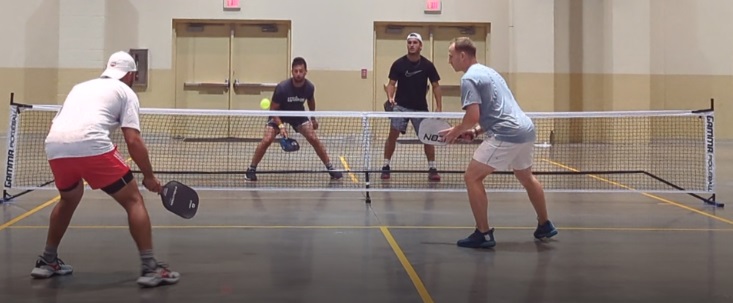
Pickleball Transition Zone: Stop Pop-Ups, Earn the Kitchen
Mid-court is where good points go to die. Not because you’re “too slow,” but because you’re walking when you should be hitting. Win the in-between and you stop donating pop-ups.
Picture this: you hit a decent third shot. You take two steps in. The next ball comes back heavy to your feet… and suddenly you’re swinging from your shoelaces like you’re chopping wood. Pop-up. Speed-up. Handshake.
Here’s the tell: if your shoes squeak during contact, you’re still traveling when the paddle meets the ball. This strip doesn’t punish effort. It punishes sloppy timing.
Pro Tip: Stop at contact. Reset low. Step forward only on balls you can keep below net height.
I learned the hard way. As a newer player, I charged the net with reckless abandon. I thought speed was everything, the faster I approached the kitchen line, the better. How wrong I was. The in-between doesn’t reward hustle. It rewards decisions.
What the Pickleball Transition Zone Is (And Why It Punishes Lazy Footwork)
Coach’s rule: when you’re between baseline and kitchen, timing matters more than swing speed.
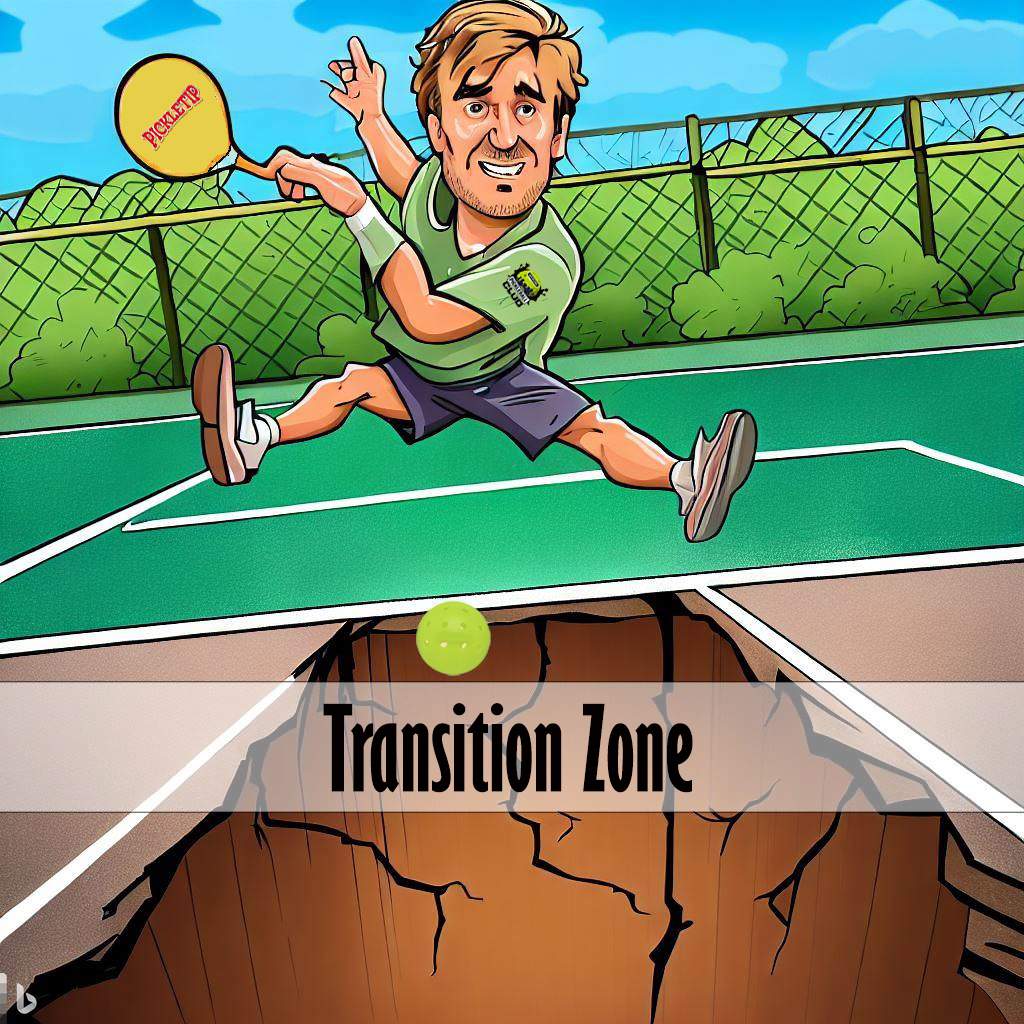
The pickleball transition zone is the space between the non-volley zone line and the baseline. Most points get messy right around the service line, where the ball is still rising, your time disappears, and your feet want to drift.
Quick clarity: “transition” here doesn’t mean right-to-left. It means moving from the baseline toward the kitchen through mid-court without getting trapped.
At the baseline you have time. At the kitchen you have angles and leverage. In the in-between, your margin evaporates unless you can slow the rally down with resets and earn your steps forward.
PickleTip insight: “no man’s land” isn’t a location problem. It’s a contact-timing problem. You’re swinging while your body is still traveling.
Common Transition Zone Mistakes: The Four Donations
- Over-swinging: big backswings turn routine balls into floaters.
- Moving through contact: feet still traveling forward when the paddle meets the ball.
- False confidence after a good drop: “perfect third” → sprint → get tagged at the ankles.
- Trying to “win” the mid-court ball: forcing offense instead of neutralizing pressure.
Self-correction: If you’re consistently popping balls up, it’s almost never bad luck, check your feet. If you’re drifting forward at contact instead of planting, your paddle face opens and you donate the point.
Transition Zone Footwork: Plant → Hit → Move (The Stability Rule)
When the ball is rising into you → stability beats speed. In the in-between, the ball arrives fast and climbs into your body. If your feet are still drifting forward at contact, your paddle face opens and you gift a pop-up.
Use a simple cadence: plant → hit → move. That “plant” can be a split step, a mini hop, or just a hard stop. Freeze your body at contact. Then move. In that order.
Timing cue that fixes a lot: split step as your opponent makes contact, not when you “feel ready.” If you split late, you lunge. If you split on time, you stay balanced.
And don’t cross your feet as a “plan” when the ball is coming fast. Cross-steps belong in travel… not in emergency defense.
Mid-Court Reset Technique: Absorb Pace and Keep It Unattackable
When pace hits your feet → your only job is to make them hit up. A reset isn’t a winner. It’s a pace-absorbing neutralizer that steals you time to earn the kitchen.
You’ll feel this most when a drive lands between your foot and knee, your “red zone.” Pace and topspin want to pry your paddle open and launch the ball. Your job is the opposite: soften, guide, and keep it low enough that nobody can finish you.
The Reset Recipe:
- Grip: 3–4 out of 10. Tight hands create trampoline rebounds.
- Paddle face: slightly open, out in front, like you’re “catching” the ball.
- Swing size: tiny. Let the ball supply the power.
- Path: quiet and short. If your paddle “chases” the ball, you’ll lift it.
- Finish: calm. If your follow-through is loud, your reset wasn’t.
Target window rule: don’t aim your reset “over the net.” Aim it to a window: near the NVZ line or at the opponent’s shoelaces. If your ball lands mid-court, you didn’t reset, you served them dessert.
Two reset types you must know:
- Block reset (volley): when it’s about to jam you, “catch” it out of the air. Stop the paddle at contact and let pace die.
- Lift reset (off the bounce): when you can let it drop, open the face and add just enough lift to clear the net, then bring it down with placement.
Common reset fails I see nonstop:
- backing up while resetting
- swinging bigger when you feel rushed
- aiming too high “for safety”
All three create the same result: a floaty sitter that gets smoked.
When the in-between ball finally turns into a real “go” moment, use when to attack in pickleball so you’re attacking on facts, not feelings.
Red Light, Green Light Transition Drill: Stop Through Contact Under Pressure
When your feet want to keep walking → the drill forces a full stop. One player feeds while the other advances. The feeder calls “red” at random moments (or flashes the paddle up). On red, the moving player must stop, plant, and make clean contact before taking another step.
Scoring standard: the rep only counts if (1) your feet are stopped at contact, (2) the ball lands at the NVZ line or feet, and (3) you and your partner stay level. Pop-up = minus one. Drifting at contact = redo.
- Make it real: 3 rounds of 2 minutes. Switch roles.
- Progression: start cooperative, then add pace. If you can’t stay stopped at contact, you’re not ready for “game speed.”
Compact Strokes in the Transition Zone: Small Shapes Beat Big Swings
When the ball is rising → you shrink the swing. The in-between punishes artwork. Big loops, extra wrist, and “creative” spin are how you turn a playable ball into a highlight reel, for the other team.
Keep preparation compact, contact out front, elbows closer to your ribs, and make the stroke feel like a block, not a full swing. Let your legs do the lifting.
Quick test: if your paddle finishes above your chest or wraps behind your shoulder, you added lift. Lift is how “safe” turns into “smoked.”
If you want a deeper breakdown of what “ready” really means, start with paddle position in pickleball so your hands are early instead of apologetic.
No Man’s Land Trap: When Moving Forward Gets You Killed
When you’re walking forward on a ball you can’t hit down → you’re volunteering to get countered. The trap isn’t “being in mid-court.” The trap is drifting forward on the wrong ball while the rally is still rising into you.
The Trap Checklist: you’re in trouble when (1) the ball is arriving above net height, (2) it’s landing at your feet with topspin, (3) your partner isn’t level with you, or (4) you’re moving forward while reaching. That’s not attack time. That’s stabilize-and-survive time.
Coach’s rule: if you can’t hit down, you don’t get to walk forward. Reset, stabilize, and earn the next step.
Doubles Spacing in the Transition Zone: Stay Level or Get Split
When one partner is ahead → the other partner becomes a target. In doubles, stay shoulder-to-shoulder with your partner. If one of you advances, the other advances. If one stops, both stop. Match your partner’s stop more than their speed.
Quick diagnostic: if you can see your partner’s back, you’re staggered. That’s an invitation, split you wide, speed up the gap, end the point.
Get Low and Keep the Paddle Out Front: The Pop-Up Prevention Rule
When the ball rises → you sink. Knees bent, chest slightly forward, head quiet. If your chest rises, your paddle face usually rises too, and that’s how “safe resets” become attackable floaters.
One ugly truth: if you see “sky” under your ball on the way over, you were late and tall. Get lower sooner and keep the paddle out front.
If you keep finding yourself stuck halfway, it’s rarely bad luck. It’s usually your approach timing. Pair this with get to the net and you’ll stop drifting into the danger zone on the wrong balls.
Transition Zone Defense Targets: Go Low Crosscourt to Buy Time
When you’re defending from mid-court → crosscourt and low keeps you alive. Crosscourt buys time because the court is longer and the net is lower in the middle. Low steals their speed-up because they’re forced to hit up.
Bailout goal: don’t “just get it back.” Hit a ball that buys you a step forward.
- Best bailout target: low crosscourt to the NVZ line.
- Second best: straight ahead at their feet if the crosscourt lane is sealed.
Either way: make them hit up… then earn your next step.
Here’s the twist: a “meh” reset from mid-court can survive because you still have space. The same height when you’re parked on the kitchen line turns into a chest-high feed that gets sped up into your face.
Transition Zone Technique Checklist: The 10-Second Fix
- Small steps as you move in (no lunging).
- Plant or split step before contact.
- Head quiet, eyes level (tall posture creates tall resets).
- Paddle up and out front (fast hands, small shapes).
- Loose grip when absorbing pace (3–4 out of 10).
- Contact out in front with compact swings.
- Reset low into a target window (NVZ line or feet).
- Advance only on green lights (balls you can keep below net height).
Transition Zone Drills: Build Control Without Rushing
When drills feel “easy” → your standards are too soft. Most players “do drills” the way they “eat salads”, technically true, functionally useless. In the in-between, the score is simple: did you stop through contact, did your ball stay unattackable, and did you climb together?
Cheat detector: if your feet are still rolling at contact, the rep doesn’t count, even if the ball goes in. Freeze at contact like a screenshot. Then move.
- Slow Motion Cadence – Move in slow motion and exaggerate: plant → hit → move. Do 20 reps each side. Standard: you should be able to freeze your body at contact like a screenshot.
- Shadow Reset Rounds – No ball. Visualize a heavy drive at your feet and rehearse the reset recipe (soft grip, open face, tiny swing). 90 seconds on, 30 seconds off, 3 rounds. Standard: paddle path stays short, no “windshield wiper” bailouts.
- Partner Climb Drill – Trade controlled shots while both of you climb together. Rule: you can only take the next step forward after a ball that stays below net height. Standard: hit 8 out of 10 “unattackable” balls before you speed this up.
- Video Check – Record 5 minutes of transition reps. On review, hunt two errors: moving through contact and opening the face under pressure. If your paddle finishes high or your feet are still traveling at contact, you found the leak.
Turn Strategy Into Action: Survive the Middle, Then Own the Kitchen
When you understand the timing (when to go, when to stop, when to reset), you become harder to speed up and harder to trap. That’s the mission: survive the in-between, then earn the kitchen, without donating a pop-up on the way in.
If you need a quick rules refresher on what you can and can’t do at the kitchen line, lock in pickleball kitchen rules so you don’t win the point and then step in the wrong place.
Now Play One Game With This Rule Set
Next time you play, run this rule set for one full game:
- Stop through contact in the in-between.
- Reset to the window (NVZ line or feet) when the ball rises into you.
- Move as a pair (level feet, level pressure).
- Only go on green lights (below net height, balanced, partner level).
Do that, and you’ll trade frustrating flubs for steadier resets, cleaner approaches, and more confident finishes at the net. Patient feet. Quiet hands. Then pounce.



Do you have any videos for the mid court reset.
I am frustrated with my pickleball skills at this point. However, I am not going to give up. I have read about the transition zone, no man’s land. I have played about a year. Maybe 2.75 to 3.00 skills.
My playing is I do get up to the kitchen; however, get caught when the opponent hits the ball to the mid court or to the baseline and I did not hit the ball in the kitchen. At times, the opponent hits my upper body while I am at non volley area, near the kitchen. Help!
great tips:)