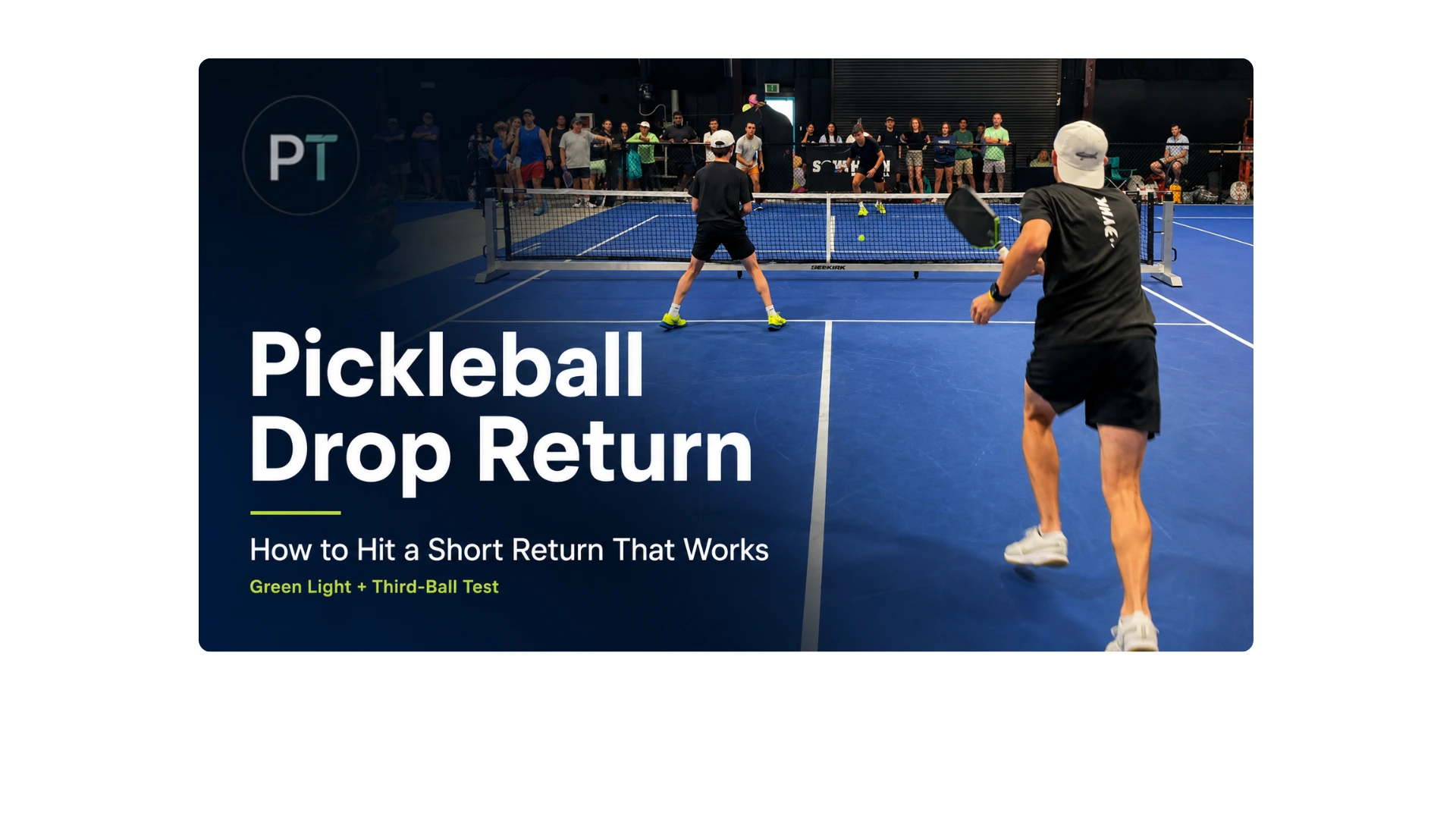
Pickleball Drop Return: How to Hit a Short Return That Works
A drop return is an intentionally short, soft return of serve designed to make the server move forward for the third shot. The challenge is not simply hitting the ball softly. You need enough net clearance to make the return safely, but not so much depth or pace that the ball carries into a comfortable third-shot position.
The easiest way to misunderstand this shot is to think of it as a miniature version of your normal return.
It is not.
A normal return usually tries to buy time and keep the serving team back. A drop return deliberately gives up some of that depth in exchange for a different problem: the server now has to recognize the short ball, move through the transition area, arrive under control, and play the third shot from somewhere they may not have expected.
That tradeoff is why this is a specialty return rather than a default one.
If you are deciding whether bringing a particular opponent forward is a good strategic trade over the course of a match, start with Pickleball Return Strategy. Here, the question is more immediate: Has this particular serve given you a good enough opportunity to hit the short return, and can you execute it without simply giving the server an easy walk to the kitchen?
What Is a Drop Return in Pickleball?
A drop return is a return of serve hit intentionally short enough that the server must move forward to play the third shot.
The word intentionally matters. Sometimes a poor return accidentally dies short and still wins the point. That does not make it a useful drop return. The controlled version is short on purpose, with enough margin that you have a reasonable idea what problem the server will face next.
Do not confuse a lucky short return with a repeatable drop return. One happened because the ball lost depth. The other happened because you controlled the depth. If you cannot explain why the ball landed short or roughly predict what the server will face next, you probably hit a short return by accident rather than a drop return on purpose.
The exact landing spot is less important than the problem you create. The ball should be short enough to make the server cover meaningful forward distance, but controlled enough that you are not handing them a comfortable attacking ball at shoulder height.
The shot may land in the non-volley zone or beyond it. I would not define success by whether the ball lands inside the kitchen. Look at what happens next: Did the server have to accelerate forward? Were they still moving when they contacted the ball? Did they arrive balanced and comfortable, or did the short depth actually make the third shot harder?
A short return is not successful because it lands short. It is successful because the short depth creates the problem you wanted.
A Drop Return Is Not the Same as a Third-Shot Drop
The names are similar, but the jobs are different.
| Shot | Who hits it? | When? | Main purpose |
|---|---|---|---|
| Drop return | Receiving team | Second shot of the rally | Bring the server forward unexpectedly |
| Third-shot drop | Serving team | Usually third shot | Neutralize the return team’s net advantage and earn a path forward |
If you are trying to learn the serving team’s soft third ball, see the pickleball drop shot guide. Here, we are dealing with the receiver intentionally taking depth off the second ball.
The Short-Return Green Light: When the Ball Gives You Permission
Before worrying about touch, target, or disguise, I want to know whether the serve has actually given me a reasonable opportunity to hit the short return.
I use four checks: Serve, Space, Movement, and Readiness.
Short-Return Green Light
- Serve: Can I control the incoming ball, or is it already pushing me backward, jamming me, stretching me wide, or forcing late contact?
- Space: Am I organized around the bounce with enough room to make clean contact?
- Movement: Will short depth make the server cover meaningful ground, stop, reverse direction, or otherwise solve a movement problem?
- Readiness: Am I (and in doubles, is my partner) prepared for the third ball to arrive sooner and from farther inside the court?
You do not need perfect conditions. This is not a four-box test where one imperfect answer automatically kills the shot. But the more of those answers turn against you, the more the drop return becomes something you are forcing instead of a changeup the ball has actually given you.
The short return gets a green light when you can control the serve, control your contact, create useful movement, and live with the third ball it produces.
Once the ball gets the green light, execution comes down to four variables.
Four Things That Control the Short Return
Drop Return Control
- Pace: How much speed does the ball carry after contact?
- Height: How much net clearance are you using?
- Depth: How far into the opponent’s court does the ball travel?
- Direction: Where will the server have to move to reach it?
Players often focus almost entirely on softness. That can create a ball that barely reaches the net or forces them to guide the paddle through contact.
I would rather think of the shot as a controlled combination of reduced pace plus usable height. Let the ball travel safely over the net, then run out of forward energy before it carries deep.
1. Start With a Serve You Can Control
The first part of the Green Light is the incoming serve itself.
The drop return gets harder when the serve is pushing you backward, stretching you wide, jamming your body, or forcing late contact.
A shorter, slower, or more comfortable serve gives you a much better opportunity because you can get organized around the bounce instead of trying to absorb a difficult serve and create precise short depth at the same time.
A short serve can also move your contact farther inside the court. With less court between you and the target, you can create short depth without taking as much pace out of the ball.
That does not mean you can never drop a hard serve. It means the margin gets smaller as the incoming ball makes your own contact more difficult.
I learned this from the other side when I was newer. I used to stand too close to the baseline, and a genuinely deep serve could rush me before I ever started forward. I eventually backed up a step or two just to give myself enough room to organize the return. That experience is one reason I do not love trying to manufacture a precision short ball when the serve has already taken away my space.
The harder the serve makes your contact, the less attractive a precision changeup becomes.
If deep serves are already jamming you or making your return unreliable, solve that problem first in Pickleball Return Mistakes.
2. Create Space Around the Bounce
The second Green Light check is your spacing.
Soft touch gets much harder when the ball crowds your body.
Move your feet early enough to create a comfortable contact window. You want to arrive at the ball organized rather than reaching, backing away, or improvising at the last moment.
One return mistake I see in clinics is players mentally leaving the shot before they have actually hit it. They are already thinking about moving forward, switching sides, or getting to the kitchen, and the return gets shortened almost by accident. A drop return needs to be short on purpose. Finish the contact first, then solve the movement that follows.
This is one place where the drop return shares mechanics with every other return. The difference is what you do with that clean contact once you have it.
For the complete return sequence, including ready position, spacing, contact, and recovery, see How to Return a Serve in Pickleball.
3. Shorten the Result, Not the Swing Into Nothing
This is where many drop returns fall apart.
The player decides to hit softly, becomes afraid of sending the ball too deep, and starts decelerating the paddle into contact. The stroke turns into a poke or guide. Now the ball can die in the net, come off the paddle unpredictably, or sit higher than intended.
You still need a committed movement through the ball. What changes is the amount of energy you send into it.
- Use a compact, controlled stroke.
- Reduce unnecessary backswing.
- Keep the paddle face predictable through contact.
- Let the ball leave with less speed without stopping the paddle at impact.
Soft does not mean hesitant.
4. Give the Ball Enough Net Clearance
A drop return that never crosses the net is not deceptive. It is just a missed return.
Because you are removing pace, you usually need enough trajectory to carry the ball safely across the net. The ball can then descend into shorter court space instead of driving through it.
The mistake is trying to make the ball both extremely soft and extremely low. That creates almost no margin.
AJ corrected me on a version of this problem years ago with my normal return. I was trying to keep the ball low, but those low returns were costing me time and margin. When I started giving the return more height, I had more time to get forward and the shot became more reliable.
A drop return has a different job because I am intentionally taking away depth, but the lesson still applies: low is not automatically good. I want enough air under this ball to make it safely before I start chasing perfect short depth.
You are looking for a ball that clears safely but loses forward momentum. The exact height will vary with your contact, incoming serve, distance from the net, and how short you are trying to play it.
I would rather see the return land a little deeper than watch you chase the perfect short ball into the net. Make the return first. Then tighten the depth.
5. Do Not Obsess Over Landing It in the Kitchen
I used to think getting this ball into the kitchen should be the main target. I do not anymore. That makes the shot unnecessarily precise.
You do not need to paint the kitchen line or force the ball to land inches over the net.
A return that lands a little deeper can still work if it makes the server move forward, contact from an uncomfortable location, or play while their momentum is carrying them toward the net.
A useful short return often catches the server while they are still moving or makes them play the third ball before they are fully balanced. That tells me more than whether the bounce was technically inside the kitchen.
Give yourself enough depth margin to make the return first.
Short enough to create movement is more useful than perfect enough to miss.
6. Choose a Target the Server Actually Has to Solve
This is where the Movement part of the Green Light becomes useful.
Short depth by itself is only part of the shot.
If the server is already moving toward the exact place your ball is headed, your drop return may simply make their transition easier.
The opposite matters too. If the server finishes the serve deep or their weight is drifting backward, making them stop and reverse direction can create more trouble than trying to hit an extreme angle. The useful question is not just Where can I land this? It is What movement will that landing spot force?
A useful target can require the server to change direction, cover diagonal distance, or play the ball from a less comfortable side. But do not turn the shot into a low-percentage attempt to paint a sideline.
The priority is still:
- Make the return.
- Make it intentionally short.
- Then use direction to increase the movement problem.
Which player, side, or area you should target over the course of a match is the larger strategic question covered in Pickleball Return Strategy.
7. Disguise the Changeup
The short return becomes easier to read if your entire preparation changes before contact.
You do not need perfect disguise, but it helps if your early movement and setup resemble the return the opponent normally expects. Make the meaningful change closer to contact by controlling pace and trajectory rather than announcing the shot with an obviously different stance.
This matters most after the opponent has seen enough normal returns to establish an expectation.
A Drop Return Does Not Have to Be a Slice Return
Short and slice describe two different things.
Short describes the depth and destination of the return.
Slice describes the spin and shape you put on the ball.
You can hit a short return without backspin, and you can hit a slice return deep.
If you want to add intentional backspin, including how the paddle travels through contact and what slice changes about the ball, use the dedicated Pickleball Slice Return guide. The short-return principles here still apply whether you hit the ball flat, with topspin, or with slice.
What Usually Goes Wrong With a Drop Return?
| Problem | Likely reason | First adjustment |
|---|---|---|
| Ball dies in the net | Too little pace, too-flat trajectory, or deceleration | Add usable net clearance and keep the paddle moving through contact |
| Ball lands too deep | Too much forward energy | Reduce pace or backswing before trying to hit lower |
| Ball floats high and attackable | Paddle face changes or contact becomes a scoop | Stabilize the face and simplify the stroke |
| Server reaches it easily | Return was not actually short enough or target matched their movement | Adjust depth first, then direction |
| The server attacks anyway | The ball sat too high or you brought a strong mover forward comfortably | Reconsider trajectory, target, or whether this opponent is worth bringing in |
That last problem is important. Sometimes the execution is fine and the opponent simply handles the shot well.
Do not automatically turn a strategic failure into a technical rebuild.
The Biggest Risk: You Are Inviting the Server Forward
Every drop return contains a built-in tradeoff.
The receiving team normally benefits from keeping the serving team behind the baseline while moving forward. A short return deliberately reduces that distance.
I see the downside from the sideline all the time. A return lands around the service line, the serving team gets to step forward, and the returner takes a couple of rushed steps toward the kitchen before having to defend the third ball while still moving. The player often thinks they were late with their hands. The real problem started on the return. They gave the serving team time and court position.
This is one reason I like tracing the point backward instead of blaming the final miss. The later ball may expose the problem, but the return may have created it. If you keep getting caught moving when the third shot arrives, look at the return before you start rebuilding your hands.
When you hit the short return intentionally, that is the trade you are accepting. The ball needs to create enough trouble on the other side to justify some of the time and distance you just gave away.
If the server reads the ball early, moves well, and handles the short contact comfortably, you may have helped them reach the part of the court they wanted to reach anyway.
Whether bringing that particular server forward is actually a good trade is a different decision. The return strategy guide covers that choice in more detail. Before you drill the short return for an hour, understand what a successful version still gives up.
Your Partner Needs to Know the Short Ball Is Coming
In doubles, a surprise return can surprise your partner too.
A normal deep return gives both receivers more time to move forward while the server handles the third shot from farther back. A short return changes that timing. The third ball may arrive sooner, from farther inside the court, and while the returner is still finishing the move forward.
That is the Readiness part of the Green Light. If this is a shot you intentionally use, your partner should at least understand that it is part of your return mix. You do not need a dramatic signal before every ball, but both players should recognize that a short return may force the receiving team to stop and get balanced sooner than a normal deep return would.
The Third-Ball Test: How to Tell Whether the Drop Return Worked
Once the return leaves your paddle, stop judging it by the target alone.
I want to see what the short ball actually did to the server. The Third-Ball Test looks at four things: Movement, Balance, Contact, and Options.
The Third-Ball Test
- Movement: Did the server have to cover meaningful forward distance, stop, or change direction?
- Balance: Were they still moving or trying to organize their body when they played the third shot?
- Contact: Did they get comfortable contact, or did the short ball make them reach, adjust, or play from a less comfortable position?
- Options: Did your return reduce what they could comfortably do next, or did you simply give them an easier third ball from closer to the kitchen?
You do not need all four to look terrible for the server. The point is to stop confusing a pretty bounce with a useful return. A ball can land beautifully short and still fail the test if the server arrives balanced with every option available.
Do not grade the drop return only by where it bounces. Grade it by what the server can do next.
Drop Return Practice: Build Depth Control Before Disguise
Start by learning to make the ball land in a useful short zone. Do not worry about fooling anyone yet.
Short-Return Progression
- Cooperative feed: Have a partner send easy or shorter serves and work only on reducing depth.
- Depth window: Choose a generous short landing zone rather than a tiny target.
- Normal vs. short: Alternate one normal return and one short return without changing your early setup.
- Green Light reads: Have the server vary depth, pace, and location. Before hitting, decide whether the serve gives you enough control and space for the short return.
- Add movement: Pay attention to where the server finishes the serve and choose a short target that makes their next movement less comfortable.
- Live third shot: Let the server play the next ball and score your return with the Third-Ball Test instead of judging the bounce alone.
The final stage matters because landing the ball in your target is not the entire test. Watch the server. Did they have to hurry forward? Were they still moving at contact? Did the third ball come from an awkward position? Did you limit their comfortable choices, or did you simply give them an easy step into the court?
When Not to Force the Drop Return
If the Green Light is mostly turning red, use the higher-percentage return.
- You are retreating through contact. Create space and make the return before demanding short depth.
- You are badly stretched wide or jammed. Solve the contact problem first.
- Your short ball repeatedly sits high. A soft ball is not automatically a safe ball.
- The server is already moving comfortably toward your intended target. Short depth may solve their movement problem instead of creating one.
- You or your partner are not ready for the quicker third ball. Do not create a timing problem for your own side.
- You cannot make the shot without guiding or stopping the paddle. Return to a larger target and rebuild control.
You can always choose a normal return and wait for a better ball.
Drop Return FAQ
A drop return is an intentionally short, soft return of serve designed to make the server move forward to play the third shot. It is a specialty changeup rather than the normal deep return most players use as their foundation.
Look for a serve that gives you the Short-Return Green Light: you can control the incoming serve, you have space for clean contact, short depth will create a useful movement problem for the server, and you or your partner are ready for the quicker third ball. The fewer of those conditions you have, the more likely you are forcing the shot.
Use the Third-Ball Test. Watch the server’s movement, balance, contact, and third-shot options. If the server reaches the ball balanced and comfortable with every option available, the return may not have created enough trouble even if the bounce looked perfect.
No. The return only needs to be short enough to create the forward-movement problem you intended. A ball landing beyond the non-volley zone can still be effective if it makes the server cover meaningful distance or play the third shot before becoming fully balanced.
No. A drop return describes short depth. A slice return describes backspin. You can hit a short return flat, with topspin, or with slice, and you can also hit a slice return deep.
A short return often dies in the net when the player removes too much pace, uses too-flat a trajectory, or decelerates through contact. Add usable net clearance and keep the paddle moving through the ball before making the target even shorter.
The shot is easiest when the incoming serve gives you time and comfortable spacing. Shorter, slower, or less demanding serves generally make precise short-depth control easier than serves that push you backward, jam your body, or stretch you wide.
Beginners are usually better served by developing a dependable normal return first. Once they can control contact, trajectory, recovery, and depth consistently, the drop return can be added as a specialty changeup rather than replacing the foundational return.
No. A return can accidentally land short because of a mishit, poor depth, or hesitant contact. A true drop return is intentionally shortened with enough control that the receiver is deliberately creating a forward-movement problem for the server.
Make the Short Return Earn Its Place
The drop return does not need to replace your normal return to be useful.
First look for the Green Light: can you control the serve, create clean contact, make the server solve useful movement, and handle the third ball that follows?
Then execute the shot without chasing perfection. Make the return, control the pace, give yourself net clearance, create useful short depth, and choose a target that actually makes the server move.
Finally, run the Third-Ball Test. If the server keeps reaching the ball balanced and comfortable with every option available, do not keep chasing a shorter bounce just because the shot is called a drop return.
If the short depth makes the server hurry, change direction, contact while moving, or play from a less comfortable position, you have something worth keeping in the return mix.
A good drop return is not the shortest ball you can hit. It is the shortest ball you can control that creates a problem worth creating.