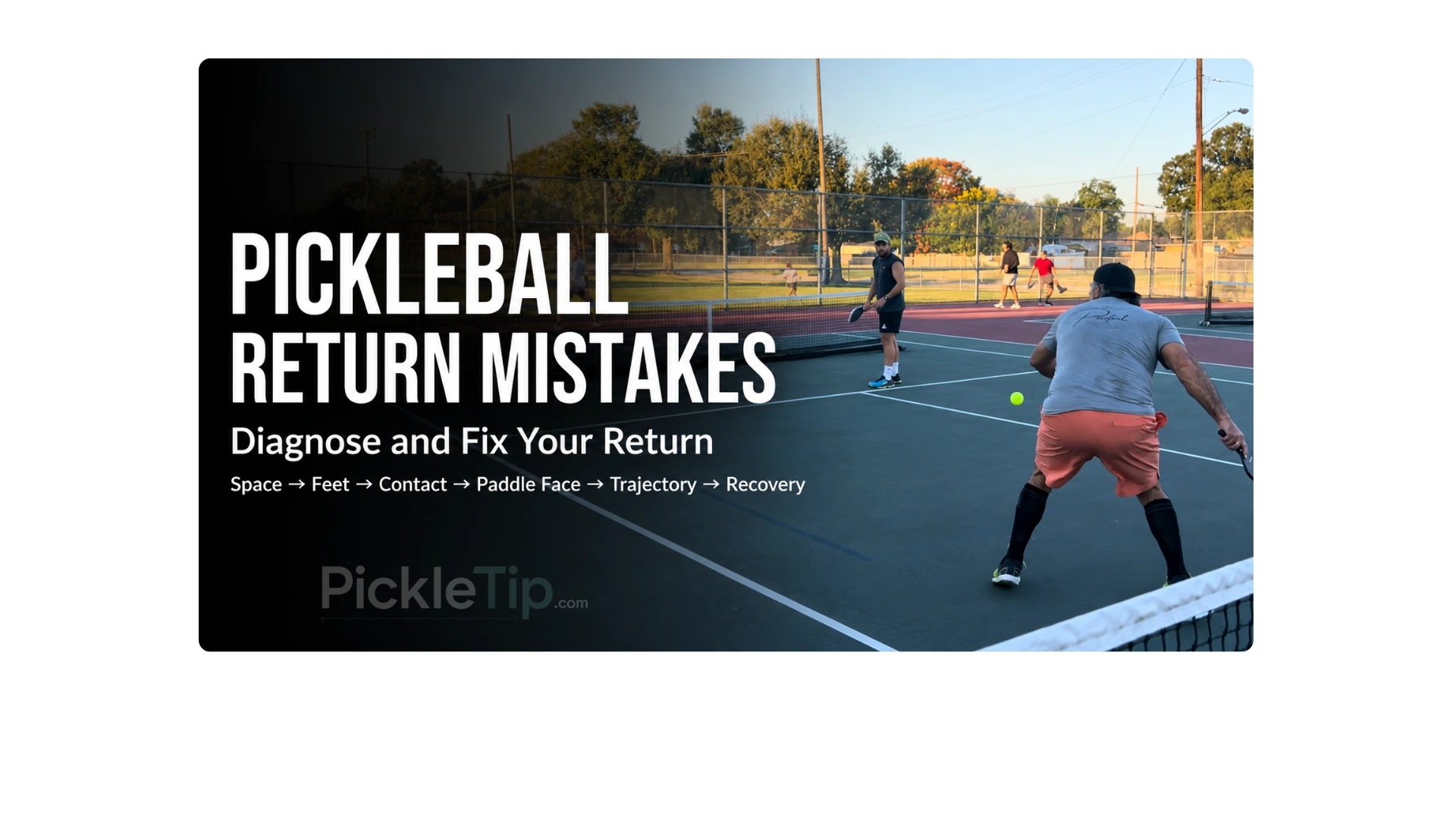
Pickleball Return Mistakes: How to Diagnose and Fix Your Return
If your pickleball return keeps missing, do not rebuild your whole stroke at once. Start with the symptom. A return that sails long usually points to a different problem than one that pops up, dies short, jams you, or leaves you late getting to the kitchen. Diagnose what the ball and your body are telling you, then fix the earliest problem in the sequence.
When players tell me, “My return is terrible today,” I usually want to know something more specific.
- Are you missing long?
- Are you dumping returns into the net?
- Are they floating up?
- Are deep serves jamming you?
- Are you reaching instead of making clean contact?
- Are you making the return but arriving late for the third shot?
Those are different problems. Treating all of them with the same cue is how players end up changing five things when only one thing was broken.
I see the same pattern in lessons. A player tells me the last thing the ball did and wants to fix the swing. When we recreate the situation, the useful problem is often earlier: the feet did not create enough space, contact moved, balance disappeared, or the decision changed. The ugly ball is real. It just may not be where the mistake started.
If your basic return mechanics need work, start with How to Return a Serve in Pickleball. If your return is dependable but you are trying to decide where to put it, use Pickleball Return Strategy.
Diagnose the Return Before You Fix It
I like to work backward from the miss. What happened to the ball? What was your body doing when it happened? Then find the first thing in the sequence that went wrong.
Quick Return Diagnosis
| What you see | Likely cause | First thing to check |
|---|---|---|
| Deep serves keep jamming you | Starting too close or reacting backward too late | Give yourself more room and see if your first move becomes easier |
| You reach or crowd the ball | Poor spacing and late footwork | Move your feet before changing the swing |
| Return floats or pops up | Unstable paddle face, reaching, or too much hand | Create space and quiet the paddle face |
| Return keeps going into the net | Late or low contact, a closed paddle face, steering, or too-flat trajectory | Give the ball more margin and check contact before changing the whole stroke |
| Return keeps sailing long | Overhitting, changing the paddle face, or chasing too much depth | Reduce effort and use a larger target |
| Return lands short and weak | Late contact, arm-only swing, or poor body organization | Find cleaner contact in front before adding power |
| Return is good but you are late to the kitchen | Too little flight time or watching the shot | Move sooner and consider more usable height |
| Every miss looks different | The breakdown may be happening before the swing | Check starting position, feet, and spacing first |
Coach Sid’s diagnostic rule: Fix the first thing that went wrong, not the last thing you noticed.
If you were standing too close, retreated through the bounce, reached for the ball, and then opened the paddle face, the open paddle face may be what you noticed. But the return started breaking down several steps earlier.
1. Deep Serves Keep Jamming You
Symptom: A routine deep serve makes you retreat, crowd the bounce, contact the ball late, or swing while falling backward.
Likely cause: Your starting position is not giving you enough room for the serve you are receiving.
There is no magic distance behind the baseline. Some servers barely push you back. Others consistently drive the ball deep enough that standing on top of the line turns every return into an emergency.
First Fix: Give Yourself More Space
Move back enough that a normal deep serve lets you organize yourself instead of immediately retreating through the shot. If the serve lands shorter, moving forward is usually easier than trying to manufacture space while falling backward.
I had to learn this myself. I used to stand too close to the baseline and kept getting crowded by good deep serves. Moving back gave me time to read the bounce and get organized instead of fighting the ball.
Treat your starting position as adjustable, not permanent. A server who repeatedly drives the ball near the baseline may require more room than someone whose normal serve lands several feet shorter.
Court Check
If your first movement on ordinary deep serves is constantly backward, test a deeper starting position before changing your swing.
2. You Are Reaching for the Return
Symptom: Your arm gets away from your body, contact feels different from ball to ball, or you keep catching the ball too close, too far away, or beside you.
Likely cause: Your feet are not creating the spacing your swing needs.
This is one of the biggest reasons I do not want players immediately changing their paddle mechanics after a bad return. Sometimes the paddle did exactly what you asked it to do from a terrible position.
First Fix: Move to the Ball Before Reaching for It
Use your feet to create a comfortable contact window. Cover the bigger distance early, then use smaller adjustment steps as you get close to the bounce.
You do not need to freeze your feet before every return. Good players can hit while moving. The difference is between organized movement and scrambling through contact.
A short return and a jammed return can look like two different swing problems, but I often check the same thing first: where was the player when the ball arrived? If the feet left the contact too close to the body or too far away, the paddle is already solving an emergency.
If contact keeps moving around, check your feet before you blame your swing.
3. Your Return Floats or Pops Up
Symptom: The ball leaves the paddle higher than expected, floats shorter than you intended, or gives the serving team a comfortable third shot.
Likely causes: Reaching, crowding the ball, changing the paddle face through contact, or trying to create the shot with too much hand and wrist.
First Fix: Quiet the Paddle Face
I would not tell a player to lock the wrist rigidly. The better cue is to keep the wrist and paddle face stable enough that they are not flipping unpredictably through contact.
Early in my own game, I kept trying to manufacture spin with my wrist. A few looked great. Plenty more flew long or came off the paddle differently than I expected. My consistency improved when I stopped trying to create so much with my hand and let the return become a simpler stroke.
- Create enough spacing that the ball is not crowding your body.
- Contact the ball in a comfortable position in front of you.
- Keep the paddle face predictable through the contact window.
- Let spin be an addition to a dependable return, not a rescue for unstable contact.
If you eventually want to use backspin intentionally rather than accidentally, that becomes a specialty shot. See Pickleball Slice Return. If your specific problem is a backhand slice that floats or loses depth, use the dedicated Backhand Slice Return guide.
4. Your Return Keeps Going Into the Net
Symptom: The return repeatedly clips the tape or dies into the net, especially when you are trying to keep it low.
Likely causes: Contact getting too low or too late, a paddle face that closes through contact, decelerating because you are steering the ball, or asking the return to travel on too flat a line.
First Fix: Give the Ball More Margin
A low return is useful. A return in the net is not. If you keep clipping the tape, give the ball a little more shape before deciding the swing itself is broken.
Check where contact is happening and what the paddle face is doing there. If the ball is getting too low beside you, create space and get to a cleaner contact window. If you are steering the paddle because you are afraid of missing long, let the stroke finish instead of poking the ball toward the service box.
I have seen the same control trap on the serve side. After misses, a nervous player may try to guide the ball into the box, and the motion gets smaller and tighter instead of more dependable. A return is a different stroke, so I would not assume the cause is identical, but if your netted returns start coming with a cautious, steered finish, test a complete relaxed stroke before adding another mechanical cue.
Do not confuse “keep the return low” with “clear the net by the smallest possible amount.” The return still needs enough margin to survive an ordinary miss.
5. Your Return Is Weak or Keeps Landing Short
Symptom: You make clean-enough contact, but the return repeatedly dies in the middle of the court without intending to.
Likely causes: Late contact, an arm-only stroke, poor body organization, or decelerating through the ball because you are worried about missing.
First Fix: Improve Contact Before Adding Effort
One of the early things Coach AJ pointed out to me was that I was not using my body very well on the return. I was asking my arm to create too much of the shot by itself.
Once I started getting better organized and allowing my body to move through the return, I got more usable pace and depth without feeling like I had to swing harder.
The important part is not forcing a dramatic back-foot-to-front-foot transfer on every ball. If the serve has you moving laterally or adjusting, your feet may organize differently. What I want is a body that supports the contact instead of an arm trying to rescue it.
Coach Sid Note
If you need a bigger swing just to get the ball deep, check your spacing and contact first. Power problems are often contact problems wearing a different shirt.
6. Your Return Keeps Sailing Long
A return does not receive bonus points for landing six inches from the baseline.
Symptom: The return feels solid but repeatedly misses beyond the baseline.
Likely causes: Too much effort, an unstable paddle face, trying to create spin with the hand, or chasing a target that leaves no depth margin.
First Fix: Stop Trying to Paint the Baseline
If you are repeatedly missing long, move your target farther inside the court and see whether the same stroke becomes reliable. A return that lands a few feet shorter but still keeps the server deep is more valuable than the perfect return that never lands.
I have watched plenty of players (including friends I play with) keep aiming for corners because the successful ones look great. Once the target gets bigger, the return usually gets boring. That is often an improvement.
Do not diagnose a missed target as a bad stroke until you ask whether the target was asking too much.
Once you can make the return reliably, choosing deep middle, a corner, a weaker player, or an occasional short ball becomes a tactical decision rather than a repair job. The pickleball return strategy guide goes deeper into those choices.
7. Your Return Gets Back to Them Before You Get to the Kitchen
Symptom: The return lands in, but the third shot reaches you while you are still moving through the transition area.
Likely cause: You may be treating return speed as the goal instead of asking how much time the return gives you.
First Fix: Give Yourself Usable Flight Time
A controlled return with a little more height can stay in the air longer and give you more time to move forward. That does not mean floating a short sitter. Height works best when it comes with useful depth.
AJ pointed this out to me when some of my lower returns were getting back to the serving team so quickly that I was still trying to establish position when the third ball came back. Adding usable height gave me more time.
This is also why “harder” is not automatically “better.” A fast return can pressure the server, but it can also steal your own recovery time.
Once the return itself is dependable, choosing more height, more pace, or a different target becomes strategy. The return strategy guide covers those tradeoffs. For troubleshooting, the clue is simpler: if the ball keeps beating you forward, look at how much time your return is giving you.
8. You Make the Return and Then Watch It
Symptom: The return itself is fine, but you hesitate after contact and end up hitting the next ball from somewhere you did not want to be.
Likely cause: You are treating contact as the end of the return instead of part of a larger sequence.
First Fix: Move, Then Get Balanced
I learned this one the annoying way. I would hit a return I liked, spend just enough time watching it to be pleased with myself, and then realize the serving team was already hitting the third ball while I was still moving.
Now I want the movement to begin as part of the return. Go forward immediately after contact, but do not confuse moving quickly with blindly sprinting through the next shot. Wherever you are when the serving team is about to hit, get balanced enough to react.
A good return can still create a bad position if you admire it too long.
If you need a deeper look at getting balanced before the opponent contacts the ball, see the pickleball stance and split-step guide.
When Every Return Miss Looks Different
This is the frustrating one. One return goes long. The next one clips the net. Then you pop one up. Then somehow you hit the best return of the game.
When the result changes constantly, I become suspicious of something earlier in the sequence rather than assuming you suddenly own four different swing problems.
Coach Sid’s Return Repair Order
When I cannot immediately tell whether the return problem is the swing or something earlier, this is the order I check.
- Space: Did you start with enough room for the serve?
- Feet: Did you move to create the bounce and spacing you needed?
- Contact: Was the ball in a repeatable contact window in front of you?
- Paddle face: Did the face remain predictable through contact?
- Trajectory: Did the ball have enough margin, depth, and flight time for the job?
- Recovery: Did you move forward and get balanced for the third shot?
Work through that order instead of jumping directly to the swing.
The order does not mean every bad return starts with your feet. Sometimes you simply make a bad swing. It is a way to check upstream before you rebuild one.
For example, if your spacing changes on every serve, your contact point changes too. Once the contact point changes, your paddle face and swing start making emergency corrections. At that point the miss may look like a wrist problem even though the original problem was your feet.
The farther downstream you fix the problem, the more compensations you usually need.
Give One Fix Enough Balls to Prove Itself
The fastest way I know to make a struggling return even less predictable is to give yourself five new swing thoughts.
Pick the miss that keeps showing up and make one change. Then give that change enough balls to prove whether it helped. One better return proves almost nothing.
If you change your feet, grip, target, backswing, and follow-through after every miss, you never really learn which one mattered. I want to see whether the same correction keeps helping when the serve changes depth, moves you a little, or the score starts making the ball feel more important.
A Simple Return-Diagnosis Drill
You do not need a complicated drill to learn what your return is doing.
- Have a partner serve 10 balls to you without changing the goal.
- Do not judge the return as simply “good” or “bad.”
- Record the result: long, net, short, float, jammed, clean, or late recovery.
- Look for the most common pattern.
- Choose one adjustment from the Return Repair Order.
- Hit another set of 10 and see whether that specific symptom improves.
If the pattern changes, you learned something. If it does not, move one step earlier in the sequence and test again.
Do not ask, “Did that return feel better?” Ask whether the same miss happened less often.
This is more useful than hitting 50 random returns while changing your grip, backswing, stance, target, and follow-through after every miss.
Return Troubleshooting Questions
If the return repeatedly dies in the net, check whether contact is getting too low or too late, whether the paddle face is closing, or whether you are steering the stroke because you are afraid of missing long. Give the ball more net margin first, then see whether the same miss keeps happening before you change several mechanics.
If the return is dependable on predictable feeds but disappears in games, the stroke may not be the only problem. Live serves add changing depth, direction, movement, decisions, score pressure, and less preparation time. Recreate more of those conditions one at a time instead of assuming the clean drill stroke vanished. The same idea is covered more deeply in Improving Pickleball Consistency.
Enough to see a pattern. For a simple practice set, I use 10 returns to establish the recurring miss, make one adjustment, then hit another 10. One good ball or one bad ball is not enough evidence to rebuild the stroke. Look for whether the same symptom happens less often.
If a server’s normal depth repeatedly forces your first move backward, give yourself more room. Your return position should adjust to the serve you are receiving. Moving forward to a shorter serve is usually easier than trying to create space while a deep serve is already crowding you.
No rigid lock is necessary. The useful goal is a stable wrist and predictable paddle face through contact. Excessive flipping or last-second manipulation can make the ball difficult to control, but a natural stroke does not require making the wrist completely immobile.
Move forward immediately, but be ready to get balanced before the serving team hits the third shot. The goal is not to sprint blindly to the non-volley-zone line. Use the time created by your return and be under control when the next ball is struck.
Start earlier in the sequence than the swing: check your starting space, footwork, and spacing around the bounce. If those change from ball to ball, your contact point and paddle face will also change. Once those are stable, diagnose the swing or trajectory.
Let the Miss Tell You What to Fix
The miss gives you information if you know what to look at.
Long, short, net, jammed, floating, reaching, and late are not seven ways of saying the same thing. Each one gives you a clue about where the return started breaking down.
So do not rebuild everything after one bad ball. Use the same diagnostic order: Space → Feet → Contact → Paddle Face → Trajectory → Recovery.
Find the earliest failure, make one adjustment, and see whether the symptom changes.
The miss is not just the result. It is the clue.