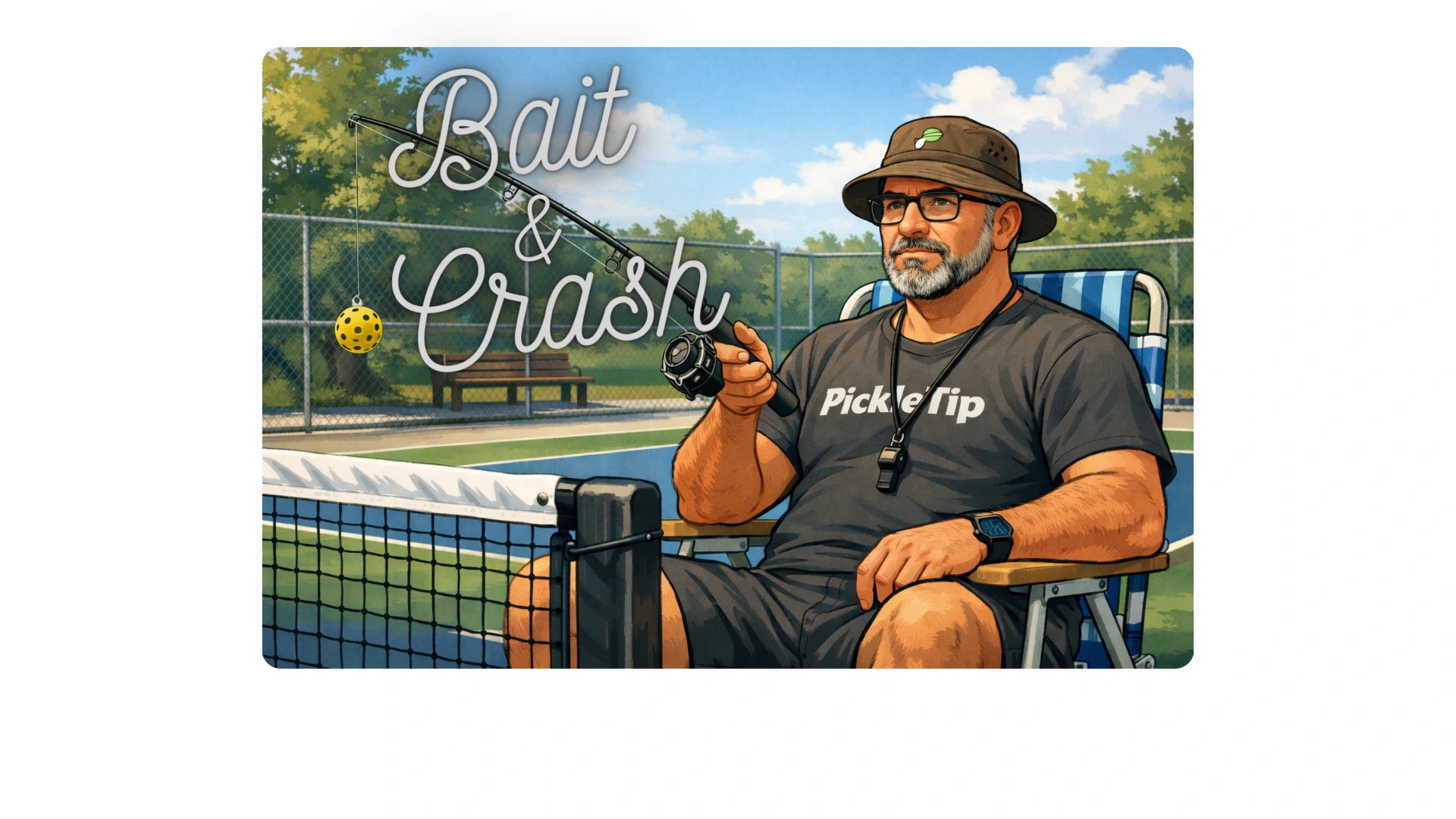
Third-Shot Bait Drop Crash: Punish a Predictable Fourth Ball
You hit a quality third shot drop, take the ground it earns, and plant. The opponents have seen you in this in-between spot several times, and every time they have tried to pin you there with the same safe deep fourth.
This time, you are waiting for it. The familiar ball comes. Instead of getting pushed backward again, you step into the clean volley window and pick it off before the opponents realize you were reading the pattern, not just reacting to the ball.
The third-shot bait drop crash is an advanced pattern: hit a quality drop, take only the ground it earns, plant before the fourth, recognize a predictable deep next ball, then pick it off early only when the ball stays attackable and you can contact it in front while balanced.
Who this helps: players who already have a usable third shot drop, understand basic transition movement, and keep getting pushed back by opponents who default to safe depth on the fourth ball. Rating matters less than the prerequisites: you need enough drop quality, balance, and pattern recognition to earn the read instead of guessing.
This is not a replacement for sound third-shot strategy or transition fundamentals. It is a specific change-up used to punish a predictable fourth-ball habit. Start with Third Shot Strategy and Pickleball Transition Zone if the foundation is not stable yet.
What Is the Third-Shot Bait Drop Crash?
The third-shot bait drop crash is a stop-and-go tactic built around pattern recognition. The bait is not the pause by itself. The bait is showing an opponent the same in-between court picture that has repeatedly triggered the same fourth-ball response.
The pattern clicked for me while watching AJ and Ethan play Mark and JP in a Cat 5 Moneyball in Mandeville. Both AJ and Ethan used this pattern repeatedly: hit the drop, take the ground it earned, stop, let the familiar deep fourth show itself, then pick it off before it pushed them back again. It kept working against 5.0+ players. I remember watching from the sideline and thinking, that is some high-level pickleball.
What stood out was not the crash by itself. It was how early they seemed to know what fourth ball was coming. The attack looked aggressive, but the real advantage came from recognizing a habit before the ball arrived.
- You hit a third shot drop that forces the opponents to contact from below or near net height.
- You take the ground the drop earned, then plant before the opponent strikes the fourth.
- You present the same in-between court picture that has previously triggered the opponent’s safe depth response.
- The opponent sends the expected deep fourth ball.
- You volley it early if the ball stays attackable, arrives in front, and lets you keep the paddle compact.
- You abort if the ball dips, skids, jams you, forces a reach, or removes the compact volley window.
Coach’s rule: If you cannot predict the fourth ball, you are not setting a trap. You are gambling.
Why the Bait Works
Players often repeat the fourth ball that has been working. When they see a serving team still between the baseline and kitchen, common keep-you-back responses include:
- push the ball deep to the backhand side
- roll safely through the middle
- aim at the inside foot to keep the player moving
The bait is there when those replies stop looking random. Maybe the fourth keeps traveling through the same lane. Maybe the opponents keep adding the same safe height or depth whenever they see you parked in the same in-between position. Once the same court picture keeps producing the same fourth ball, now you have a pattern.
Your plant recreates that familiar picture, but this time you are balanced early enough to act on the next ball instead of letting it pin you in transition. It is the same way I build a pickleball tournament game plan: watch what the opponent keeps giving you, then adjust when the pattern changes.
The Non-Negotiable: Your Drop Must Earn the Setup
The crash only works after a drop that reduces the opponent’s attacking options. If your third sits high enough for a comfortable downward or aggressive contact, you do not have a bait-crash setup. You have a defensive problem.
A usable setup drop should do at least one of these:
- make the opponent contact lower than they wanted
- force a reach, scoop, controlled block, or upward contact
- make the opponent add height for safety
- create a slower, more readable fourth ball
Drop-quality test: Judge the setup by the opponent’s contact. If they are upright, balanced, and attacking comfortably, the problem is not your crash timing. The third ball never created the trap.
For the complete drop-versus-drive decision, use Third Shot Strategy. For drop mechanics, use Pickleball Drop Shot.
The Core Setup: Earn Ground, Plant, and Hold
Take only the ground the drop earned, then get planted before the opponent strikes the fourth. If you are still drifting when they make contact, you cannot read the trap cleanly. If stopping in transition is still the problem, work on the Pickleball Transition Zone first.
- Position: wherever the previous ball lets you stop in balance while still leaving room to handle a dipping next ball. Do not chase a fixed distance from the kitchen.
- Feet: athletic and stable, not gliding forward.
- Paddle: in front of the chest with a compact ready position.
- Balance: stable enough to attack a clean window or soften the ball if the window disappears.
- Eyes: on the opponent’s paddle face, swing path, and contact height.
The pause is not passive. It is the moment that makes the pattern readable: you are stable before the opponent’s contact, so the fourth ball can confirm or cancel the trap.
Coach’s rule: Think spring, not statue. You are still, but ready.
Green Light vs Red Light on the Fourth Ball
| Fourth-Ball Read | Decision | Why |
|---|---|---|
| Rising or flat, contact available in front, feet stable | Crash | You can volley early without reaching or lifting |
| Ball stays high enough at your contact point to attack without lifting | Crash | The pickoff window is still clean |
| Ball dips enough that you must lift from a low contact | Abort | Forcing the volley turns the trap into a pop-up risk |
| Ball reaches your hip or gets behind your clean contact window | Abort | You are late and the compact volley is gone |
| Your momentum is still carrying you toward the NVZ | Abort | You lose balance and increase the risk of an NVZ momentum fault |
Green-light test: Can you contact in front, keep the volley compact, stay balanced, and regain control without your volley momentum carrying you into the kitchen?
NVZ rule check: Under USA Pickleball’s non-volley-zone rules, a volley is a fault if your momentum from the volley carries you into or causes contact with the NVZ, even after the ball becomes dead. The crash is only available when you can control the volley and your momentum. See the official USA Pickleball rules.
Read the Opponent’s Swing Path
The best trigger is not whether the opponent “looks nervous.” It is what the paddle face and swing path tell you.
- Lift cue: paddle face opens, swing travels low to high, shoulders rise, and the opponent adds margin. This often produces the crashable depth ball.
- Flat cue: compact swing, controlled face, ball travels firm but not sharply downward. This may still be volleyable if you are early.
- Carve cue: closed face, outside cut, or downward action that creates skid and dip. Prepare to reset.
- Late cue: the ball is already beside your hip before you decide. The crash window is gone.
Predictable lift plus a clean contact window equals go. Dip, skid, reach, late contact, or drift cancels the trap.
The Pickoff Volley
Keep the pickoff volley simple: early contact, almost no backswing, a low target, then get ready for the next ball.
- Contact: comfortably in front of the body; if you are reaching beside or behind the hip, abort.
- Backswing: almost none.
- Paddle face: neutral to slightly closed so the ball stays down.
- Wrist: quiet.
- Base: stay controlled through contact; do not lunge through the volley.
- Finish: hands remain in front of the chest.
- Recovery: expect a counter and recover immediately after the compact volley.
Coach’s rule: If the paddle disappears behind you, the volley became a swing and the counter window just opened.
Best Targets for the Pickoff Volley
You are not hunting a highlight. You are trying to create a ball the opponents cannot block cleanly.
| Target | Why It Works |
|---|---|
| Feet | Forces a late or downward defensive block |
| Hip or body | Jams the paddle and steals extension |
| Seam | Creates hesitation and communication pressure |
| Open court | Useful only when the opening is obvious and the volley can stay low |
Aim at hips and feet, not faces. The goal is a jammed response, not a dangerous shot.
For more on compact volley control, read Pickleball Blocking.
The Abort Rule
The abort is what keeps this from becoming a reckless charge. Once the clean attack window disappears, let it go.
If the fourth dips, skids, jams you, reaches beside or behind your clean contact window, catches you still drifting, or leaves your partner exposed, forget the trap. Neutralize the ball you actually received and get back into the rally.
That is not a failed version of the play. Recognizing an unattackable ball before you manufacture a bad attack is part of the skill.
For the full reset system, use How to Reset in Pickleball.
Your Partner Has a Job Too
The crash is not a solo stunt. Your partner needs to recognize that the bait is on and be ready for the counter lane the pickoff can create.
- Hold: both players recognize that the bait pattern is on.
- Go: the crashing player takes the clean pickoff while the partner protects the most likely counter lane.
- Abort: if the window disappears, neither player forces the pattern.
- Recover: both players expect another ball after the pickoff instead of assuming the pattern ended the rally.
“Hold” means the pattern is armed. “Go” means the clean pickoff appeared. “Abort” means the ball canceled the trap. Call it whatever you want. What matters is that one player knows the attack is coming and the other knows which counter lane has to be covered.
If one player steps in to create pressure, the other cannot admire the play. Cover the ball that pressure is most likely to send back.
When Not to Use It
- Opponents knife the fourth ball low with slice.
- Heavy topspin makes the ball dip before your contact point.
- Your third shot drop is floating and attackable.
- You cannot stop without drifting into the kitchen.
- Your partner is not connected or prepared for the counter.
- You are using the play repeatedly enough that the bait is no longer believable.
If the opponents stop giving you the safe deep fourth because you picked it off a few times, do not chase the old pattern. The bait already did useful work: it made them change. Read the new response and play the ball they are giving you now.
Frequency rule: This is a change-up built on an observed habit, not your default transition pattern.
Common Bait Drop Crash Mistakes
- Pausing upright: a pause only helps if you are loaded and ready to move again.
- Taking a large swing: the pickoff should be compact. A big backswing gives the opponents time and opens the counter window.
- Admiring the volley: expect the ball to come back and re-split for the counter.
- Running it without a pattern read: if you are guessing at the fourth ball, you are gambling, not baiting.
- Leaving the partner behind: the player who is not crashing still has a job. Protect the likely counter lane and stay connected.
- Forcing it after the opponents adjust: once they stop giving you the same safe depth ball, the old trap is gone. Read the new pattern instead.
Third-Shot Bait Drop Crash Drill
Train the decision before training the finish.
Go-or-Abort Decision Drill
- Start: serve, return, and third shot drop.
- Movement: take only the ground the drop earns and arrive balanced before the fourth-ball feed.
- Feed: partner alternates a rising depth ball, a dipping ball, and a skidding ball.
- Call: say “go” or “abort” before contact.
- Crash standard: contact must be in front with stable feet and a compact volley path.
- Abort standard: recognize the disappearing attack window early enough to choose a controlled neutralizing ball instead of forcing the volley.
- Recovery standard: recover in time to handle the opponent’s next ball.
- Scoring: one point for the correct decision and one point for clean execution.
Progression: Once the ball-shape decision is reliable, let the feeder vary lanes and tendencies so you must combine the fourth-ball read with an actual pattern read.
Bait Drop Crash FAQs
It is an advanced pattern where the serving team hits a quality third-shot drop, recreates an in-between court picture that has been producing a predictable deep next ball, plants before the fourth, and picks that ball off early only when the contact window stays clean.
Abort when the fourth dips, skids, jams you, reaches beside or behind your clean contact window, catches you still drifting, or otherwise removes the compact attack window.
Use it as a change-up after identifying a predictable fourth-ball habit. If opponents stop giving you that safe depth ball, do not force the old pattern. The bait has already done useful work by making them change.
Yes. I watched AJ and Ethan use this pattern repeatedly against Mark and JP in a Cat 5 Moneyball in Mandeville, and it worked well even at the 5.0+ level. The important part was not simply charging forward; they were recognizing the fourth-ball pattern early and attacking only the clean window.
Stop running the old trap. Once opponents change the predictable next ball, read the new pattern and play the ball they are giving you now. Forcing the bait after the habit disappears turns pattern recognition back into guessing.
Yes. If you volley the ball and your momentum carries you into the non-volley zone, it is a fault. Plant before contact and make sure you can control your momentum after the volley.
Run the Play in Five Steps
- Step 1: Hit a drop that reduces the opponent’s attacking options.
- Step 2: Take only the ground the drop earns and plant before the fourth.
- Step 3: Confirm that the opponent is repeating the fourth-ball pattern you expected.
- Step 4: Pick off the clean attack window or abort when the ball dips, jams, skids, or forces a reach.
- Step 5: Recover immediately and expect another ball.
Final coaching cue: Create the habit. Show the picture. Plant early. Read the fourth. Pick off the clean window. Respect the abort.
Build the Skills Behind This Play
- Third Shot Strategy — choose the right third shot before using advanced patterns.
- Pickleball Drop Shot — build the drop quality required to create the bait.
- Pickleball Transition Zone — learn the stop, split-step, and movement foundation.
- How to Reset in Pickleball — develop the abort option when the fourth ball dips.
- Pickleball Blocking — sharpen compact volleys and counter control.
- Pickleball Tournament Game Plan — turn repeated opponent behavior into a usable pattern instead of a guess.