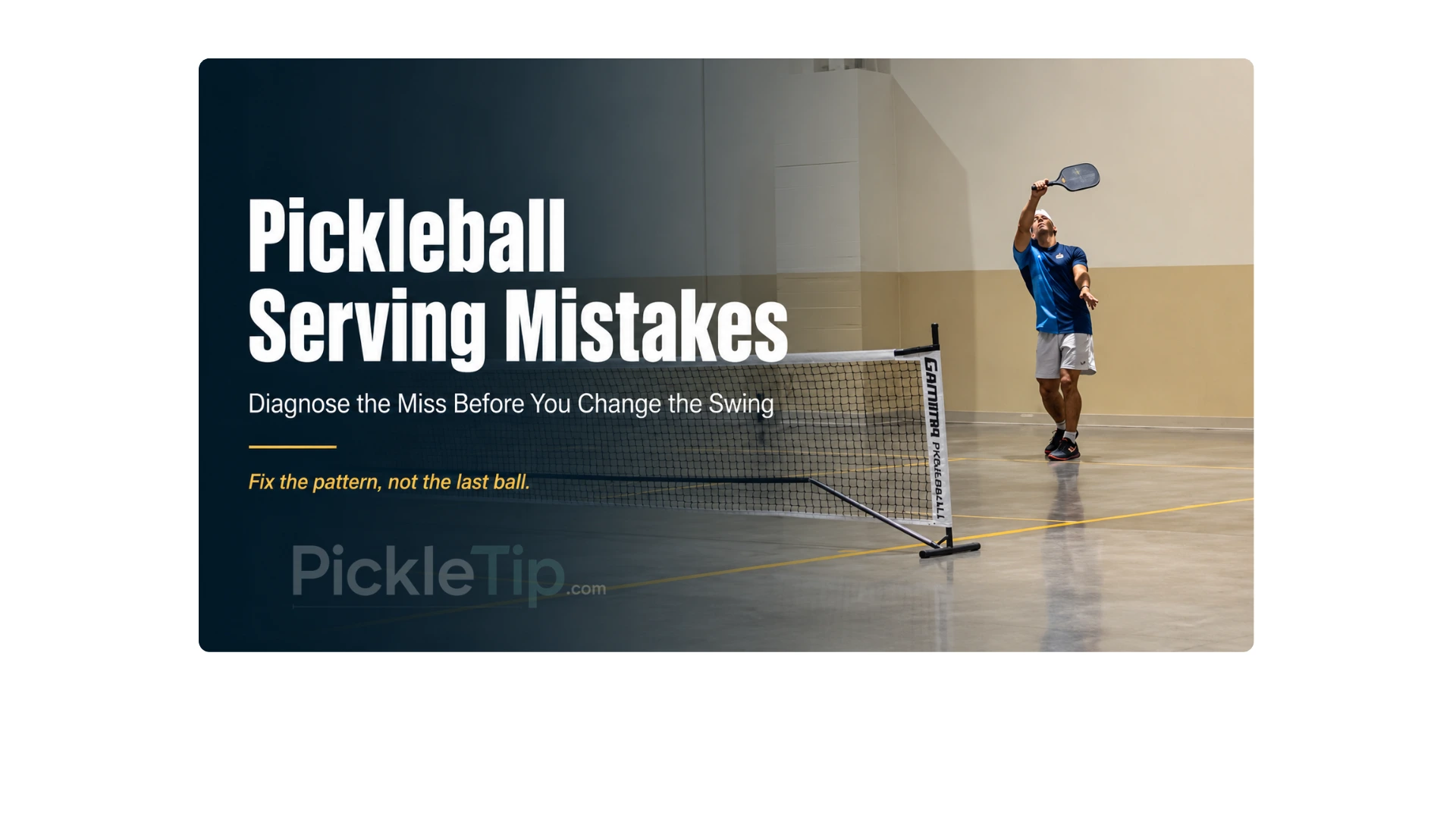
Pickleball Serving Mistakes: How to Diagnose and Fix Your Serve
Diagnose the Miss Before You Change the Swing
A bad pickleball serve usually leaves a clue. The ball hits the net, sails long, pulls wide, lands short, or behaves differently from one serve to the next. The mistake is changing three things at once because one ball missed.
I prefer to diagnose the ball first. See the miss, identify the first variable worth checking, test one correction, then hit enough serves to know whether it actually worked. That turns a frustrating serve into something you can troubleshoot.
Coach Sid’s serve diagnostic: Read the miss. Change one variable. Hit enough balls to see whether the pattern changes. One bad serve is noise. A repeated miss gives you something to work with.
That way of coaching didn’t start with pickleball for me. I’ve spent more than 30 years coaching basketball, baseball, football and now pickleball, and one problem keeps showing up in every sport: the visible mistake and the cause of the mistake are not always the same thing. If I only coach what the ball did, I may fix the wrong thing.
If your serve basically works but something keeps going wrong, stay here. If you’re still building the motion itself, start with my pickleball serve technique guide. If you’re questioning whether the motion is legal, use my pickleball serving rules. If the serve works and you’re trying to decide where to put it, that’s a serve placement and strategy problem.
Quick Diagnosis: What Is Your Serve Doing?
Start with the result you can actually see. Don’t rebuild your entire serve because of one miss. Look for a pattern across several balls.
A net ball is the symptom. “Swing harder” is a guess. Deceleration, late contact, a flatter swing or a changing paddle face are variables you can actually test.
| Serve Problem | First Things to Check | Quick Test |
|---|---|---|
| Keeps hitting the net | Deceleration, flat swing path, low/late contact, closed paddle face | Hit 10 smooth serves at reduced pace and finish completely |
| Keeps going long | Too much forward force, changing contact point, open face, body drifting through contact | Reduce pace without shortening the swing |
| Keeps missing wide | Contact drifting sideways, early body rotation, swing wrapping across the body | Choose a large center target and finish through that lane |
| Keeps landing short | Deceleration, arm-only swing, incomplete weight transfer, too much loft | Use the same swing speed and finish deeper through the court |
| Ball flight changes every serve | Release point, contact window, grip pressure, tempo | Film 10 serves without changing anything |
| Accuracy disappears when adding power | Arm tension, rushed sequence, changing paddle face | Build speed gradually instead of jumping to maximum effort |
| Serve works in practice but not games | Routine, tempo, grip tension, release, trying to do too much | Practice with score calls and one committed target |
Treat those as suspects, not verdicts. Two players can hit the same ball into the net for completely different reasons. Ball flight narrows the search; it does not prove exactly what your body did. Test the simplest explanation before chasing a complete swing change.
The 20-Serve Diagnostic Session
If your serve feels broken and you don’t know where to begin, don’t hit 100 random balls. Hit 20 useful ones.
- Serves 1-5: Baseline. Don’t fix anything. Record what the ball actually does.
- Serves 6-10: Test one variable. Choose the most likely cause from the pattern above.
- Serves 11-15: Repeat the correction. Don’t add another swing thought because one ball missed.
- Serves 16-20: Pressure check. Call a score, choose a target and see whether the correction survives a more game-like routine.
At the end, ask one question: Did the error pattern improve?
If yes, you’ve found something worth practicing. If no, go back to the original miss and test the next reasonable variable. That’s more useful than collecting six new swing thoughts from six different YouTube videos.
Twenty balls can show you a pattern. They can’t prove the problem is gone. You’re looking for evidence that one change moved it in the right direction.
1. Your Pickleball Serve Keeps Hitting the Net
If several serves keep dying in the net, don’t immediately tell yourself to “hit up more.” First figure out whether you’re slowing or steering the swing before contact.
The first things I check are whether the player is slowing the paddle down, contacting the ball farther back than usual, swinging too flat, or changing the paddle face at the last second. A nervous server will often try to guide the ball into the box. The player wants more control, so the motion gets smaller and tighter. The funny part is that steering usually makes the ball less predictable.
Try 10 serves at a comfortable practice pace. Keep the release and contact routine the same, make a complete smooth finish instead of poking at the ball, and count how many clear the net and land in.
If the net errors disappear when you stop trying to guide the ball, you probably didn’t need more effort. You were cutting off or slowing the swing before it finished.
If they do not disappear, check the contact window and paddle face next. The full mechanics behind contact, sequence and follow-through belong in the master serve technique guide.
2. Your Serve Keeps Going Long
A long serve doesn’t always mean you simply hit the ball too hard. That’s one possibility, but I’ve also seen players create long misses because their contact point moves, their paddle face opens, or their body keeps drifting forward while the swing tries to catch up.
That’s why “swing softer” can fix one serve and wreck the next one. If softer turns into deceleration, you haven’t fixed the motion. You’ve just traded a long miss for a short one.
Test whether speed is actually the problem
Keep the same complete motion and reduce only the amount of acceleration. Hit three groups of five serves:
- 5 at easy pace
- 5 at normal pace
- 5 slightly faster
Watch where the miss begins. If your easy and normal serves stay in but the faster group starts sailing, you’ve found your current speed ceiling. Train just below it until contact and paddle-face position stay stable when you add pace.
If all three groups miss long, speed probably isn’t the only variable. Film from the side and compare a good rep with a bad one. Look first at where contact happens relative to your body and whether your torso is drifting farther through the ball on the misses.
A second angle from behind or slightly off the back corner can help you compare the swing lane and where the paddle is sending the ball. The camera isn’t there to make your serve look pretty. Use it to find the first thing that actually changes between the good balls and the bad ones.
3. Your Serve Keeps Missing Wide
Repeated wide misses make players aim farther and farther toward the middle. Sometimes that gets the ball in, but it can hide the real problem.
Check whether your contact is moving sideways, your shoulders are opening earlier on the bad reps, or your paddle is wrapping across your body before you’ve sent the ball through the intended lane.
Pick a large target in the middle of the legal service box. For 10 serves, forget about painting a corner. Watch only two things: where you contact the ball and where the paddle finishes.
If the wide miss improves when the target gets bigger and the finish becomes more direct, don’t answer that improvement by making the target tiny again. Stabilize the path first.
Once the serve itself is reliable, then start manipulating lanes intentionally. That’s a strategy problem, and I cover it separately in Where to Serve in Pickleball.
4. Your Serve Lands In but Keeps Landing Short
A serve can be legal and still give the returner a comfortable start. If your ball repeatedly lands short without you intending to hit a short serve, look at whether you’re actually finishing through the ball or just lifting it safely into the box.
I first look for a player slowing down at contact, swinging mostly with the arm, cutting off the finish, or floating the ball upward without carrying enough of the motion forward through the court.
Put a visual marker in the back half of the service box and hit 20 serves. Don’t chase the baseline. You’re testing whether your normal motion can move the landing point deeper without becoming wild.
- If the ball gets deeper when your finish becomes more complete, stay with that correction.
- If extra effort makes the ball spray, back down. Get the stance, balance, contact and finish repeatable before trying to manufacture more pace.
- If you’re deliberately choosing short versus deep targets, you’ve left troubleshooting and entered serving strategy.
You don’t win much by hitting one beautiful deep serve followed by two faults. Depth becomes useful when you can repeat it.
5. Your Contact Point Changes on Every Serve
This is one of the biggest reasons a serve can feel good one minute and completely foreign the next. If the ball arrives in a different place every time, your swing has to improvise every time.
On a volley serve, pay attention to the consistency of your release and the timing between release and contact. On a drop serve, pay attention to where you release the ball and where the bounce places it relative to your body.
Don’t obsess over finding one magical inch of court. You’re trying to make the ball arrive in a repeatable strike window.
The no-swing test
Before hitting another 50 bad serves, rehearse only the release.
- Set up exactly as you normally serve.
- Release the ball without swinging.
- Repeat it 10 times.
- Watch whether the ball keeps arriving in roughly the same usable area.
If the release itself is wandering, fixing your swing first is backwards.
This is also a good place to use video. From the side, compare the release height, where the ball travels before contact and where contact sits relative to your front hip. You’re not searching frame by frame for some perfect textbook coordinate. You’re looking for the obvious variable that keeps moving.
If you’re a newer player and volley-serve timing keeps creating problems, the beginner serving guide explains the simpler drop-serve option and the basic setup without burying you in advanced mechanics.
6. You Lose Accuracy Every Time You Add Power
This one is common because players often add power by changing the swing instead of accelerating the same swing.
The arm tightens. The tempo gets rushed. The body sequence changes. The paddle face starts moving around. Then the player concludes, “I can’t serve hard and keep it in.”
You may simply be trying to jump too far up the ladder.
Build a speed ceiling instead of chasing max power
- Find a pace where you can reliably repeat your serve.
- Add a small amount of speed.
- Hit enough balls to see whether accuracy changes.
- If the motion breaks, return to the previous level.
The goal isn’t to discover the hardest serve you can hit once. It’s to find the fastest version of your normal serve that still behaves like your normal serve.
Coach Sid’s rule: If adding speed changes your contact, balance, swing path and paddle face all at once, you didn’t add power. You changed serves.
7. Your Grip or Paddle Face Changes During the Motion
A serve can look like a swing problem when the paddle is actually changing orientation in your hand.
Check whether you start relaxed and squeeze hard before contact, rotate the grip during the motion, or flick the paddle face at the last second trying to manufacture spin.
For most players, a relaxed Continental-style starting grip gives you a useful neutral reference point. That doesn’t mean every player has to serve with the exact same grip. It means you need to know what you’re holding and be able to repeat it.
Hit 10 simple serves with no attempt to create extra spin. Keep your normal hand position and pay attention to whether the paddle face stays predictable through contact. If the serve suddenly cleans up, add spin back gradually instead of rebuilding everything at once.
If the grip itself keeps shifting, fix the grip before you start changing the rest of the swing. My pickleball paddle grip guide covers Continental position, grip pressure and hand placement in much more detail.
8. Your Serve Works in Practice but Disappears in Games
This one gets called a technique problem even when the relaxed practice swing is fine.
Score pressure changes people. You rush the setup, squeeze the paddle tighter, choose a smaller target, change the release, start guiding the motion, or suddenly decide 9-9 is the perfect time to unveil a serve you practiced twice on Tuesday.
Those aren’t theoretical pressure symptoms for me. I’ve watched nervous players do exactly those things: rush the routine, tighten the grip, alter the ball release, steer the swing and start thinking about the result before the motion is even finished. The serve can look like it disappeared when the real change happened before or during the setup.
If the serve works during relaxed repetitions but falls apart when the score matters, don’t rebuild the mechanics at 9-9. Test whether your routine, breath, grip tension, target or tempo changed first.
Pressure-practice test
- Choose one large target.
- Call a realistic score before each serve.
- Use the same breath, setup and tempo every time.
- Hit 20 serves and track both makes and whether you completed the routine.
You’re trying to make your match serve look boringly similar to your practice serve. Boring is useful when your brain suddenly decides the scoreboard is an emergency.
If pressure is the thing changing your serve, my pickleball nerves guide goes deeper into the CLEAR routine and pressure training. If the problem begins even before the motion, use my pickleball serve routine to make the beginning of each serve more repeatable.
At game point, you do not need a different server. You need a familiar beginning.
9. You’re Trying to Fix Too Many Serving Mistakes at Once
This may be the biggest troubleshooting mistake of all.
A serve goes long, so you change your grip. The next one hits the net, so you alter your stance. Then you move your contact point, add topspin, slow the swing down and aim somewhere else. Five minutes later, you have no idea which serve you’re practicing.
When that happens, go back to one variable at a time:
- Observe: What is the ball repeatedly doing?
- Choose: What is the first reasonable variable to test?
- Change one thing: Leave everything else alone.
- Hit a real sample: One successful serve proves almost nothing.
- Compare: Did the pattern actually improve?
That is how you stop guessing. The ball becomes feedback instead of a verdict.
10. You’re Using Variety to Hide an Unreliable Base Serve
Serve variety can absolutely matter. Pace, spin and placement can disrupt an opponent. But variety is not a cure for a serve you don’t trust.
If your basic serve is inconsistent, adding a slice, harder drive, short angle and three different targets gives you more variables to manage before you’ve stabilized the first one.
I like to earn variety in this order:
- Repeatable legal serve
- Reliable contact
- Useful depth
- Intentional placement
- Pace and spin variation
A newer player who is still trying to find the same contact window needs something different from an experienced player who can already move the serve around and wants another look for a returner. Variety becomes an advantage after the base serve stops demanding your full attention.
Once you’re ready to manipulate the returner rather than simply fix your own ball, move to the serve placement and strategy guide.
Don’t Confuse a Serving Mistake With an Illegal Serve
Technique problems and rule violations are different problems. If you’re asking whether the serve itself is legal, I don’t want a troubleshooting article pretending to be the rulebook.
Under the current USA Pickleball framework, volley serves and drop serves are evaluated differently. The serve still has to land diagonally in the correct service court, foot-position requirements apply at contact, and pickleball gives you one serve attempt per rally. A serve that touches the net and still lands legally is live rather than an automatic replay.
I’ve watched hundreds of rec players lose points on serves they thought were legal, and some of the violations are subtle enough that changing the swing for performance reasons can accidentally create a rules problem too. If legality is in doubt, separate that question from the troubleshooting process.
Rules can change, so use the current USA Pickleball rulebook as the official source. I also maintain a plain-English Pickleball Serving Rules guide covering volley-versus-drop-serve requirements, foot faults, net-touch serves and the rest of the current legality checklist.
When to Stop Troubleshooting and Rebuild the Serve
Troubleshoot when you still have a recognizable serve and one piece keeps breaking. Rebuild when the setup, release, contact and swing are all changing from rep to rep.
Sometimes the problem isn’t one leak. The motion itself needs work.
Move from troubleshooting to a full mechanics rebuild when:
- you cannot reproduce the same basic contact window;
- your stance, grip and release all change from rep to rep;
- adding even modest pace makes the entire motion break down;
- you don’t know which parts of your serve are supposed to create power;
- or you are repeatedly changing mechanics without knowing why.
A routine can reduce rushing and make a miss easier to diagnose. It cannot repair an unstable stance, release, balance, contact point or paddle path. That’s technical work.
At that point, use the Pickleball Serve Mechanics guide and rebuild the sequence deliberately. Troubleshooting works best when there is already a recognizable serve underneath the mistake.
Other Serving Problems I Check
What should I look for when I film my pickleball serve?
Don’t try to diagnose every body part at once. Film a short set without changing anything, then compare good serves with the repeated miss. From the side, look at release, contact location, body drift and whether the finish changes. From behind or slightly off the back corner, compare swing direction, paddle-face behavior and where the ball starts relative to your target. Find the first obvious variable that changes and test that one first.
How do I know whether to troubleshoot or rebuild my serve?
If your basic motion is recognizable and one result keeps breaking down, troubleshoot the likely variable. If your stance, release, grip, balance, contact and swing all move around from rep to rep, there may not be a stable enough base serve to troubleshoot yet. That’s when I would go back to the serve technique guide and rebuild the motion deliberately.
Can a pre-serve routine fix an inconsistent serve?
It can fix some kinds of inconsistency. A routine helps when rushing, target confusion, pressure or changing tempo is making the setup unpredictable. It cannot fix a contact point, release, grip or swing path that is mechanically unstable. If the inconsistency mostly appears when the score matters, use the SERVE routine and CLEAR pressure routine. If it happens on every relaxed practice ball too, work on the mechanics.
Do I get another serve if the ball touches the net?
Not simply because it touched the net. A net-touch serve that still lands legally in the correct diagonal service court beyond the non-volley zone is live. If it fails to land legally, it is a fault. For the maintained rule explanation, see Pickleball Serving Rules or check the current USA Pickleball rulebook.
Fix the Pattern, Not the Last Ball
The biggest lesson I want you to take from pickleball serving mistakes is that one miss is not a diagnosis.
A serve that hits the net, sails long or pulls wide isn’t insulting you. It’s giving you information. Learn to read that information and serving practice becomes a lot less mysterious.
If the problem turns out to be the underlying motion rather than one specific leak, go back to the master pickleball serve guide. If the motion works and you’re ready to decide where the ball should go, move next to serve placement and strategy.