
Pickleball Wall Drills: How to Practice Against a Wall
Pickleball wall drills are best for repeatable contact, paddle control, quick recovery, touch, blocks, counters, and simple movement patterns when you do not have a partner. A wall gives you a ridiculous number of contacts in a small space, but it sends the ball back faster and more predictably than a real opponent. Use it to clean up a skill, not as proof that the skill is ready for a game.
Mark a net-height line and one or two target windows, choose a distance that gives you time to finish the skill correctly, and count a specific result. Start slower than you think. If your paddle drops, your swing grows, your contact moves behind you, or your balance disappears, simplify the drill instead of rescuing a longer streak.
If a wall is the practice partner you have today, use it for the things it does well: repeated contact, paddle control, compact movement, and quick recovery. For a complete solo session that also includes serving, footwork, court targets, and practice plans, use How to Practice Pickleball Alone. If you are not sure which drill matches your problem, start with the PickleTip DRILL framework.
The wall is good at giving you the same problem again. It is bad at surprising you. Use that predictability to clean up contact and recovery. Find a partner when the missing skill becomes reading, spacing, decision-making, or live timing.
How to Set Up a Wall for Pickleball Practice
You do not need a permanent court painted onto a garage. You need a smooth rebound surface, safe footing, enough room to move, removable tape or chalk, and markings that give your repetitions a purpose.
- Wall: Use a flat, solid surface with a reasonably consistent rebound. Avoid glass, fragile siding, doors with windows, rough masonry that chews up balls, and garage-door seams that send the ball in strange directions.
- Floor: Make sure the surface is dry, uncluttered, and safe for lateral movement.
- Space: Remove breakable objects and leave room behind and beside you. Do not backpedal blindly in a garage or tight room.
- Ball and noise: A plastic ball against a hard wall can be loud. A foam or quieter ball may be friendlier indoors, but its rebound speed and feel will not match a standard pickleball.
- Markings: Use painter’s tape, removable tape, or chalk only where the surface allows it.
Set Up the Net Line, Kitchen Line, and Targets
- Mark a net-height reference
Place a visible horizontal reference about 34 inches high. A regulation pickleball net is 34 inches high at the center and 36 inches at the sidelines. Your wall line does not need to imitate the net’s slight rise; it needs to give every repetition the same useful height reference.
- Mark the seven-foot kitchen reference
Measure seven feet out from the wall and place a removable floor line. Treat the wall as the net plane. Use this mark to keep your starting distance consistent for touch, dink, and compact block work, while expecting the rebound to arrive faster than a ball crossing a real net.
- Create a target window
Add a second horizontal strip roughly 8 to 12 inches above the net line. The space between the strips becomes your first target window. The exact height matters less than using the same window long enough to measure control.
- Add directional targets
Place two or three target boxes inside the useful rebound area. Begin with boxes large enough to reward controlled contact. Shrink them only after you can hit them without reaching, leaning, or making the swing larger.
- Choose the distance for the skill
Do not use one distance for every drill. Compact volley and counter work usually starts closer. Touch work can use the seven-foot line. Groundstroke and drop-shape work need more room. Start far enough away to finish one clean contact and recover before the rebound returns.
The 34-inch center height, 36-inch sideline height, and seven-foot non-volley-zone distance come from the USA Pickleball rules. For a complete court layout, see the PickleTip court and net dimensions guide.
What a Pickleball Wall Is Actually Good For
A wall gives immediate feedback because every contact creates the next feed. It can expose a drifting contact point, a growing swing, or slow paddle recovery almost immediately. The problem is that players often ignore those clues as long as the streak stays alive. The number keeps going up while the movement quietly gets worse.
| Wall is useful for | Wall is weak for |
|---|---|
| Compact volleys and counters | Reading an opponent |
| Forehand-backhand switching | Deception and anticipation |
| Paddle-face control | Realistic third-shot spacing |
| Touch and soft contact | Partner movement |
| Block and ready-position recovery | Shot selection under uncertainty |
| Target discipline | Score pressure |
| Simple lateral movement | Full-court depth and trajectory |
The fast, predictable rebound is not a flaw when you use it on purpose. It can expose a paddle that drops, contact that drifts behind you, or a backswing that steals time from the next ball. Just do not let the streak become more important than the movement you meant to practice.
Wall or Practice Partner?
A partner is not automatically better for every stage of practice. A wall never gets bored, misses the feed, or decides it wants to work on something else. That makes it useful when you need a pile of clean contacts and nobody is available. A partner becomes more valuable when you need changing pace, spin, depth, location, or a real shot choice.
The useful progression is not wall or partner. Use the wall for clean repetition, a partner for uncertainty, and live points for consequence.
8 Pickleball Wall Drills From Basic Control to Faster Reactions
Use the same progression for each drill: shape → target → recovery → speed → variation. Beginners usually need a bigger target, a slower rebound, and more room. Experienced players can add pace, movement, alternating locations, or a tighter target—but only one at a time.
A 50-ball streak is not 50 good repetitions if your paddle ends up at your waist and every swing gets bigger. Stop counting when the movement you meant to train disappears.
1. Compact Forehand-Backhand Volley Drill
Goal: Keep the paddle in front, switch faces cleanly, and recover before the rebound.
Start: Stand about two to four feet from the wall. Volley at an easy pace and alternate forehand and backhand contacts. Give yourself enough room to return the paddle to ready before the ball comes back.
- Measure: Count 20 alternating contacts only when the paddle recovers in front of you.
- Progress: Increase the pace without changing the size of the motion, then alternate between two targets.
- Simplify: Move back or slow down when the paddle drops, contact moves behind you, your feet start hopping wildly, or you are merely slapping at the rebound.
Speed without shape just teaches panic faster.
2. Target-Window Control Drill
Goal: Control height and direction instead of merely keeping the rally alive.
Start: Stand far enough away to swing without rushing. Send the ball through the taped window above the net line. Begin with a large window.
- Measure: Hit 20 balls and count only the balls that pass through the intended window while you remain balanced.
- Progress: Repeat three sets, then shrink the window or alternate between two boxes.
- Simplify: Enlarge the target when accuracy makes you reach, lean, or steer the paddle at the last moment.
A score such as 11, 14, and 15 target hits across three sets tells you more than one lucky streak. It also gives you something honest to retest next time.
3. Bounce-and-Hit Groundstroke Drill
Goal: Find a repeatable contact point on forehand and backhand groundstrokes without rushing the swing.
Start: Move far enough back for the rebound to bounce before you hit it. Work 10 forehands first, then 10 backhands. Let the ball come into your strike zone, make contact in front of your body, and recover your feet before the next bounce.
- Measure: Count balls contacted in front of your body that return through the intended target window.
- Progress: Alternate forehand and backhand, add a lateral recovery step, or aim at two directional targets.
- Simplify: Slow the feed or move farther back when the bounce jams your hip, the contact drifts behind you, or your feet are still scrambling during the swing.
The wall can show you whether the contact point and swing repeat. It cannot tell you whether that same ball would land deep in the court, so finish the work later with real landing targets.
4. Wall Dink and Touch Drill
Goal: Train soft contact, a stable paddle face, and recovery after each touch.
Start: Use the seven-foot floor line and soften the feed until you can guide the rebound through the target window without popping it higher on every contact. The wall is giving you paddle-face and touch practice here; it is not trying to copy the arc of a crosscourt dink.
- Measure: Count contacts that stay inside the height window and leave you balanced for the next ball.
- Progress: Work forehand only, backhand only, then alternate. Add one lateral step once the touch stays stable.
- Simplify: Use a softer feed or move back if the ball begins climbing or you have to jab at it.
For contact, footwork, trajectory, and live dinking progressions, continue with the pickleball dinking guide.
5. Block-and-Recover Drill
Stand close enough for the rebound to challenge your hands but not so close that you are flinching. Feed the first ball with moderate pace, absorb it with very little swing, and return the paddle to ready before the next contact. The job is to take heat off the ball without letting the paddle collapse or jab forward.
Count this: Blocks that stay inside the target window and leave the paddle ready for the next ball. Add a little pace while the block stays quiet. Back up or soften the feed if every rebound comes back hotter or your weight starts falling backward.
6. Backhand Counter Wall Drill
Hit 20 controlled backhand counters with the paddle in front and no backswing. The wall is especially revealing here: when the motion creeps behind your body, the next rebound arrives before the paddle gets home. Count only clean contacts that travel through the target window.
Increase the rebound pace or alternate between a block and a counter while both motions stay compact. If the ball keeps climbing, check for an open paddle face. If it keeps diving, look for a chop or deceleration.
This drill gives you the repetitions. Use the backhand counter guide if the contact or mechanics need more work.
7. Lateral Volley Movement Drill
Mark two targets a few feet apart. Hit to the first, recover the paddle, take a controlled lateral step, and send the next ball toward the second. Count balanced contacts after the step, not merely target hits. A ball that finds the box while your body is falling sideways does not earn the point.
Widen the target spacing or change direction sooner when the pattern becomes comfortable. Pull the targets closer together if your feet begin crossing, your upper body leans, or you are still moving during contact.
The drill repeats a movement-contact-recovery pattern. For split steps, balance, and movement triggered by an opponent’s contact, use the pickleball footwork guide.
8. Drop-Shape Wall Drill
Goal: Practice soft acceleration, paddle-face control, and repeatable contact from increasing distances.
Start: Begin near the seven-foot line and send a controlled ball into a window above net height. Use a soft, lifting contact that keeps the rebound manageable. When you can repeat the shape, move back a few feet without turning the motion into a shove or a full swing.
- Measure: Count contacts that clear the net line, stay inside the window, and retain the same swing shape.
- Progress: Move back in small steps while keeping the same controlled acceleration.
- Simplify: Move closer when the swing grows, the ball climbs, or contact starts drifting behind you.
A wall cannot reproduce the distance, arc, bounce, landing, and moving contact of a real third-shot drop across a 44-foot court. Treat this as drop-shape practice. A floor target or open box can help you visualize soft landing space, but it cannot score a real kitchen landing because the rebound geometry is different. Use the third-shot drop guide when you are ready to work on the complete shot.
How Far Should You Stand From the Wall?
There is no universal wall distance. Start far enough away to complete the contact and recover before the rebound arrives, then adjust the distance for the timing you want to train.
| Starting distance | Best use | Move back when |
|---|---|---|
| About 2–4 feet | Compact volleys, counters, fast paddle recovery | You slap at the ball, flinch, or cannot recover the paddle |
| Around 7 feet | Touch, blocks, dink-window work, compact NVZ patterns | The rebound is too fast to keep the contact soft and balanced |
| Farther back | Groundstroke shape, movement, softer drop-pattern work | You need more room to finish the swing or move safely |
Moving closer shortens reaction time. Moving back gives you time for a fuller swing, softer contact, or more movement. Neither distance is automatically harder or better. Use the closest distance that still lets you finish the contact correctly and recover before the ball returns. If every rebound becomes a rescue, back up.
How to Progress a Wall Drill Without Turning It Into Random Hitting
Change one variable at a time. If you increase speed, shrink the target, add movement, and change direction together, you will not know what caused the drill to fall apart.
| Stage | What changes | Advance when |
|---|---|---|
| 1. Shape | Easy pace and a large target | Contact and recovery repeat across several sets |
| 2. Target | Smaller or directional target | Accuracy improves without reaching or making a bigger swing |
| 3. Recovery | Return to ready after every contact | You are balanced before the rebound arrives |
| 4. Speed | Increase rebound pace | Contact point, swing size, and balance survive |
| 5. Variation | Alternate targets, heights, or movement | You can adjust without abandoning the skill |
Do not make a wall drill harder until you know what “better” looks like. Better might mean 15 of 20 target hits, the paddle recovering before every rebound, or three sets completed without the swing growing.
A Simple 10- to 15-Minute Wall Session
Eight drills do not belong in every session. Pick one contact drill and one touch or movement drill that connect to the same problem.
- Two minutes: Easy contacts to find your distance, paddle position, and target.
- Four minutes: Three fixed sets of your main drill.
- Four minutes: Add one connected drill involving touch, movement, or a second paddle face.
- Two minutes: Add one challenge—pace, a smaller target, or direction.
- One minute: Record the score and what broke first.
Ten focused minutes can beat half an hour of keeping a meaningless rally alive. One ball is enough for every drill on this page. More balls only save time when a miss rolls away.
What Should You Measure During Wall Practice?
A long rally is useful only when the streak rewards the skill you want. Pick one measure before you start: target hits out of 20, contacts inside a height window, clean forehand-backhand switches, balanced contacts after a lateral step, or repetitions where the paddle returns to ready before the rebound. Keep the misses in the score and record several sets. One perfect streak may be luck. A result you can repeat tells you the contact is becoming more stable.
Common Wall-Drill Mistakes
| Mistake | What it teaches | Better adjustment |
|---|---|---|
| Standing too close too soon | Flinching, slapping, and late contact | Back up until you can finish the motion and recover |
| Chasing a huge streak | Saving bad rebounds instead of repeating good contact | Use fixed sets with a technical rule |
| Swinging harder as the drill speeds up | A growing swing that steals recovery time | Keep the same shape and shorten the set |
| Using tiny targets immediately | Reaching and steering instead of controlled contact | Start large and shrink the target gradually |
| Practicing on one side only | Avoidable hesitation when the ball reaches the other hip | Use forehand, backhand, and alternating sets |
| Counting minutes instead of results | More practice without evidence of improvement | Track target percentage, clean contacts, or recovery |
| Confusing wall success with game transfer | Confidence in a predictable feed rather than a usable shot | Test the skill with a variable partner feed |
When to Leave the Wall
The wall is the right tool while the problem is repeatable execution. It becomes the wrong tool when the missing part of the skill is uncertainty.
- If you cannot repeat the contact, stay with the wall or another controlled feed.
- If the contact is stable but falls apart when the ball changes location, add variation or a partner feed.
- If you can execute the shot but choose it at the wrong time, wall practice is no longer the main answer.
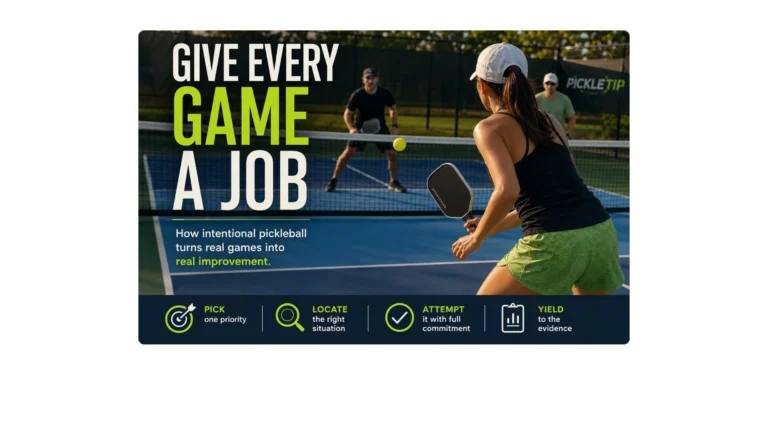
- If the skill works in drills but disappears in games, use Intentional Play to test it inside real points.
Give the Skill a Live Test
Ask a partner to give you 10 feeds with small changes in pace and location. Use the same contact you practiced against the wall and count two things separately: whether you chose the correct response and whether you executed it with the same compact shape. If the contact survives but the decision does not, you do not need more wall repetitions. You need reads and live choices.
The wall drill is finished when the contact stays repeatable. The skill is not finished until it survives a ball you did not expect.
For full solo-session structure, use How to Practice Pickleball Alone. For building a corrective drill around a recurring mistake, use Pickleball Drills That Fix Your Game.
Pickleball Wall Drill FAQs
Yes. Wall drills help with repeatable contact, paddle-face control, compact volleys and counters, touch, targets, and paddle recovery. They cannot fully train opponent reading, live spacing, shot selection, deception, or score pressure.
Mark a horizontal reference around 34 inches high. A regulation net is 34 inches at the center and 36 inches at the sidelines. The wall line is a consistent height reference, not a recreation of the net’s full shape.
Stand far enough away to finish the contact and recover before the rebound returns. Compact volley and counter drills may start two to four feet away. Touch work can use a seven-foot mark. Move back whenever you begin flinching, slapping, or losing the intended swing.
Yes. A beginner can accidentally reward a long swing, dropped paddle, frozen feet, or rushed contact by counting every rebound as a success. Use a large target, stay below full speed, and stop counting when the technique changes.
Yes. Use wall dinks to train soft contact, paddle-face control, and recovery. Then test the touch with a partner because the wall rebound does not reproduce the bounce, spacing, or trajectory of a live crosscourt dink.
They can improve quick paddle recovery and compact reactions because the rebound arrives fast. Increase the speed only while the paddle stays in front, the motion remains small, and your balance survives.
You can practice soft acceleration, paddle-face control, and a repeatable drop-shaped contact. You cannot reproduce the full distance, arc, bounce, landing, and movement of a real third shot. Confirm the shot on a court.
Use a wall for many compact contacts in little space. Use a ball machine when you need more realistic depth, spacing, movement, and repeatable feeds. Use a partner when the skill needs changing balls, reads, or decisions.
Short, focused sessions can fit several times per week when fatigue or soreness does not change your mechanics. Ten to 15 purposeful minutes on one problem is more useful than a long session of random hitting. Balance wall work with partner drills and live play.
Use the wall to repeat the part you can control. Then find out whether it survives a ball you did not expect.