The Agony of Silver – and Why It’s Still a Win
The Agony of a Silver Medal
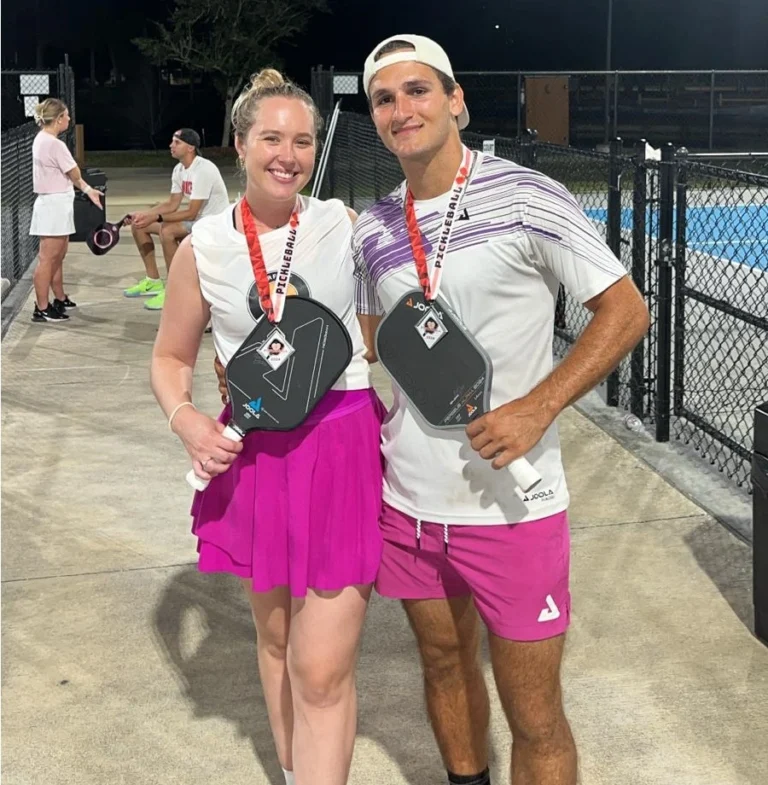
I watched every point. The final ball at the 2025 NOLA Picklefest drifted long, and the arena noise fell into that strange hush you only hear after a war of inches. You could hear the squeak of shoes on the court, the faint murmur of fans. My son AJ and his partner Diana stood frozen for half a breath, shoulders heaving, eyes burning. Silver hung around their necks like a reminder and a promise.
Here’s the truth: I felt two things at once. A sting that bit deep. And a pride so fierce it steadied my jaw. They fought in Mixed 5.0 doubles, best-of-three, and it took all three. Rallies stretched forever. Gets that normal humans do not make. A rolled ankle on day two forced a pivot; they adapted, shifted lanes, and kept swinging.

People will argue about whether silver hurts worse than bronze. I don’t buy it. What hurts is the distance between your ceiling and today’s execution. That gap? It’s the exact shape of your next breakthrough.
Quick Summary: Turning Silver Into Fuel
- Feel the sting, on purpose, then put a clock on it.
- Process over podium. You improved if your skills under fatigue rose.
- Capture three keeps and one change; schedule the change within 72 hours.
- Run the checklist below; track in a simple table so you can repeat what works.
The Pain of Coming Up Short
The final rally felt like an entire tournament stuffed into forty seconds. Reset. Counter. Hands battle. A daring third. A line painted by a millimeter. When the last ball missed by inches, the crowd exhaled; inside, the heart didn’t. My chest felt like it had been cinched tight with rope.
I looked at AJ and Diana. Their faces said everything, because that’s what striving looks like in real time. The weight of silver isn’t metal; it’s the math of what almost happened. That weight can crush, or it can concentrate you.
“Pain clarifies. It shows you the exact edge you need to sharpen.”
Coaches Analysis: Near-miss pain is amplified by contrast. Your brain expected a dopamine surge; instead, it got a cliff. Athletes who label the feeling, breathe down the spike, and exit quickly into a plan to recover faster and improve more.
Related read for building toughness under pressure: hands battles and blocking patterns on PickleTip.
The Truth Behind the Effort (Pride With Teeth)
Let’s talk receipts. AJ and Diana drilled before sunrise while most players were still asleep. The morning air was still hot enough to cause them to sweat, but the sound of the ball on paddle cracked like a starter pistol with each drill. Reps on footwork. Drilling third shots. Reps on defending heat at the kitchen. That work punched the ticket to the gold medal match on Saturday.
Day two, the ankle rolled. They didn’t fold; they adjusted. Roles shifted. Diana took more court; AJ dialed back raw aggression and leaned into control. That’s not passive, it’s tactical. Against a field this sharp, cooperation beats ego every time.
“You don’t need perfect health to play a complete match, you need a complete plan.”
If the outcome stung, why do I feel proud? Because their process was elite. They won the controllables, warm-up cadence, between-point breath, ball selection under pressure. The result was close not by chance, but by craft.
Want a deeper dive into role clarity? See our guide on when to take the middle and how to communicate with your partner.
Redefining “Winning” (How Silver Becomes Momentum)
If you’ve ever walked off the court replaying one point in your head, you know this truth. Scoreboards don’t define you, standards do. If your execution under fatigue climbs, you’re winning. Silver can be a step, not a sentence. The trick is refusing the easy story: “We lost.” No, you learned. And you learned at 5.0 speed.
Sid’s Analysis: Three levers convert second place into progress: skill under stress, teamwork signals, and post-event iteration. Improve one by five percent and your next bracket feels different. Improve all three and your rivals feel slower.
“You didn’t lose the final, you discovered the blueprint to win the rematch.”
The Minimal Blueprint
| Lever | Measure | Next Week Action |
|---|---|---|
| Stress Skills | Unforced errors per 20 rallies | 3x 15-min hands-only gauntlet sets |
| Signals | Hesitations per set | 2 cue words, used every serve receive |
| Iteration | New reps scheduled within 72h | One focused drill block on the #1 leak |
For drive mechanics that hold up when legs are heavy, study our drive consistency guide.
The 24-Hour Post-Loss Protocol (Checklist You Can Use Tonight)
Actionable: “Honor the sting, then put it on a clock.”
That clock matters, because if you let the sting linger too long it turns into weight, and weight drags.
Use this checklist to lock in growth while emotions run hot but focused.
- Set a 20-minute timer to feel it. Breathe, name the emotion, no judgment.
- List three keeps. Skills or choices that worked under pressure.
- List one change. The highest-leverage fix. Only one.
- Clip the tape. Save two points: one you won by pattern, one you lost by pattern.
- Schedule the rep. Put the change into two drilling sessions within 72 hours.
- Define roles. Who takes the middle on speed-ups? Who resets chaos?
- Close the book. Bedtime routine, light stretch, water, sleep.
If resets broke down late, revisit our dinking stability framework to rebuild your floor.
Picture This: Your Next Run (Forecast the Rematch)
The same blinding lights overhead, the same fresh pickleballs from the basket, but your body feels light this time. You and your partner step onto the same court, next event. The air hums, but your bodies feel quiet. You pick on the backhand hip they hated. Your cues are clean: “You hold middle; I clean the line.” Their speed-ups find your paddle, not your panic. When they try to drag you wide, you float the reset to their weaker player and walk in.
Why will it feel easier? Because you rehearsed the chaos you once feared. The clip you saved? Now it’s a drill. The drill became timing. Timing became faith. Faith doesn’t mean hope; it means history you created on purpose.
“Confidence is memory under pressure.”
FAQ
Near-miss pain hits harder because expectation was higher. Use structure to channel it.
Twenty minutes today. Then schedule one improvement within 72 hours.
Not fast. Review roles, fix one pattern, and test again in two events.
Train hands under fatigue and codify your middle rules.
What Is the Productive Silver Mindset?
Productive Silver is a deliberate frame: second place reveals the delta between your capacity and your competition output. You convert that gap with three tools, honest film, focused reps, and role clarity. The medal color records a day; the system you build changes your ceiling.
Pillars
- Clarity: Name leaks with film, not feelings.
- Specificity: One change per cycle beats five vague goals.
- Consistency: Reps scheduled on the calendar, not “when we can.”
A Note to AJ and Diana – And Everyone Who Fought
To AJ and Diana: your run wasn’t luck. You earned the right to feel that sting because you earned the stage. First tournament together, top division, full distance. When you both walked back to the baseline after that timeout, I saw it, the unspoken nod between you that said, “We’re still in this.” You adapted when an ankle said “no.” You trusted each other when it mattered. Keep striving, Keep competing.
“Hold your head up if you gave it your all.”
This note is for every player who left sweat and breath on the court and walked away with silver, or fourth, or anything short of the dream. You did not fail. You found the exact coordinates of your next climb.
Next Steps
- Event & Opponents: Sign up for another tournament.
- Scout Opponents: Names, styles, key tendencies.
- Three Keeps: Identify patterns that survived pressure.
- One Change: Highest leverage fix for the next tournament.
- Roles & Cues: Middle rules, speed-up targets, resets.
- Reps Scheduled: Schedule two dates for drilling within 72 hours.
Why the Brain Obsessively Replays the Final Point
Expert analysis: Brains predict payoff. When outcome flips at the finish, error signals spike and memory tags the moment as “urgent.” That’s why the last point keeps replaying. Give the loop a job: extract the decision, tag the cue, and encode a drill. Loop satisfied.
Turn Strategy Into Action
Right now, while the sound of that last point is still in your ears, write down the one thing you’ll fix this week.
- Complete a one-page debrief within 24 hours.
- Schedule two 30-minute sessions on your one change.
- Run the hands gauntlet: 3 sets × 15 minutes; record unforced errors.
- Codify middle rules with two cue words; use them.
- Rematch a similar style within 14 days and compare metrics.
When you finish, send your metrics to your partner with a simple line: “We got better this week.” That’s how silver turns into history.
About the Author: Coach Sid is the founder of PickleTip and a pickleball analyst who believes tough love, honest film, and clean reps beat talent that won’t do the work.