How to Hit a Backhand Dink on the Stretch
Wide kitchen balls expose every extra moving part. One second the rally feels calm; the next, the ball pulls outside your backhand frame, your feet stall, your arm starts reaching, and the ball floats up like you left it on a tee.
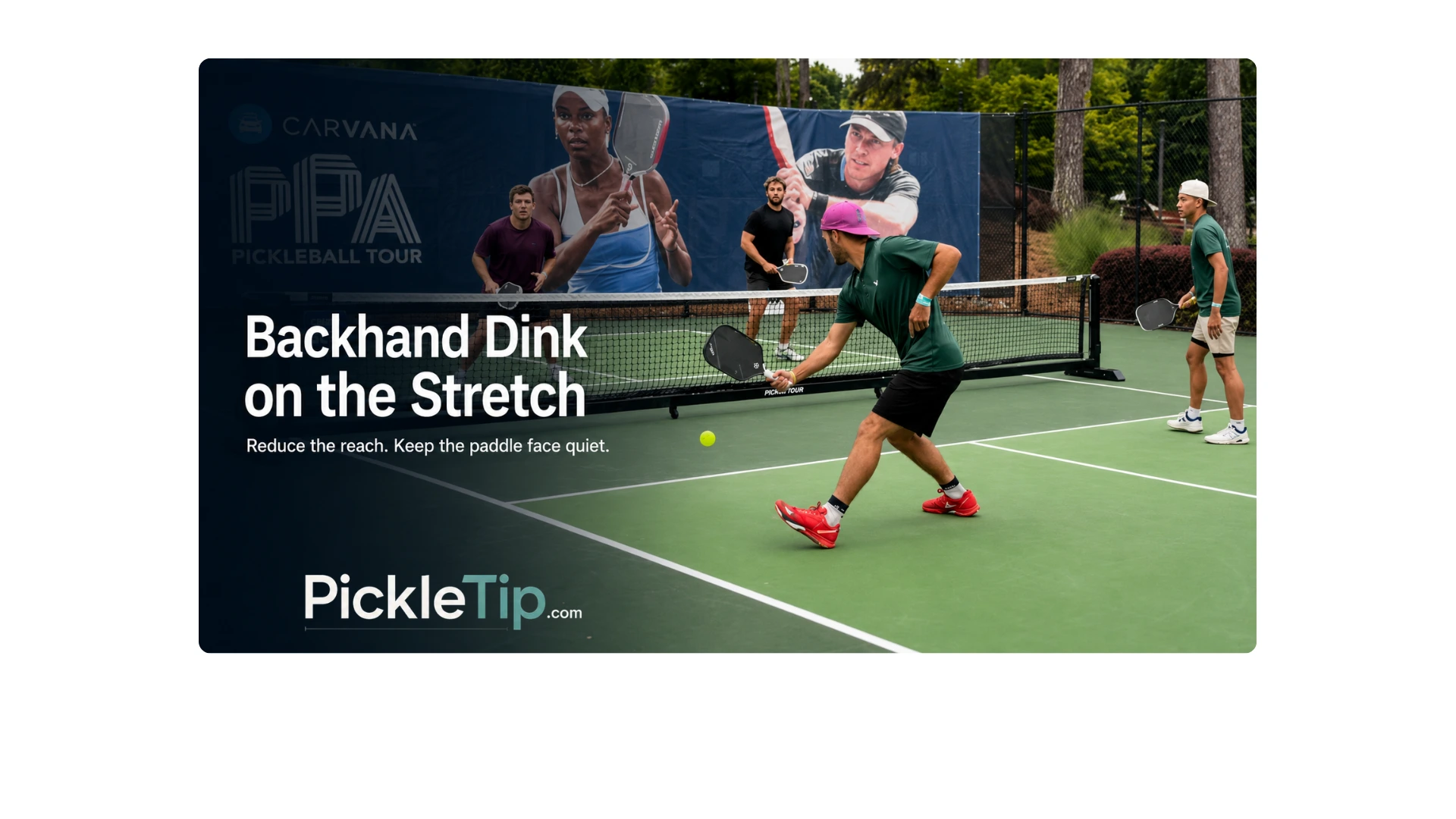
This is the emergency version of the backhand dink. Your spacing is already compromised, so forget trying to reproduce the perfect balanced stroke. Steal back whatever distance your feet can give you, keep the paddle face quiet, shorten the swing, choose a target that matches the contact, and recover from the shot you actually had, not the one you wish you had.
Start here when your regular backhand dink is mostly dependable but wider, shorter, lower, or late balls keep pulling you outside the normal contact window. If the balanced version is still unstable, begin with How to Hit a Reliable Backhand Dink. This lesson is for the player who can dink comfortably until the ball takes away the comfortable part.
Quick Answer
To hit a backhand dink on the stretch, move enough to reduce the reach before the arm completes it. Keep the head quiet and the chest supported, organize the paddle face early, and use the smallest swing that clears the net. The arm may have to improvise. The paddle face should not.
The Stretch-Dink Sequence
- Recognize whether the ball beat you sideways, forward, low, or late.
- Close distance without collapsing your head and torso toward the bounce.
- Choose one or two hands according to the reach you actually have.
- Set the face before the final emergency adjustment.
- Shorten the swing as the contact becomes more compromised.
- Choose a large target that requires little paddle manipulation.
- Recover the paddle and body before admiring the save.
Why the Normal Backhand Dink Stops Working
On a normal backhand dink, you have your spacing, contact point, and balance. A stretch dink starts when the ball steals one of those from you.
| Balanced Backhand Dink | Backhand Dink on the Stretch |
|---|---|
| Contact stays inside a comfortable frame | Contact occurs wider, shorter, lower, or later than preferred |
| The feet establish the base before contact | The base may still be moving or extended |
| The complete compact dink motion is available | You may have enough room for a dink, or only enough room to push, guide, or block the ball back |
| One or two hands can be chosen mostly by preference | Reach may force the support hand to release |
| Several precise targets may remain available | A larger neutral target usually becomes smarter |
| Recovery begins from ordinary kitchen position | Recovery begins from an outside or forward position |
The stretch dink is not a worse-looking copy of the standard stroke. It is a defensive adaptation with different priorities. Once the contact gets ugly, survival, control, and recovery matter more than making the shot look textbook.
Not Every Stretch Is the Same
I started separating these into four contacts because players kept trying the same correction on different misses. “I was stretched” is not a useful diagnosis by itself. The ball may have beaten you sideways, pulled you forward, dropped below your preferred height, or passed your ideal contact point before you arrived.
Coach Sid’s diagnostic rule: Do not diagnose every bad backhand as “too much reach.” First decide which direction took away your normal contact. The miss may look the same after the ball pops up, but the correction changes with the direction of the stretch.
1. Lateral Stretch
The ball pulls outside your stance, but you can still reach it beside you or a little in front. Take the extra side step the rally allows, preserve room between the handle and torso, and avoid reaching across an empty gap. If the contact is still in front, you may have a compact dink. If it reaches the hip, the swing needs to get much smaller.
2. Forward Stretch
The ball lands short or stays low enough that you must reach into the kitchen. Move the body forward before asking the arm to finish the reach. Keep the chest supported, and remember the non-volley-zone rule if you contact the ball in the air: your momentum cannot carry you into the kitchen after a volley. For the full rule explanation, see Pickleball Kitchen Rules.
3. Low Stretch
The ball drops below your preferred contact height. Lower through the knees and hips when time allows, match the paddle face to the ball, and add just enough lift to clear the net. The paddle still needs to travel forward. A mostly vertical path usually turns the save into a floater.
4. Late or Behind-the-Hip Stretch
The ideal contact is already gone. Stop trying to make it look like a normal dink. In front, you may still dink. Beside the hip, shorten it. Behind the hip, guide the ball back to the safest part of the kitchen and save the rally first.
Some balls are too far gone to neutralize cleanly. You can make the right save and still leave the ball a little high, and extreme extension may leave only a legal block or a ball you have to concede. The goal is not to pretend every ball is recoverable. The goal is to stop making the recoverable ones harder than they need to be.
Your exact saving range depends on your reach, mobility, and balance. Do not copy someone else’s extension if it pulls your head off line, strains the knees or hips, or makes the non-volley line unsafe. The best version is the farthest contact you can still control legally and recover from.
Move Enough, Without Collapsing Toward the Ball
Most players blame touch when the stretch dink pops up. I check spacing first. Touch is often the last thing that failed, not the first.
Take whatever extra step the rally gives you before asking the arm to reach. But “get closer” does not mean dropping your face beside the bounce or folding your torso sideways. Bring your base closer while keeping your eyes level enough to track the ball and your chest supported over the legs instead of folding sideways.
- Move the feet and center of mass: reduce the unnecessary gap between your body and the expected contact.
- Keep the head quiet: do not chase the ball with your face or tilt so far that vision and balance disappear.
- Keep the chest supported: lower through the knees and hips instead of folding at the waist.
- Preserve handle space: get close enough for control without jamming the paddle against your body.
- Accept some extension: the goal is not perfect comfort. It is less panic at contact.
Better feel: Move your base toward the bounce, not your face toward the ball.
Stretching is sometimes unavoidable. Arm-only reaching is not always avoidable either, especially late in the rally. The useful distinction is whether the feet reduced the reach before the arm completed it.
One-Handed vs. Two-Handed Stretch Dinks
Two hands may make the ball feel safer, right up until they stop you from reaching it.
| One-Handed Stretch Dink | Two-Handed Stretch Dink |
|---|---|
| Provides the greatest maximum reach | Adds support and face stability on moderate extension |
| Allows the paddle farther from the torso | Can help on low contacts that remain close enough to the body |
| Often becomes necessary on severe lateral width | May crowd the contact when the ball gets extremely wide |
| Requires the wrist to stay quiet without a rescue flick | Works best while both hands arrive without pulling the torso off balance |
| May begin from a two-hand preparation before the support hand releases | Reduces reach when the support hand becomes the limiting factor |
Keep two hands only while both hands help. When the support hand starts stealing reach or pulling the shoulders off line, release it and finish the contact with one hand.
A player may prepare with two hands and release the support hand only when full extension becomes necessary. That is not a breakdown of the two-handed technique. It is a practical response to the ball. Your preferred style stops mattering when the second hand is the reason you cannot reach the contact.
AJ worked on this for a long time. He habitually had problems during tournaments where he would squeeze the middle of the court too much and get caught inside. He would then get stretched by a wide dink and prepare his two-handed backhand, but because he was late, he would stay attached too long which caused him to lose reach. He studied film, and drilled the mechanics so that it no longer happens because he releases his support hand earlier now.
Stable Paddle Face, Adaptable Arm
The arm may have to improvise. The paddle face should not.
- Let the shoulder lead: carry the hand toward contact without turning the save into a large rotational swing.
- Let the elbow fit the spacing: extend naturally instead of poking, chopping, or accelerating independently.
- Keep the wrist quiet: natural movement is fine; a late flip, snap, or emergency slap is not.
- Use the torso for support: move with the base instead of trying to power the ball while already extended.
Your wrist will not freeze in place while the arm reaches. That is fine. “Stable” does not mean motionless. It means the paddle face does not make a sudden independent decision during the contact window.
If your normal dink has too many moving parts, Pendulum Dinking may help you feel a shorter shoulder-led motion. Do not turn that cue into rigidity. The elbow and arm still need enough freedom to fit the emergency spacing.
Shorten the Swing, Give Yourself Margin
The worse the contact gets, the less swing you can afford. Use the smallest motion that gives the ball enough height and depth to remain playable.
- Set the face as early as the stretch allows.
- Guide the hand toward the ball with the shoulder.
- Let the elbow extend according to the reach you have.
- Move forward through the ball with just enough lift to clear the net.
- Finish small enough that recovery can begin immediately.
Low Net Clearance Is Not the Goal
A stretched contact usually needs more margin than a balanced dink. Give the ball enough arc to survive the net while keeping it below comfortable attack height. A defensive ball that lands safely and buys recovery is doing its job.
A good save can still be attacked. That does not automatically make the mechanics wrong. Sometimes the contact was simply too compromised to create a perfect neutral ball. Judge the shot by whether you chose the best response the position allowed.
Avoid the Scoop
“Get under it and carry it” can help a player understand that a low ball needs clearance. Taken too literally, it also creates the scoop.
| Controlled Low Stretch Dink | Scooped Stretch Dink |
|---|---|
| The face matches the contact | The face opens too much |
| The path moves forward with enough lift | The path moves mostly upward from beneath the ball |
| The arm guides the contact | The wrist or hand lifts independently |
| The ball clears and begins descending | The ball floats and stays attackable |
| The finish remains compact | The finish rises or wraps unnecessarily |
Better cue: Guide forward through the back of the ball and add only the lift the low contact requires.
Standing tall can contribute to a poor low contact, but posture alone does not make the ball float. Check the face angle, paddle path, wrist, spacing, and timing together. “Softer hands” is not much of a diagnosis when the wrist is doing emergency surgery at contact.
Optional Adjustment: Grip Position
I would not teach a last-second grip change as the first repair. Most players already have enough variables moving during a stretch. Fix the spacing and paddle face before adding another emergency decision.
Staying in your normal grip preserves familiar timing and face awareness. Holding lower toward the butt cap can add effective reach, but it also makes the paddle feel longer and may reduce face stability. Choking up slightly can improve maneuverability, but it takes reach away. None of those tradeoffs is automatically better.
There is no universal emergency grip position. Test small changes during controlled feeds and decide whether one helps your specific stretch pattern. If the adjustment makes you late, awkward, or unsure, leave it alone. For grip fundamentals, see How to Hold a Pickleball Paddle.
Dink, Block, or Let It Bounce?
Not every stretched ball should be forced through the normal backhand-dink motion. The farther contact moves behind the hip, the less swing remains available.
| Contact You Have | Best Response |
|---|---|
| Moderate lateral stretch with contact still in front | Compact adapted dink |
| Low stretch with usable balance | Short forward-and-upward neutral dink |
| Volley reached comfortably outside the base | Short defensive block |
| Contact beside the hip | Abbreviated push or neutral block |
| Late contact behind the body | Guide it back to the safest part of the kitchen |
| The bounce creates a better contact window | Let it bounce and reclaim spacing |
Do not reach for a volley merely because taking the ball early sounds aggressive. Let it bounce when the bounce gives you a better base, more room from the body, or a contact point farther in front. Earlier is not automatically better. More controllable is better.
For general bounce-versus-volley mechanics, see How to Dink in Pickleball.
Bad Contact, Bigger Target
From a compromised position, do not try to solve the whole rally with one dink. First send a ball that lets you recover.
Choose the largest available target that requires the least paddle manipulation.
A bad contact is the wrong time to prove you can paint a sideline.
That target may be middle, straight ahead, or moderate cross-court depending on your body position and the paddle path you still have. Do not prescribe the inside foot, cross-court, or down the line automatically. The safest target changes with the contact.
For complete target selection, angle management, ATP awareness, and partner recovery after a wide cross-court dink, see How to Defend a Wide Cross-Court Dink. For broader patterns and pressure decisions, use Pickleball Dinking Strategy.
The Shot Is Not Over at Contact
The ball leaving the paddle does not finish the rep. You still have to regain balance, bring the paddle home, and play the next one.
- Stabilize the contact: do not push back before the paddle has completed the shot.
- Load the outside leg when possible: use it to begin the return toward balance.
- Bring the paddle back in front: recover the hands while the feet move.
- Use controlled recovery steps: avoid crossing so early that the next ball catches you turned.
- Recover according to the ball you sent: do not sprint toward one painted spot without reading the next shot.
Success Standard
A stretch dink is not successful merely because it lands. It should also leave you capable of playing the next ball.
Team shifting, middle coverage, and ATP protection are part of the wider tactical problem. Those belong in the wide cross-court defense guide. Here, the individual job is simple: stabilize, recover the paddle, and regain a base that lets you participate in the next exchange.
Why Stretch Dinks Pop Up, Spray, or Die
When a player tells me the ball “just popped up,” I check spacing and paddle path before blaming touch. The ball result is useful, but it is only the final clue.
| What You See | Likely Cause | First Repair |
|---|---|---|
| Ball floats high | Arm-only reach, open face, mostly vertical path, or late wrist change | Move the base closer, set the face earlier, and add more forward direction |
| Ball dies in the net | Face too closed, not enough lift, late contact, or reaching level across the ball | Improve spacing and add just enough upward path to clear the net |
| Ball sprays wide or deep | Late face rotation, off-center contact, across-body path, or wrist rescue | Shorten the path and guide through a larger target |
| Ball lands but sits up | Too much height or depth, poor target, or slow recovery | Reduce unnecessary lift and choose a simpler neutral target |
| Contact feels weak | Too much reach and no body support underneath it | Close more distance or use a shorter block |
| Two-handed contact feels crowded | The support hand is limiting reach | Release the support hand |
| One-handed contact feels unstable | Grip tension, wrist rescue, or poor body support | Quiet the face and improve the base before adding hand action |
| Next ball catches you late | Oversized finish, poor outside-leg load, crossing too early, or watching the save | Finish smaller and recover the paddle with the feet |
| Contact is acceptable but the opponent attacks anyway | The target was too ambitious or too comfortable for the opponent | Choose the boring location that buys recovery |
The most common pattern is still spacing. The miss usually starts before contact: the feet stop, the arm reaches across empty space, and the paddle face gets asked to rescue the whole shot. Fix that sequence before chasing a magical touch cue.
How to Practice the Stretch Dink
I do not start this with random feeds. Let the player find one clean correction first. Then start changing the feed and punishing the balls that sit up.
Build the Base Dink First
If you cannot yet land routine cooperative backhand dinks, this progression will turn into emergency practice before the base stroke exists. Build the balanced version first, then return here when width, height, or timing is the part breaking the shot.
1. Shadow Reach and Recovery
Without a ball, rehearse lateral, forward, low, and late-contact positions. Move the base, extend the arm, hold the paddle face, then recover from the outside leg.
Goal: 10 controlled repetitions in each direction without head collapse, a wrist flick, or an oversized finish.
2. Fixed Wide Feed
The feeder sends the same moderate lateral ball repeatedly. Close distance, keep the contact outside but in front, and use a compact neutral dink. After several clean repetitions, feed the same width a little lower.
Track: whether the body reduced the reach before the arm finished it, and whether the paddle traveled mostly forward or mostly upward.
3. One-Hand vs. Two-Hand Decision Drill
The feeder varies width. Keep two hands while they support the contact without stealing reach. Release the support hand when the ball moves beyond the practical two-hand window.
Goal: let the ball decide the hand structure instead of choosing from habit.
4. Random-Width Recognition Drill
Mix normal backhand dinks with lateral, forward, low, and late feeds. The player calls the type of contact before hitting, uses the largest neutral target available, then recovers the paddle and base.
Goal: recognize when the normal dink remains available and when an emergency adaptation is required.
5. Live Consequence Game
Start with one comfortable dink followed by a wider backhand feed. After the stretch contact, the rally becomes live. The feeder may attack any ball that sits up.
- Hit 8 to 10 balls per set.
- Include at least 6 genuine stretch feeds.
- Run 3 to 5 sets, then switch roles.
- Do not run around the feed to avoid training the backhand pattern.
- Count the rep successful only when the defender begins a usable recovery.
Pressure Standard
The shot should clear the net with margin, remain difficult to attack, and leave you square enough to handle the next exchange. Merely surviving the net is not the complete skill.
A Wide Ball Is Not Always the Same Problem
A wide cross-court dink can create the stretch, but surviving the contact and defending the angle are two different jobs. The immediate problem is your spacing, reach, hand structure, paddle face, swing size, and recovery. The wider tactical problem includes reading the angle, protecting the ATP, moving with your partner, and deciding where the team shifts after the return. That larger problem is covered in How to Defend a Wide Cross-Court Dink.
Backhand Stretch-Dink Learning Path
| Your Question | Best Guide |
|---|---|
| How do I build the ordinary balanced backhand dink? | Reliable Backhand Dink |
| How do I build the complete basic dink? | How to Dink in Pickleball |
| How do I defend the geometry of a wide cross-court dink? | Defending a Wide Cross-Court Dink |
| Where should I target the ball during dink rallies? | Pickleball Dinking Strategy |
| How do I simplify a dink with too many moving parts? | Pendulum Dinking |
| How should I hold the paddle? | How to Hold a Pickleball Paddle |
| What are the kitchen momentum rules? | Pickleball Kitchen Rules |
| How do I build the rest of the backhand game? | PickleTip Backhand Guide |
Recover From the Contact You Actually Had
A good stretch dink does not need to look like the ordinary version. The contact is already compromised. Steal back what spacing you can, keep the face from panicking, choose the boring target, and recover quickly enough to play the next ball. Once you stop asking an emergency position to produce a perfect shot, a lot of ugly kitchen rallies become much easier to survive.
Backhand Dink on the Stretch FAQ
It is a defensive backhand dink played when the ball pulls outside, shorter, lower, or later than the normal contact window. The shot usually requires more movement, a smaller swing, a simpler target, and an immediate recovery.
Move the feet and center of mass closer to the expected contact before completing the reach. Keep the head quiet and the chest supported instead of folding sideways. Some arm extension may remain necessary, but the base should reduce it first.
Use two hands while they add stability without limiting reach. Release the support hand when the ball moves beyond the practical two-handed window or starts pulling the torso off balance.
The most common causes are poor spacing, an open paddle face, a mostly vertical paddle path, late wrist movement, or contact that has moved too far beside or behind the body. Check the full sequence before blaming touch.
Volley when you can meet the ball outside the base without leaning, jamming, or losing face control. Let it bounce when the bounce gives you better spacing, a contact point farther in front, or more time to recover the base.
Choose the largest available target that requires the least paddle manipulation. That may be middle, straight ahead, or moderate cross-court depending on the contact and body position. A compromised contact is usually the wrong time to chase a sideline.
Not during the emergency unless the adjustment has already been practiced. Holding lower can increase effective reach but may make the paddle feel longer. Choking up can improve maneuverability but reduces reach. Fix spacing and face control first.
Begin with fixed wide feeds so you can feel the spacing and paddle-face correction. Then vary width, make one-hand-versus-two-hand decisions, add random recognition, and finish with a live rally where the feeder may attack any ball that sits up.