

Understanding DUPR Pickleball Ratings
If you’ve been around the courts lately, you’ve probably heard players ask: “What is DUPR?” It’s one of the most common questions in pickleball today, because understanding DUPR is the first step to making sense of skill levels and competitive play.
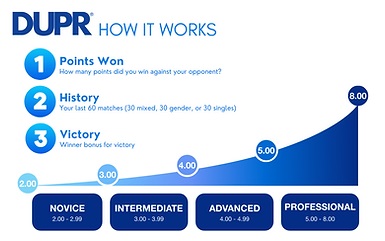
DUPR stands for Dynamic Universal Pickleball Rating. It’s the official global rating system designed to measure player performance on a single scale. Instead of relying on self-assessment or loose labels, DUPR calculates your rating using actual match results, your opponent’s strength, and how close the score was.
Every player, from casual beginners to touring pros, lands somewhere on the same 2.0 to 8.0 scale. That shared framework makes it possible to compare skill across ages, genders, and locations, giving clubs, leagues, and tournaments a consistent way to match players fairly.
The Importance of DUPR in Pickleball
DUPR isn’t just another number, it’s the system that keeps pickleball organized and competitive. Without a trusted rating scale, players would struggle to find fair matches, tournaments would end up unbalanced, and improvement would be difficult to measure.
For everyday players, DUPR offers a clear benchmark. Instead of guessing whether you’re a 3.0 or a 4.0, the system provides a rating based on real results, not opinions. That helps you track progress, set realistic goals, and choose events that fit your skill level.
For clubs and leagues, DUPR is a sorting tool. Organizers can place players into brackets or divisions with more confidence, ensuring close, competitive games that keep people coming back. Nobody wants to play matches that are lopsided from the start.
For the sport as a whole, DUPR provides a common language. Whether you’re in a local rec center or a national tournament, a DUPR number means the same thing. That consistency makes it easier to grow pickleball across different regions and levels of play.
Changes in the DUPR Algorithm
DUPR has already gone through several updates as the system has grown. Understanding these changes helps players make sense of why ratings move the way they do.
The old DUPR algorithm
- Updates were made weekly, often without explanation.
- Ratings could shift even if you hadn’t played that week.
- Some players saw their number rise after a loss, or fall after a win, which caused confusion.
The new DUPR algorithm
- Ratings now update faster, often within 24 hours.
- Wins always move your rating up, and losses move it down.
- The margin of victory still matters, a narrow win against a weaker player won’t help as much as a dominant one.
- Tournament results carry extra weight to reflect higher pressure play.
- New tools, like the DUPR app and “genie tool,” let players see how results impact their number in real time.
These adjustments are designed to make DUPR more transparent, predictable, and trustworthy, so players understand why their rating changes.
If you’re hearing people talk about the new paid Reset window, here’s the full breakdown: DUPR Reset (2026): dates, cost, rules, and reliability
DUPR Waterfall – How it Works
One unique feature connected to DUPR is the Waterfall Tournament format. It’s designed to give players multiple competitive matches in a short window, while keeping games balanced based on performance.
Here’s how it works step by step:
- Starting point: All teams begin in the middle of the bracket, regardless of rating.
- Round one: Winners move to the “east” side of the draw, while those who lose shift to the “west.”
- Round two and beyond: Teams keep moving east or west depending on wins and losses, gradually sorting players into groups of similar strength.
- Finals: The last round determines winners from each side, ensuring every team gets four meaningful matches.
A standard waterfall draw usually includes 16 teams (32 players), with all matches played in just a few hours. Each match is best two out of three games to 11 points.
The benefit of this format is efficiency and fairness: everyone gets the same number of games, and players end up facing opponents at their own level by the end of the event. It’s a popular way for clubs to run social but competitive sessions while feeding results directly into DUPR.
Frequently Asked Questions about DUPR
DUPR (Dynamic Universal Pickleball Rating) is the official skill rating system in pickleball. It ranks players worldwide on a 2.0 to 8.0 scale using match results, opponent strength, and score margins.
DUPR ratings update based on how you perform relative to expectations. Beating stronger opponents boosts your rating more, while a narrow win against a weaker player may not help much.
Most results appear within 24 hours. During busy tournament weeks, updates may take longer. New players starting with no rating might see up to a 7-day delay.
While DUPR adjusts from your very first games, at least 20 matches are recommended for a stable and reliable rating.
Half Life means older matches slowly lose weight in the algorithm. This keeps your rating focused on recent play, not just old results.
If you were expected to win easily but only scraped by, DUPR may still adjust your rating downward. It measures performance versus expectation, not just wins and losses.
Most recreational players sit between 3.0 and 4.0 DUPR. Competitive players often rate 4.5 and higher, while professionals range from 6.0 to 8.0.
No. Accounts are free, and both recreational and tournament matches can be logged to update your rating.
Final Thoughts on DUPR
DUPR gives every pickleball player a place on the same scale, from first-timers to seasoned pros. By tracking match results against opponent strength, it provides a fair and transparent way to measure progress.
This page explained the basics of DUPR, what it is, why it matters, and how players can expect ratings to change. If you’d like to dig deeper, you can explore our companion guides:
- How DUPR Ratings Work – a full breakdown of the system, algorithm, and updates.
- DUPR Ratings: Strengths and Weaknesses – an opinion piece on what DUPR gets right and where it falls short.
By starting with the fundamentals here, you’ll be ready to understand those deeper discussions and make the most of your rating.





Great article, but I have to say, it’s frustrating how often DUPR changes its algorithm. Just when I think I’ve got a handle on how it works, they go and tweak something. The new features like the genie tool are helpful, but I wish they would just pick a system and stick with it. It’s hard to keep up with all the changes and understand how they affect my rating.
DUPR is currently not accurate.
It is producing many obvious significant errors.
It can impact playing and coaching careers.
Can DUPR be fixed?
DUPR is trash. There are great losses and bad wins. DUPR doesn’t really tell you much accurately at all especially when considering doubles play. Shame this is what people are hanging their hats on.
I think that recently DUPR has been much better. The new reliability thing is nice. They have fixed a lot of things, and my rating looks much more accurate.