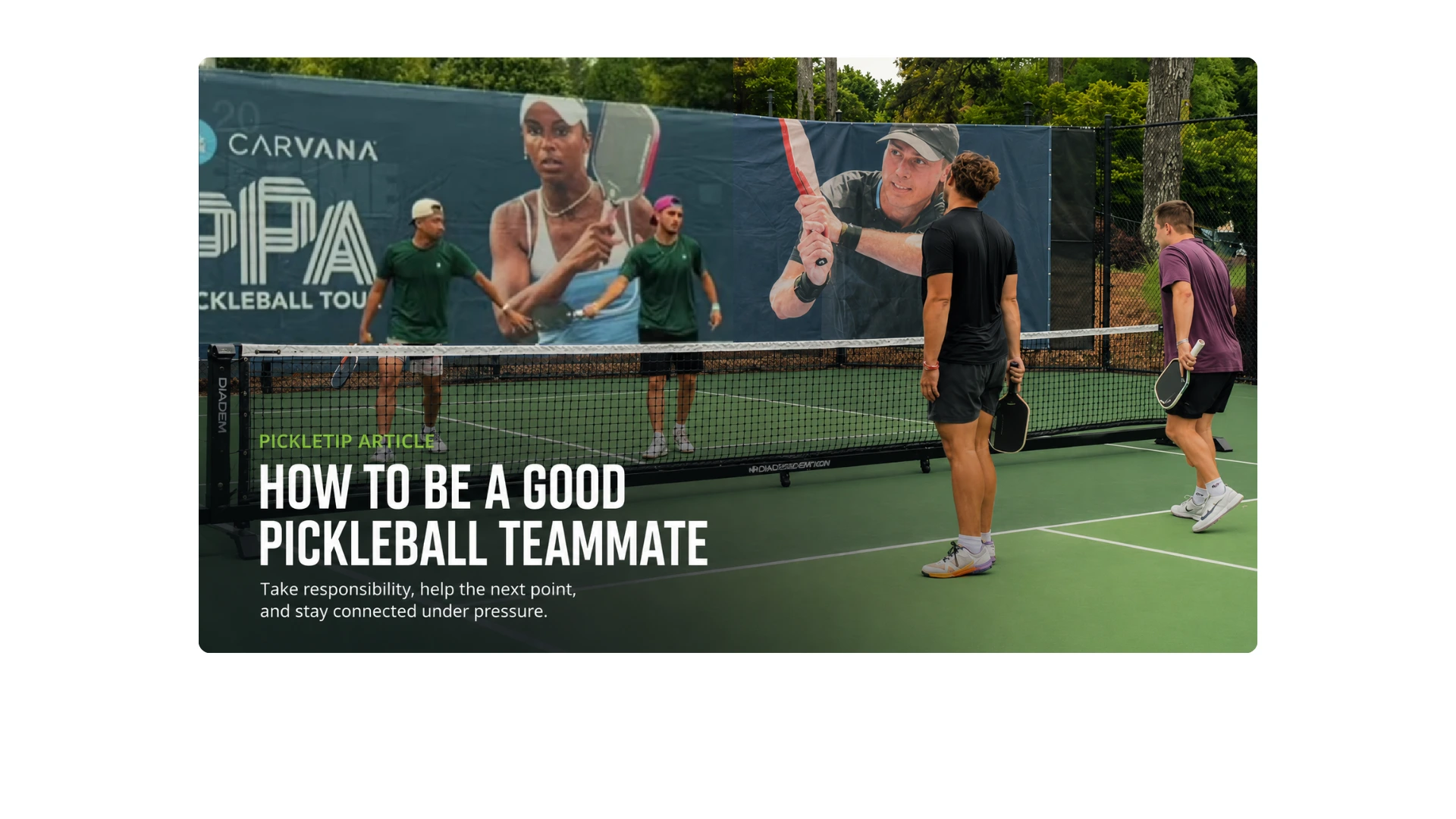
How to Be a Good Pickleball Teammate Under Pressure
Your partner misses two returns, gets targeted on the next rally, and looks toward you. What you do in the next five seconds can steady the team or make the match feel even heavier.
A good pickleball teammate becomes easier to play beside when the match gets uncomfortable, not harder. Your partner should be preparing for the next ball, not studying your face to figure out whether you are angry, disappointed, or about to start coaching.
I have seen a player miss one ordinary return and spend the next three rallies watching their partner’s reaction. The original mistake was gone. The uncertainty between them was what kept growing. They were no longer reading only the opponents. They were also trying to figure out whether the person beside them still trusted them.
I also coached a student who sighed so loudly after mistakes that every partner knew exactly what he was thinking. He was a great player, but nobody wanted to play beside him.
Your partner should not have to compete against the opponents and recover from you at the same time.
How to Be a Good Pickleball Teammate
Take responsibility for your own play. Respond to mistakes in a way that helps the next point. Ask before coaching. Stay engaged when the match becomes uncomfortable. A good teammate gives the partnership more clarity under pressure instead of becoming another problem the partner must manage.
What Your Partner Needs From You
A good teammate gives the other player fewer things to worry about. Your partner should be watching the ball, not wondering what every sigh, paddle slap, stare, or sudden change in court position means.
Your partner should not have to wonder:
- Are you angry with me?
- Are you blaming me for the score?
- Are you about to coach me again?
- Did the plan change?
- Are you taking over the court?
- Do you still trust me?
- Am I allowed to make another mistake?
You cannot control every rally. You can control whether your behavior gives the team more clarity or more uncertainty.
The PickleTip TEAM Standard
| Letter | Teammate responsibility |
|---|---|
| T | Take Responsibility for your own contribution |
| E | Ease the Next Point after a mistake |
| A | Ask Before Coaching your partner |
| M | Maintain the Partnership under pressure |
T — Take Responsibility Before Correcting
Own your contribution before pointing toward your partner.
- “I crowded you there.”
- “My return gave them that attack.”
- “I changed the pattern without telling you.”
- “I need to move with you earlier.”
Use I when the mistake was yours. Use we for a shared tactical adjustment. Avoid using you to assign blame during the match.
| Useful language | Blaming language |
|---|---|
| “I am leaving too much middle. I’ll close earlier.” | “You keep leaving the middle open.” |
| “Let’s give ourselves more margin on the next return.” | “You need to stop missing those.” |
| “I changed the call late. That was mine.” | “We were both confused,” when the late call was yours |
Do not hide behind fake shared blame when the mistake was clearly yours. Specific ownership builds more trust than a vague apology.
Own the Mistake Without Starting an Apology Loop
A short apology can help when your action directly created confusion:
“I changed the call late. That was mine.”
An apology becomes another burden when it turns into:
“I’m sorry. I’m playing terribly. I’m ruining this.”
Now your partner has to stop preparing for the next point and convince you that you are not ruining everything. The apology sounds accountable, but your partner is suddenly managing your reaction while trying to play the next point.
Own the mistake without asking your partner to make you feel better about it.
E — Ease the Next Point
After a mistake, ask one question:
What response helps this team play the next rally?
The answer may be no response, a paddle tap, “Next ball,” one tactical cue, a brief clarification, or a timeout. The right response depends on the player, the score, and whether the problem was emotional, tactical, or simply one missed ball.
The last point is over. Your response should help your partner play the next one.
| Situation | Useful response | Unhelpful response |
|---|---|---|
| Partner misses a routine ball | Reset normally; use a familiar short cue if needed | Technical explanation |
| Partner repeats the same tactical choice | Suggest one shared adjustment during a natural pause | “Why do you keep doing that?” |
| Partner appears embarrassed | Reduce attention on the miss and prepare normally | Excessive reassurance |
| Partner becomes visibly frustrated | Stay steady; ask one direct question during a timeout | Match their frustration |
| Partner is being targeted | Stay connected and cover the predictable next ball | Take over the entire court |
| You caused the breakdown | Own it specifically | Say “we” to avoid responsibility |
| You disagree with the plan | Request one clear adjustment | Quietly abandon the plan |
What This Looks Like at 8–8
Picture a game tied at 8–8. Your partner has missed two returns, the opponents have started sending every third shot toward them, and you feel yourself creeping farther into the middle.
At 8–8, start with your own behavior. Own any ball you crowded, help the next point instead of replaying the last one, ask before offering a correction, and stay connected without quietly replacing your partner. You may still adjust the pattern. You may even take more middle. But the adjustment should be clear and agreed, not something your movement announces after you have already stopped trusting your partner.
Honest Encouragement Is Better Than Fake Praise
Support does not require pretending that every shot was good.
- Avoid “Great shot!” after an obvious miss.
- Avoid “No problem!” when a repeated team problem clearly exists.
- Avoid praising every miss so aggressively that your partner starts feeling handled instead of supported.
- Avoid turning every mistake into a motivational speech.
More useful responses may include “Right idea,” “More margin next one,” “I’m with you,” “Same pattern,” “Let’s slow this down,” or “We’ll discuss it at the timeout.”
Different partners want different things. One player may want a paddle tap. Another may want one direct tactical cue. Another may want you to call the score and stop talking. The mistake is assuming your preferred style of encouragement works for everybody.
Sometimes the most supportive response is calm, normal behavior. Not every partner wants “You’ve got this!” after every error.
Ask your partner before the match: “When you miss, do you want encouragement, information, or space?”
A — Ask Before Coaching
A missed shot does not automatically create a coaching invitation.
The Two-Minute Conversation to Have Before You Play
You do not need a team summit before every rec game. Before a tournament, league match, or serious session, however, two minutes of clarity can prevent a lot of tension later. You also do not need to work through every question like a prematch questionnaire. Pick the two or three most likely to matter with this partner.
- Do you want feedback during games?
- Are short tactical reminders helpful?
- After a mistake, do you want encouragement, information, or space?
- What should we do if one player starts getting targeted?
- What phrase means we need to slow down?
Match Information Is Not a Swing Lesson
| Tactical information | Technical coaching |
|---|---|
| Concerns the current match | Tries to change mechanics |
| “They are sitting on the crosscourt dink.” | “Move your contact point farther forward.” |
| “Let’s use more middle.” | “Your backswing is too big.” |
| Can often be useful during competition | Usually belongs in practice or after the match |
Say the useful thing directly, briefly, and at the right time. Do not disguise criticism inside a praise sandwich. For calls, signals, middle-ball language, and communication mechanics, use the doubles pickleball communication guide.
M — Maintain the Partnership Under Pressure
Support is not a reward your partner receives only while playing well.
Keep moving, continue communicating, and return to position after every rally. When one player withdraws, stops making calls, rolls their eyes, or begins walking away after mistakes, the whole partnership becomes uncertain.
Stay engaged when you are receiving fewer balls, getting targeted, or watching a lead disappear. You can usually see a partnership fall apart before the score does: fewer calls, slower walks back to position, and two players standing beside each other without really playing together.
Your facial expressions, posture, and paddle gestures also affect the next point. For the full mechanics, use the pickleball body language guide.
When Your Partner Is Being Targeted
Opponents may direct most balls toward one player. That is a tactical choice, not a public verdict on your partner’s worth.
Help with the pattern, not the panic. If the opponents keep driving at your partner and then looking for the next ball through the middle, prepare for that ball. If the crosscourt dink keeps pulling your partner wide, agree on who protects the middle behind it. Solve the rally pattern without treating your partner like the problem.
- Prepare for the predictable next shot.
- Use a timeout when the team needs clarity.
- Continue giving the partner playable opportunities.
- Adjust roles only through an agreed plan.
- Do not make the partner feel ashamed for receiving more balls.
Being targeted does not mean your partner has stopped being your partner.
Support Without Taking Over the Court
Sometimes planned poaching or court compression is the right tactical adjustment. Quietly replacing your partner is different.
- Crossing far beyond agreed middle responsibility.
- Cutting off balls the partner is prepared to play.
- Changing sides without discussion.
- Playing every third shot without an agreed reason.
- Using movement to signal that the partner is no longer trusted.
Once you start cutting your partner off, both players become less certain about who is taking the next ball. The spacing gets worse, the hesitation gets worse, and the struggling player usually tightens up even more.
Do not confuse helping your partner with replacing your partner.
For planned court responsibilities, middle ownership, and partner roles, use the pickleball partner strategies guide.
Cover the Ball First. Debate It Later.
Partners will disagree. One player may think the middle ball belonged to the forehand. The other may believe a switch should have happened sooner. During the rally, cover the choice your partner made. A disagreement becomes two mistakes when one player stops playing to prove the other decision was wrong.
| When | What to do |
|---|---|
| During the rally | Cover the decision your partner made |
| Between rallies | Clarify only what the next point requires |
| During a timeout | Discuss the repeating pattern |
| After the match | Review the decision without putting every missed ball on trial |
This follows the same principle used in the pickleball team chemistry guide: cover first, discuss it later.
When Your Partner Corrects You
Being a good teammate also means receiving feedback without treating every suggestion like an accusation.
- Listen to the full cue.
- Ask whether the feedback is tactical or technical.
- Do not answer every suggestion with an excuse.
- Say when the timing or amount of feedback is becoming unhelpful.
- Return attention to the next point.
If you coach your partner after every miss but have an excuse for every suggestion they give you, that is not teamwork.
If the feedback becomes constant, personal, or badly timed, say so without starting another argument: “I can use one tactical cue right now. Let’s save the mechanics for later.”
What to Say After a Difficult Match
Do not conduct a full emotional trial in the parking lot.
- Each player owns one thing.
- Identify one repeating team pattern.
- Preserve one thing that worked.
- Decide whether a longer review is needed.
- End the immediate conversation before frustration becomes accusation.
For a full post-tournament review after a painful result, use The Agony of Silver. When the problem is your own mistake carrying into later rallies, use the PACE mental-game process.
Some Partnerships Need a Different Conversation
The TEAM standard can make a difficult match more manageable, but it cannot repair every partnership in eleven points. Some partners are still arguing about the same middle ball they disagreed about three tournaments ago. Others have different competitive goals, communication styles, or ideas about court roles.
If the same conflict keeps returning, the problem may not be what either player says after one missed ball. It may be whether the partnership works at all. The guide to choosing a pickleball partner addresses that larger question.
Pickleball Teammate Questions
A good pickleball teammate takes responsibility, helps the team reset after mistakes, avoids unwanted coaching, communicates clearly, and stays connected when the match becomes uncomfortable.
Use the response your partner actually finds helpful. That may be a paddle tap, a calm “Next ball,” one tactical cue, or no comment at all. Avoid turning one missed ball into an immediate technical lesson.
Only when that type of feedback has been discussed or requested. Short tactical information can help during a match, but unrequested mechanical coaching usually adds tension and extra thoughts.
Stay connected, prepare for the predictable next ball, and make tactical adjustments together. Do not shame the partner or begin taking every ball without discussion.
Yes. Constant reassurance can make a miss feel larger or make the partner feel managed. Honest, normal behavior is often more supportive than automatic praise after every error.
Be Easier to Play Beside
The best teammate is not always the loudest encourager or the player who takes the most court. It is the person who remains predictable, honest, and connected when the match starts going badly.
Competitive goals do not excuse disrespect. A match can matter without making your partner feel small.
Your partner will remember how you played. They will also remember how playing beside you felt.