
Vapor Power 2 vs Spartus P1 Hybrid: Speed Hands vs Tank Stability
Vapor Power 2 vs Spartus P1 Hybrid comes down to one ugly moment: you’re down 8–9, a speed-up is coming at your right hip, and your “save” block has to stay boring. One of these paddles tends to reward being early and aggressive. The other tends to forgive being late and cramped.
Picture this: your partner just fed a shoulder-high floater, the other team is loading up, and you’ve got about half a heartbeat to decide whether your paddle will reward “early and square” or forgive “late and reaching.” That’s the comparison: quick-reload speed versus composure stability, especially when contact happens behind your hip.
One thing to remember: any numbers used in the specs sections below are presented as manufacturer specs and/or reported third-party examples (methods and units vary). Use them as direction signals. Make the final call based on what happens when you’re late, jammed, or tired.
Straight answer: If your biggest point leak is late blocks that launch, P1 Hybrid usually fits better because lower pop and higher stability tend to keep panic contact shorter and calmer. If your edge is early counters and fast reload, Vapor Power 2 usually fits better because it rewards being first and square, at the cost of stricter face discipline when you’re late.
Verdict for most players
Choose based on the one touch that decides your rallies. If you’re usually early on the speed-up and you like taking space with first-strike counters, Vapor Power 2 tends to pay you back. If you’re usually late (jammed, reaching, feet stuck) and you need your blocks to stay short and forgettable, P1 Hybrid tends to save more points.
At a glance
- Pick Vapor Power 2 if: you win points by taking space early, countering first, and you can keep a quiet, slightly closed face when the ball is speeding up.
- Pick P1 Hybrid if: you win points by surviving ugly exchanges, keeping blocks boring, and shaping the ball without overswinging, especially when fatigue shows up.
- Avoid both if: you refuse to adjust anything when you’re late, because both choices still require you to recognize the speed-up early and avoid the wide-open “panic face” that gifts depth.
Skip this matchup if…
- You’re not choosing between these two mistake-coverage profiles.
- You don’t play hands battles or defend speed-ups at the kitchen line (because that’s where the separator shows up).
Regret triggers (read this like money matters)
- You’ll regret Vapor Power 2 if… you’re late by habit and your “save” block tends to be open-faced (Vapor can turn that into depth and launch).
- You’ll regret P1 Hybrid if… you live for fast reload hands battles but your wrist/forearm gets cooked late (higher swing weight can shrink your timing window).
- You’ll regret either if… you need tournament-rule certainty and you don’t check the event requirements and the current approval listing before you buy.
Glossary (the few terms that matter here)
- Swing weight: A measure that strongly predicts how fast a paddle feels to accelerate and how taxing it becomes late in sessions. Higher swing weight often narrows your “late contact” window.
- Twist weight: A measure tied to stability on off-center contact. Higher values generally mean less face twist when you catch the ball toward the edge.
- Pop: How quickly the ball rebounds on short, compact contact (especially blocks and counters). More pop can create offense early, and launch when you’re late and open-faced.
- Dwell: How long the ball seems to stay on the face. More dwell often helps you absorb pace and shape without big motion, but it’s not automatically “better.”
- UPA-A certification: An approval path used in some competitive environments. It does not automatically equal USAP approval for USAP-only events.
- USAP approval: The approval path required in USAP-only tournament environments. Always verify current listings before purchase decisions.
Which paddle is easier to play “clean” under speed-ups, Vapor Power 2 or P1 Hybrid?
P1 Hybrid tends to be easier under pressure because lower pop and higher stability often reduce accidental launch on late contact, while Vapor rewards clean timing but can punish late, open-face blocks.
Speed vs stability is not a preference, it’s a scoring system
Here’s the uncomfortable truth: most points aren’t decided by your best counter. They’re decided by your worst block, late, stretched, surprised, and slightly open-faced.
That’s why this matchup isn’t “fast vs slow.” It’s amplifier vs limiter. A fast hybrid can amplify good timing into free offense. A stable hybrid can limit the damage when timing leaks under stress.
- When you’re early and square → Vapor Power 2 often turns counters into offense with quick reload and lively rebound.
- When you’re late and reaching → P1 Hybrid tends to keep the ball on your side of “safe,” because it typically doesn’t spike launch the way poppier hybrids can.
Decision map (don’t overthink it)
- If your blocks fly long under pace → P1 tends to make your misses shorter and boring.
- If your counters are your identity and you’re early by habit → Vapor often gives you more “first strike” value.
- If fatigue changes your mechanics late → favor the paddle that makes your bad touch less expensive (P1 often helps with launch control; Vapor often helps with speed, your timing decides which matters more).
- If you like shaping without big motion → P1 tends to give “spin access” at lower effort.
- If you like fast reload chaos and you steer well → Vapor tends to reward the aggression.
| Who wins what (behavior-first) | Leans Vapor Power 2 | Leans P1 Hybrid |
|---|---|---|
| Blocks under pace | If you’re early and square, you can redirect and turn defense into offense. | If you’re late/jammed, it tends to keep the survival block calmer and shorter. |
| Counters / hands battles | Quicker reload identity tends to reward being first. | More composed block/redirect tends to win when the exchange is ugly, not clean. |
| Resets tolerance | Can reset well, but face angle discipline matters more under stress. | Dwell + stability tend to make “just get it down” easier. |
| Mishit behavior | More likely to punish late, open-face contact with depth/launch. | More likely to keep a bad touch playable instead of explosive. |
| Aim/linearity vs free pace | Rewards quick, direct redirection when your paddle is already there. | Rewards controlled pace you can repeat without surprise rebound. |
| Drive carry / penetration | Easy pace comes from acceleration and quick contact. | Often described as heavier/steadier through the ball in stock form. |
| Forgiveness direction (jammed vs stretched) | Better when you’re early (proactive contact). | Better when you’re stretched/jammed (reactive contact). |
| Fatigue feel / timing window | Lower swing weight tends to stay friendlier late. | Higher swing weight can tax the forearm/wrist late. |
Similarity trap warning: These paddles are closer than you think on clean contact. The real separator is what happens on your third touch in a firefight, when your feet are stuck and your brain is yelling “just get it back.” Vapor tends to amplify timing. P1 tends to limit damage.
Verdict ladder
- If your #1 point-leak is long blocks/pop-ups when jammed → choose P1 Hybrid.
- If your #1 point-leak is losing hands battles because you can’t reload fast → choose Vapor Power 2.
- Still unsure → answer this: Are you usually early (choose Vapor) or usually late (choose P1) when the speed-up comes at your hip?
PickleTip Insight: Don’t choose these on your prettiest swing. Choose them on the late save you hate, the contact that decides whether the rally continues or you donate a point.
The 10-minute tie-breaker that ends the debate
Use this once as a purchase tie-breaker: you’re trying to find out which paddle makes your worst touch less expensive when the rally gets fast and messy.
- The “jam check” (3 minutes): have a partner speed up 15 balls at your right hip and backhand hip. Track how many blocks launch long versus land short. If long misses dominate, P1 tends to fit better.
- The “third-touch counter check” (4 minutes): start a hands exchange and force yourself to counter the third ball (not the first). If you win more points by being early and square, Vapor tends to fit better.
- The “small-motion shape check” (3 minutes): after a short run of points, try 10 compact roll dinks and 10 compact topspin drops without overswinging. If shape shows up without extra effort, P1 tends to earn the edge.
Run those three checks once. Whichever paddle keeps more of your bad contact playable is the smarter purchase. That’s the whole job.
Specs that actually change the point, not your ego
Reminder: units vary, and third-party “spin numbers” vary by testing system. Use the numbers as direction signals, then decide based on what happens when you’re late, jammed, or tired.
Vapor Power 2 published ranges (manufacturer): weight 8.0–8.3 oz, swing weight 108–112, twist weight 6.6–6.8, hybrid shape, 16.25″ length, 7.75″ width, 5.75″ handle.
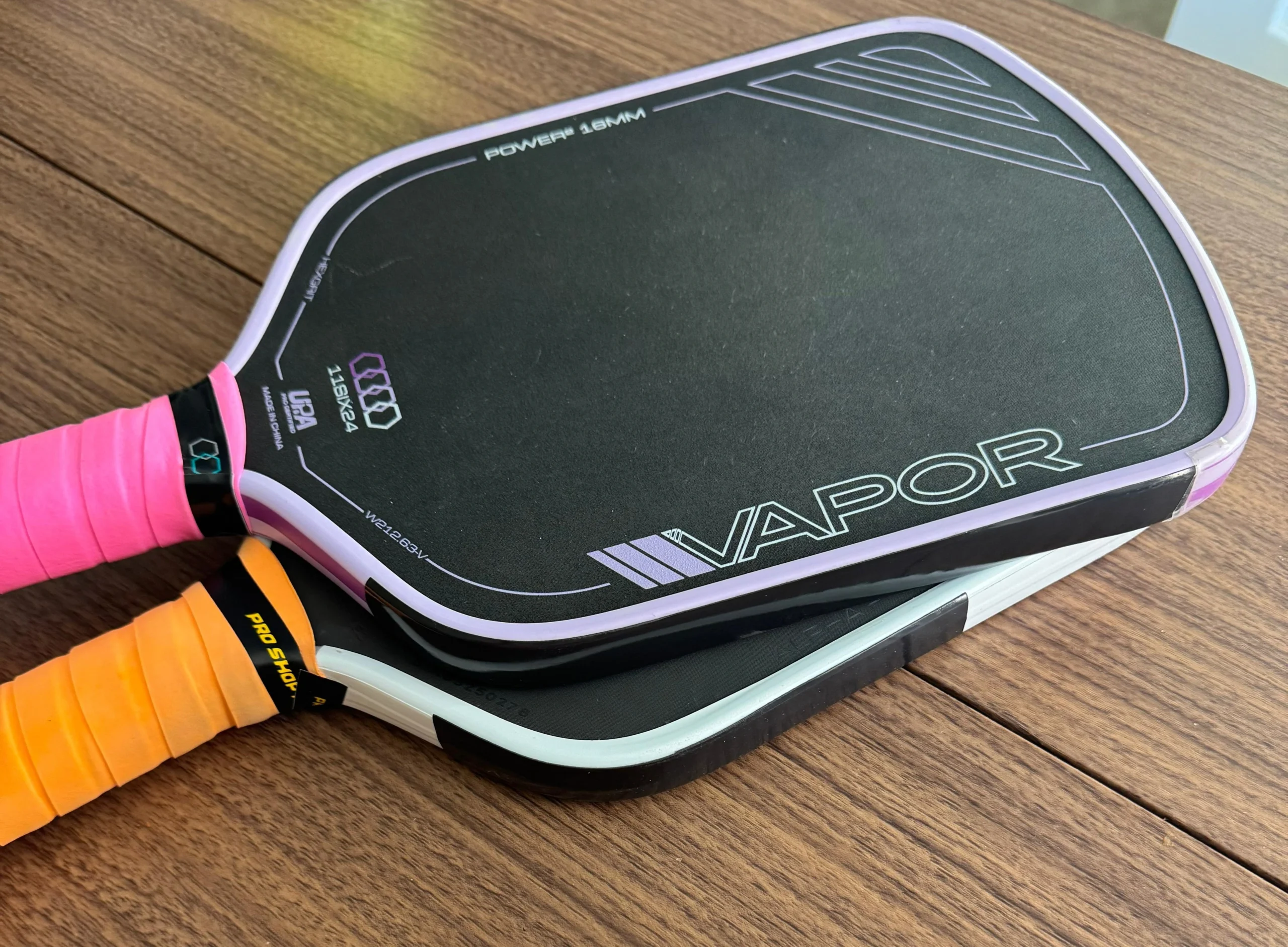
Vapor examples (reported / unit-to-unit examples): some reported examples include static weights around 7.85–8.0 oz, swing weights from about 107.55 up into the low 111s, and twist weight examples around ~6.7–6.79. Grip note (reported examples): some units have been measured with grip length around 5.5″ and circumference around 4.125″ depending on method; use published specs as the baseline reference.
Vapor internals: it’s often discussed in the “floating-foam style” family, but the brand has kept exact internal details vague. Treat deeper “foam recipe” talk as speculation unless explicitly documented.
P1 Hybrid ranges (reported examples unless otherwise stated): static weight about 8.1–8.22 oz, swing weight commonly 116–117 (with some reports closer to ~118), twist weight about 6.7–6.9, balance point around ~24.4 cm, 16 mm thickness.

Price/availability note (time-sensitive): P1 Hybrid went live January 31, 2026 and has been listed at $219.99 retail (verify current pricing and availability at purchase time).
What it’s built with (as described on this page): floating EP foam core, EVA perimeter ring, and a CFC layup, paired with a ceramic-based PermaGrit surface. The stated design goal is simple: stability and dwell first, fewer trampoline surprises later.
| Trait | Vapor Power 2 (16mm) | P1 Hybrid (16mm) |
|---|---|---|
| Hands speed | Usually faster, quick reload | Usually slower by design, more composed |
| Pop | Commonly poppier | Commonly lower pop |
| Power (stock) | Easy pace via speed, not brute force | Often described as stronger in stock form |
| Dwell | Less dwell | Notably more dwell |
| Forgiveness under pace | Can punish late/open face | Tends to be more stable and forgiving |
| Fatigue risk | Lower swing weight is friendlier | Higher swing weight can tax wrist/forearm late |
Rule of thumb: when swing weight climbs, your “late contact window” shrinks, so if you’re already late by habit, heavier can feel worse even if it’s more stable.
Why that matters: specs don’t tell you “good or bad.” They tell you what mistakes the paddle will allow you to survive.
Spin durability vs spin access: the part nobody wants to admit
What matters in real points: it’s not day-one roughness. It’s whether you can still shape the ball without overswinging when your legs are cooked and the rally gets tight.
Vapor Power 2 surface: HexGrit, described here with a peel-texture look but embedded-grit behavior and strong bite. Third-party test examples (method-dependent): some testers report roughness readings in the ~8.6 micron range and spin test outputs in the ~2300 RPM neighborhood. Treat those as system-specific snapshots, not universal truths. The consistent buyer point is “high shape potential when you swing clean.”
Durability note (keep it realistic): the buyer-relevant question is whether outcomes stay usable deep into real hours. If shaped outcomes drift, floaty roll dinks, drives that stop dipping, clean the face and re-check before assuming the texture is “dead.”
P1 Hybrid surface: a ceramic-based PermaGrit approach described here as designed for friction and texture life. Third-party test examples (method-dependent): some testers report roughness readings around the ~7.1 micron range, framed less as “max day one,” more as “consistent later.” The practical advantage tends to show up when swing speed drops: compact topspin drops, roll dinks, and tight kitchen shaping without big motion, spin you can access without overswinging.
PickleTip Insight: If your shoulder or elbow gets cranky late, you don’t need “more spin.” You need “spin at lower effort.” That’s where surface philosophy becomes performance, not marketing.
Resets and blocks: your late-contact tax bill
What happens in real points: when your face opens under pace, pop adds launch. Stability changes how harsh the penalty feels.
Vapor Power 2 failure modes: late, open-face blocks can rocket long or sit up as pop-ups. Pushy soft reloads can carry and invite speed-ups. Contact behind the hip adds launch. Trying to “create spin” with an open face raises launch angle and kills dip. Translation: Vapor rewards early paddle position and compact mechanics; it can punish panic stabs and slap blocks.
P1 Hybrid signature profile: blocks and resets tend to stay calmer and lower because it doesn’t bounce the ball forward as easily. In firefights it can help keep the face from getting bullied. The theme is composure: absorb first, then redirect into the kitchen without accidental depth.
- When the opponent speeds up at your body → P1 tends to keep your reply in-bounds more often.
- When you’re early and hunting the counter → Vapor tends to let you punish with quick reload and aggressive redirection.
Why that matters: the best “defensive” paddle is the one that makes your bad touch land short and boring instead of long and apologetic.
Power, pop, and finishing: volume knob vs light switch
What wins points: predictable power finishes more rallies than surprise launch, because it lets you swing hard without flinching.
Vapor Power 2: can feel lively. That liveliness is a weapon when you’re clean and a liability when you’re late. Stock power often gets described as lower-middle compared to the heaviest hybrids, but it can still produce easy pace because swing weight is lower and it accelerates quickly. Pop is typically higher than heavily dampened “tank” hybrids.
P1 Hybrid: often described as “linear power (volume knob, not light switch).” Drives can feel heavy, not springy. Overheads can finish without a surprise launch. It tends not to spike rebound at 80–90 percent swing the way livelier hybrids can. That predictability is why players call it “safe aggression.”
Coach Sid’s Advice: when your paddle adds surprise launch at high effort, you subconsciously swing softer, then you lose the point anyway.
PickleTip Insight: If your game is built on measured aggression, drive to earn a pop-up, then finish, the P1 personality supports the plan. If your game is built on sudden counters and quick redirection, Vapor supports the plan.
Weighting and tuning: how each paddle reacts when you stop playing stock
Decision tip: tape rarely turns a paddle into a different model. It usually shifts the mistake profile: more stability and plow-through, less free speed and timing window.
Vapor Power 2 tends to change noticeably with perimeter weighting: adding stability can reduce twisting on blocks and widen the usable window while keeping the core fast-reload identity, until it starts feeling slow for your hands game.
P1 Hybrid is already built around stock stability: its main “cost” is swing-weight fatigue rather than instability. Extra mass is less about “fixing wobble” and more about micro-adjusting feel, without turning it into a sledgehammer.
- Vapor tape goal: reduce late-contact punishment while keeping fast reload.
- P1 tape goal: micro-adjust balance/feel without making fatigue worse.
If you want the bigger picture: Vapor can get more forgiving when you add stability. P1 can get more taxing if you keep stacking weight on a higher swing-weight base.
Legality: where you play decides what “smart purchase” means
This is the boring grown-up section, and it matters: approval paths are real, and the “right” paddle depends on the events you actually enter.
Vapor Power 2 eligibility path (as stated here): this page notes it as UPA-A certified and not shown on the USAP approved list at the referenced time. If you play USAP-only events, verify the current list before purchase. If you want a broader equipment legality refresher, use this as a bigger-picture reference: Legal Equipment.
P1 Hybrid eligibility path (as stated here): presented here as USAP approved. If your calendar includes USAP-only brackets, verify current listings before purchase decisions.
PickleTip Insight: Eligibility isn’t a moral issue. It’s a logistics issue. If your calendar includes USAP-only brackets, “maybe approved later” is a bad plan.
Who should buy which: a simple fit guide that survives real points
Vapor Power 2 (short identity): a fast hybrid that rewards early prep, quick reload counters, and disciplined face angles. It’s usually lethal when you’re proactive, and usually unforgiving when you’re late and open-faced.
P1 Hybrid (short identity): a dense, stable hybrid that tends to keep blocks and resets calmer, with dwell that supports shaping without big motion. Its main trade is that higher swing weight can feel taxing late.
Maintenance and break-in: keep the paddle’s identity from drifting
Simple rule: if your shaped shots start behaving weird, clean the face before you rewrite the whole story in your head.
P1 Hybrid care: clean with a lightly damp microfiber cloth after play. Use a rubber grit eraser sparingly with minimal pressure. Avoid solvents, stiff brushes, and aggressive abrasion that can polish or damage texture.
Vapor Power 2 reality check: if your roll dinks start floating or your drives stop dipping, clean the face and re-check outcomes before assuming durability loss. Dirt and oils can change friction feel fast, especially on the shots where you’re trying to shape with compact motion.
The reality: “My paddle changed” is often a combo of grime plus late contact plus fatigue. Clean first. Then see what actually changed, your timing window or the surface.
Questions players ask (matchup-specific)
Which one is safer when I’m jammed at the right hip?
P1 Hybrid tends to be. When you’re late and cramped, lower pop and higher stability tend to keep the survival block from launching long.
Which one wins the fastest hands battles when I’m early?
Vapor Power 2 tends to. When you’re early and square, the quick reload counter identity shows up fast, especially on redirect contact, not big swings.
Which one gives me shape without a big swing late in sessions?
P1 Hybrid tends to feel easier for that, because the surface philosophy described here is “spin access” when swing speed drops. The practical win shows up when you’re tired and still need the ball to dip.
Which one punishes open-face blocks more?
Vapor tends to. When contact is late and the face opens, pop adds launch, so your “save” can turn into depth you didn’t ask for.
Which one is more likely to feel heavy after two hours?
P1 Hybrid, because higher swing weight can tax the forearm and wrist late. If your mechanics shrink with fatigue, that cost becomes real.
Is this decision mostly about spin?
No. Both can shape. The separator is what happens on bad contact: Vapor tends to amplify timing, and P1 tends to limit damage.
Frequently Asked Questions
Vapor Power 2 tends to reward early counters with faster reload. P1 Hybrid tends to reward survival hands with calmer blocks under pace. Pick based on whether you’re usually early (Vapor) or usually late/jammed (P1) when the speed-up shows up.
This page describes Vapor Power 2 as UPA-A certified and not shown on the USAP approved list at the referenced time. If you play USAP-only events, verify the current USAP list before buying.
P1 Hybrid is presented here as USAP approved, which makes it the straightforward choice for USAP-only competitive environments. Always verify current listings before purchase decisions.
Vapor Power 2 is commonly described as poppier. P1 Hybrid is deliberately lower-pop to keep resets and blocks calmer.
P1 Hybrid typically makes resets easier because it absorbs pace and adds less trampoline. Vapor can reset well, but it demands cleaner face angle and earlier contact.
Often, yes in concept: adding stability can reduce twisting and widen the usable window while keeping the core fast identity. The key is stopping before you trade away the reload speed you bought it for.
Don’t buy the story, buy the mistake coverage. If you gift points with launchy late blocks, P1 is usually the safer spend. If you win by early counters and fast reload, Vapor is usually the better weapon.
Keep exploring
If this matchup hit your exact problem (hands speed vs calm stability), here’s the clean next step, no wandering.
- Read the deeper Vapor Power 2 breakdown (if you’re leaning Vapor and want the full personality).
- Get clear on legal equipment rules before you buy for tournaments (so your calendar doesn’t punish your wallet).
Comment question: in real points, are you usually early or late when the speed-up shows up at your hip?


