Mastering Pickleball Strategy: Tips and Tricks for Winning
Pickleball Strategy Guide
The best pickleball strategy is not one magic shot. It is reading whether the ball, your feet, and your team are ready to attack, neutralize, or defend, then choosing a target that makes the opponent’s next ball easier to anticipate.
If you want to stop playing random pickleball, stop judging shots only by whether they went in. Start asking what the ball allowed, where both partners were standing, how much risk the moment justified, and what your choice was likely to bring back. Once you learn to make those reads before swinging, serves, returns, thirds, dinks, volleys, and attacks stop feeling like separate pieces of the game.
Attack or Reset Ball-Height Decisions Court Position Smart Targets Risk and Margin Next-Ball Thinking
🎧 Hear Coach AJ’s on-court breakdown of the PickleTip foundational strategy system:
What is the best pickleball strategy?
The best pickleball strategy is to make the highest-percentage decision your position and the incoming ball allow. Control the kitchen when you can, protect yourself when you cannot, attack balls that are truly attackable, and choose shots that make the opponent’s next ball more predictable.
Most points are not lost because a player lacks a special shot. They are lost because the player attacks from a defensive position, aims too close to a line, rushes toward the kitchen behind a poor ball, or chooses a shot without preparing for the reply.
Who This Helps
This guide is for beginner and intermediate players who know the rules and can hit the basic shots but still realize (usually a second too late) that they chose the wrong one. It gives you a simple way to read the ball, your position, your partner, and the likely reply before the point starts making decisions for you.
I use versions of these decisions when teaching players at Elmwood clinics and lessons who already know how to dink, drop, drive, and volley but still feel rushed during points. The problem is often not a missing shot. It is choosing the shot before fully reading the ball and the court.
Strategy Starts Before You Choose the Shot
A serve, return, drop, drive, dink, lob, reset, and volley can all be good shots. They can also all be poor choices. The name of the shot does not make it strategic. The situation does.
Good strategy begins with four questions:
- What position are we in? Are we established, advancing, stretched, or defending?
- What quality of ball did I receive? Is it high, low, fast, slow, deep, short, or forcing me off balance?
- How much risk does this moment justify? Is there a large target and comfortable contact point, or am I forcing a small opening?
- What is this shot likely to create next? Will the opponent attack, reset, block, move, or send the ball into a predictable lane?
Strategy is the difference between hitting the ball because it came to you and hitting it because you understand what the point needs next.
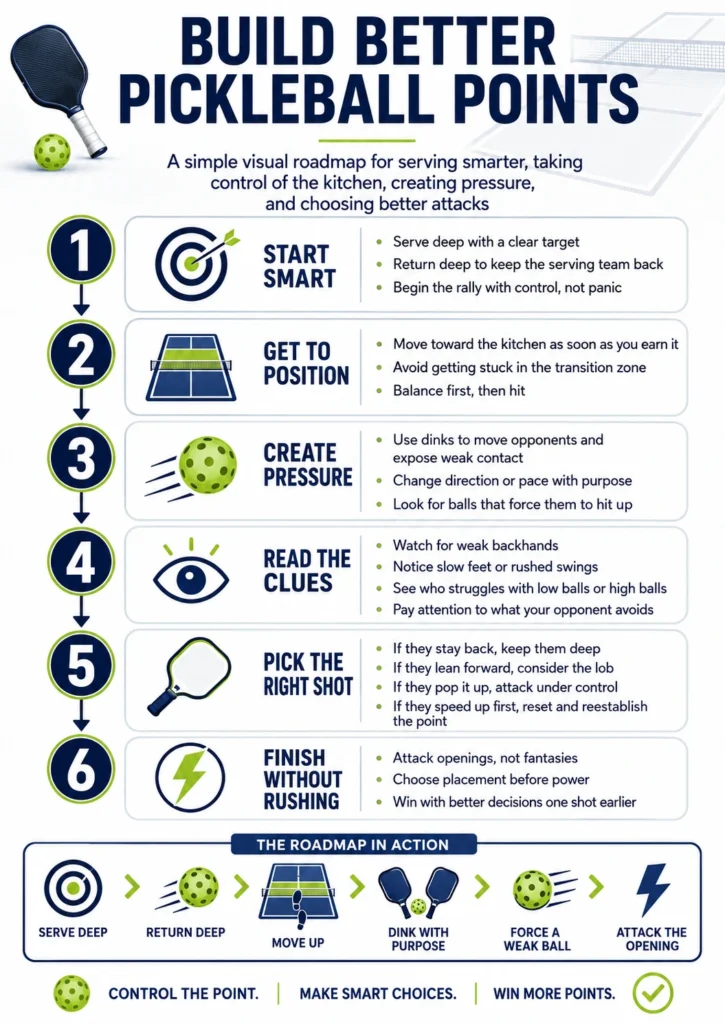
The PickleTip Traffic-Light Decision System
Incoming balls do not all deserve the same response. Ball height is one of the fastest ways to determine whether you should defend, remain patient, or apply pressure.
The Three Ball Heights
- Red Zone: Below the knees. Defend, reset, lift safely, or let the ball go if it is traveling out. This is rarely the time to force offense.
- Yellow Zone: Knees to waist. Stay selective. You may be able to roll, push, redirect, or apply controlled pressure, but only when balanced and properly positioned.
- Green Zone: Above the waist. Look to attack when your feet are stable, your partner is ready, and you have a target with reasonable margin.
Height is the first signal, not the only signal. Before attacking, check the rest of the light:
| Decision Signal | Green: Attack | Yellow: Neutralize | Red: Defend |
|---|---|---|---|
| Ball height | Above waist | Knees to waist | Below knees |
| Balance | Stable and loaded | Slightly stretched | Reaching or falling |
| Court position | Established at the kitchen or advancing behind a ball the opponents cannot attack comfortably | Advancing carefully | Under pressure or trapped |
| Partner readiness | Partner is set and covering | Partner is recovering | Partner is exposed |
| Target margin | Large, clear target | Controlled pressure target | Safety and depth first |
A waist-high ball is not automatically green if you are leaning, late, or exposing your partner. A lower ball may become playable if the opponent is badly out of position and you can apply controlled pressure without gambling the point. Do not worry about calling every ball the perfect color. Use the system to catch yourself before attacking out of impatience.
The ball my students misread most is often the one around the thighs or waist. It looks attackable, so the swing starts before the feet have stopped. The ball was yellow. Impatience painted it green.
A ball can be green for your paddle and red for your team. If your partner is recovering, stretched, or trapped behind you, an attack can expose the court neither of you is ready to cover.
The Three Reads
What color is the ball? What position is my team in? What next ball am I trying to create? You do not need ten strategy systems running in your head. The rest of the game keeps coming back to those same three reads, whether you are returning, choosing a third, moving through transition, or deciding whether to speed the ball up.
How the Read Changes by Level
| Player Context | How to Use the Traffic Light |
|---|---|
| Newer player | Treat most yellow balls conservatively until balance, contact point, and recovery become dependable. |
| Intermediate player | Add controlled rolls, pushes, redirects, and counters when your feet and partner are ready. |
| Advanced player | At higher levels, height is only the beginning. Spin, disguise, hand speed, opponent position, and the expected next ball can all change what the ball allows. |
The traffic light is a first read, not a rulebook. Spin, pace, balance, opponent position, partner position, and your ability to execute can change the correct choice. Some advanced players can attack balls I would tell a developing player to neutralize. The system has to account for the shot you can actually execute under pressure.
Serving Team vs. Returning Team: Two Different Jobs
Serving and returning are not equal assignments. One team is trying to earn its way forward. The other begins with a better chance to claim the kitchen and keep the serving team back.
| Team | Starting Advantage | Main Problem | First Strategic Job |
|---|---|---|---|
| Serving team | Controls the first target | Under the two-bounce rule, must let the return bounce and usually hits the third from deeper court position | Serve with margin, handle the return, and earn a safe path forward |
| Returning team | Can move toward the kitchen after the return | Must prevent the serving team from neutralizing that advantage | Return deep, advance under control, and protect the line |
Serving-Team Strategy: Earn the Kitchen
The serve should help you begin the point without donating it. Depth, location, and repeatability matter more than trying to win the rally immediately. Use pace when it improves the return you are likely to receive, not simply because a hard serve feels aggressive.
After the return, the third shot is not automatically a drop or automatically a drive. Ask:
- Did the return land deep or short?
- Are both opponents established at the kitchen?
- Can I contact the ball in front and from balance?
- What fifth ball am I trying to create?
A quality drive may create a predictable block and an easier fifth-shot drop. A quality drop may let both partners advance. A poor drive or drop may leave your team charging forward behind a ball the opponents can attack. Choose the third for the situation, then move according to its quality.
Third Shot or Fifth-Ball Plan?
A shorter return that sits up may invite a controlled drive through the middle or at a body, with both partners expecting a block and preparing the fifth. A deep return that pushes you back or forces contact below the knees usually asks for more height, softness, and patience. Your favorite third shot does not get to overrule the return you received. Choose the third for that ball and the fifth ball you are trying to earn.
Returning-Team Strategy: Keep the Door Shut
A strong return should usually be deep, controlled, and high enough to give you time to move forward. A deep return buys the returner time to reach the line. A short return gives that time back.
Move toward the kitchen after a good return, but do not sprint blindly. Arrive balanced enough to handle the third shot. The returning team’s advantage disappears when the returner is still running through contact or when the partner at the kitchen overreaches and opens a lane.
For detailed mechanics and target options, use the serve strategy guide and the return-of-serve guide.
Control the Kitchen Without Rushing Toward It
The kitchen line is usually the strongest doubles position because it reduces your opponents’ reaction time and gives you better angles. But “get to the kitchen” does not mean run forward after every shot.
Advance when your ball prevents the opponents from attacking comfortably. Stop and split-step when they are about to contact the ball. If your drop floats, your drive sits up, or your partner is still behind you, pause and defend the next ball before continuing forward.
Do not measure transition success by how quickly you reached the kitchen. Move forward because your last ball earned you the space, then arrive balanced behind a ball the opponents cannot punish.
Partners do not have to stand on the same painted line at every instant, but they should move as one defensive shape. If one player advances behind a good drop while the other stays deep, the gap between them becomes the easiest target on the court. The farther-ahead partner may need to pause or shade toward the middle until the team is connected again. When one partner has to stop in transition, a quick “hold” or “one more” can keep the other player from continuing forward alone. For more on shared court responsibility, use the pickleball partner strategy guide.
Use the get-to-the-net guide for a deeper explanation of advancing safely and the transition-zone guide for the mechanics of moving and resetting between the baseline and kitchen.
Apply the Traffic Light: Attack, Neutralize, or Defend
A point can turn from safe to dangerous in one ball. The earlier you recognize whether your team owns the better ball, the easier the shot choice becomes.
Attack Only When the Ball and Your Feet Agree
Attack when the contact is high enough, your body is stable, your partner is prepared, and the target has margin. Aim for useful pressure rather than a spectacular winner. The body, paddle-side hip, feet, and middle are often safer than a narrow sideline.
When the ball is yellow rather than clearly green, stay selective. You may have a controlled roll, push, redirect, or speedup, but you may also be better off keeping the ball low and waiting for a cleaner opportunity.
Neutralize Before You Try to Win the Point
A neutral ball stays low, takes some heat out of the rally, and makes the opponent prove they can attack the next one. Drops, resets, blocks, and patient dinks all serve this job. Neutral does not mean passive. It means refusing to attack from a disadvantage.
For example, a soft reset into the kitchen may not win anything immediately, but it can erase the opponent’s speed advantage, let your partner recover, and turn a red rally yellow again. That is progress, even when the shot never appears in a highlight.
A defensive ball keeps the point alive. A neutral ball removes the opponent’s advantage. Sometimes the same reset does both, but the intention is different.
Defend When the Opponent Has the Better Ball
When stretched, jammed, late, or receiving a ball below the knees, prioritize survival. Shorten the swing, increase your target margin, and recover your shape. One defensive ball can return the rally to neutral. One forced counter can end it.
Where to Aim: Middle, Feet, Space, or Sideline
Good placement is not simply hitting where no one is standing. A good target makes the opponent uncomfortable without asking you to paint the line.
| Target | Why It Works | Main Risk |
|---|---|---|
| Middle | Creates hesitation, limits angles, and gives you more court margin | Becomes predictable if used without depth or variation |
| Feet | Forces low contact and makes aggressive replies difficult | A short ball can become attackable if left too high |
| Open space | Makes opponents move and can create the next opening | Chasing space can pull your shot too close to a line |
| Sideline | Can stretch an opponent and open the middle | Smaller target with less margin |
| Body or hip | Jams preparation and can produce a predictable block | Poor height or pace may sit up in the strike zone |
The middle is often the best default because it reduces the opponent’s available angles and gives your team more room for error. It can also produce a more predictable next shot: hesitation, a late paddle, or a block that stays in the center of the court. When opponents begin sitting on that target, add depth, move toward the body or feet, or use the open angle. Use sidelines and sharp angles only when your balance, contact point, and court position justify the smaller target.
Dink With a Purpose, Not Just Patience
A dink is not successful merely because it lands in the kitchen. Its job is to keep the opponent from attacking, make them contact from an uncomfortable position, or create the next ball your team can pressure.
Crosscourt dinks provide more net clearance and court length. Middle dinks can reduce angles and create indecision. Dinks to the feet or outside foot can force reaching and movement. A firmer dink can pressure a player who is leaning or crowding the line. Use variation for a reason, not because you feel obligated to be unpredictable.
The goal is not to win the dink battle with the prettiest dink. It is to receive the first ball your team can attack without giving the opponents one first.
For mechanics, spin, targets, and common errors, use the dinking with a purpose guide.
Choose the Volley for the Job
Volley selection becomes simpler when you stop treating every volley as an attack:
- Block volley: Absorb pace, keep the ball low, and survive pressure.
- Push volley: Extend controlled pressure through depth and placement.
- Roll volley: Add controlled topspin when the ball is high enough and your contact is stable.
The mistake is not choosing the “wrong named volley.” It is trying to roll a red-zone ball, blocking a green-zone ball with no purpose, or adding pace while your team is out of position.
Your Shot Is Not Finished When You Hit It
Your shot does not end when the ball leaves your paddle. It ends when you recover into the position required by the next shot you probably created.
If you pull an opponent wide, expect the ball to travel through one of the remaining safe lanes. If you speed up crosscourt, prepare for the common block toward your partner or the middle. If you hit behind a moving player, recover for a shorter next ball. Cover the most probable response rather than standing in the center of every theoretical possibility.
Next-Ball Principle
Before choosing a shot, ask: If this works, what ball is most likely to come back, and who is responsible for it?
A crosscourt speedup often brings a block toward the middle or your partner. A ball behind a moving opponent may produce a shorter, hurried next shot. A firm shot at the paddle-side hip may jam the paddle and send the ball back through a narrower lane. The exact next ball is never guaranteed, but some replies are far more likely than others. Recover for those first.
To study repeatable sequences and likely replies in depth, use the Pickleball Pattern Library.
See the Court, Track the Ball, See the Court Again
Players often stare at the ball so continuously that they miss the information surrounding it. A better visual rhythm is:
- Court: Before the opponent strikes, scan player positions, movement, paddle preparation, and open space.
- Ball: Narrow your attention through bounce and contact so you read height, pace, spin, and direction.
- Court: After your shot, widen your vision again and recover according to the position and next ball you created.
This does not mean looking away during contact. See the court before the hit, lock onto the ball through bounce and contact, then open your vision again. Do not spend the entire rally staring through a drinking straw.
Sometimes the Best Shot Is No Shot
Out-ball recognition is a strategic skill. Many players defend balls that were already leaving the court because pace and pressure make every ball feel playable.
Common out-ball clues include:
- Contact made too far in front with an open paddle face.
- An oversized upward swing from close to the kitchen.
- The opponent moving forward or falling through contact.
- A rushed speedup struck from below net height.
- A ball that clears the net high without visible topspin pulling it down.
Do not decide solely from one clue. Read contact height, paddle path, spin, pace, and your court position together. At Elmwood, I spend a lot of lesson time on rushed speedups struck from below net height because they feel dangerous before their flight has had time to reveal itself. The better you become at leaving those balls, the less often opponents can win by simply hitting harder.
Build the Point One Advantage at a Time
Strategy is not a script that survives every ball. It is a sequence of reads. One common serving-team pattern looks like this:
- Serve with margin. Start the point with a target you can repeat.
- Read the return. A shorter return may allow a controlled drive; a deep return may demand a softer third.
- Create a manageable fourth. A body or middle drive may produce a block. A quality drop may force the opponents to lift or dink.
- Play the fifth that the fourth permits. Drop, reset, attack, or stop moving according to the ball you actually receive.
- Finish only when the point permits it. A small advantage is still an advantage. You do not have to cash it in immediately.
The useful sequence is not always deep return → drive → block → fifth-shot drop → kitchen. Use that sequence when the balls permit it. Abandon it the moment the return, block, balance, or opponent position changes the light.
When an opponent repeatedly struggles with a particular type of pressure, that moves beyond foundational strategy into opponent-specific planning. Use the PRESS method for winning in pickleball to profile comfort, run a low-cost test, examine the response, stay with what works, and shift when the opponent solves it.
Practice the Decision, Not Just the Shot
Practice situations where the right choice changes from one feed to the next. Vary the height, depth, pace, and player position instead of feeding twenty identical balls and calling it strategy practice.
- Traffic-light drill: Have a partner feed different ball heights. Call red, yellow, or green before choosing the shot.
- Third-and-fifth drill: Play the third shot, predict the likely next ball, and execute the planned fifth ball.
- Transition decision drill: Advance only behind a ball that prevents an easy attack; otherwise stop and reset.
- Target-margin drill: Play points using middle and feet as default targets, then earn permission to use smaller angles.
- Out-ball drill: Have a partner mix controlled in-balls and likely out-balls so you practice judging contact and trajectory.
For a larger practice library, visit the pickleball drills guide. To diagnose which tactical skill is limiting your decisions, use the Pickleball IQ guide and self-assessment.
Fix the Part of Your Strategy That Breaks First
| If Your Main Problem Is… | Read Next |
|---|---|
| You make low-percentage shot choices | Stay on this foundational strategy guide and apply the traffic-light system |
| You recognize the correct ball too late | Patterns in Pickleball |
| You do not know how to pressure a specific opponent | Winning in Pickleball with PRESS |
| You need a plan for scouting and tournament-day adjustments | Pickleball Tournament Gameplan |
| You want to assess your overall court intelligence | Pickleball IQ |
Pickleball Strategy FAQs
The best pickleball strategy is to read the ball, your court position, your partner’s readiness, and the likely next ball before choosing the shot. Attack when the situation is green, neutralize when it is yellow, defend when it is red, and use targets that protect your team’s position.
Attack when the ball is high enough, your feet are balanced, your partner is ready, and you have a target with reasonable margin. A ball can look green for your paddle but still be red for your team if your partner is recovering or the attack opens a lane you cannot cover.
Reset when the ball is below your comfortable attack zone, you are stretched or moving, your partner is exposed, or the opponents already own the better position. A good reset removes pace, lands low, and gives your team a chance to turn a defensive rally neutral again.
The returning team has the first opportunity to establish both players at the kitchen because the returner can move forward immediately after returning the serve. The serving team must let the return bounce, choose a third shot that fits the return, and earn its way forward through a controlled third-and-fifth-shot sequence.
The middle, the opponents’ feet, and the body or the hip of the opponent’s paddle side are strong default targets because they reduce angles, create awkward contact, and offer more margin than a narrow sideline. Use sharper angles when your balance, contact point, and court position justify the extra risk.
A defensive ball is mainly trying to keep the point alive when the opponents have the advantage. A neutral ball removes or reduces that advantage so neither team owns an easy attack. The same well-placed reset can sometimes do both.
What I Want You to Remember
You probably do not need another shot first. You need to recognize sooner when the point has turned red, yellow, or green.
After your next game, do not count only winners and errors. Find three points where you chose the shot before reading the situation. Ask what color the ball really was, whether your team was ready, and what next shot your choice invited. That is where strategy work begins. When those reads improve, the shots you already own start working more often, and your opponents receive fewer comfortable balls.