

Honolulu J6CR Review (Updated): Specs, Break-In Notes, Feel, Power, Control
The Honolulu J6CR (Core Reactor) is an elongated 16mm paddle that swings unusually fast for its shape, hits with real firepower, and still keeps a big, forgiving sweet spot, once you learn how it wants to be swung.
Update: My Review After More Hours (Yes, It Breaks In)
I’m updating this review after more court time because paddles almost always have a break-in period, sometimes subtle, sometimes obvious. With the J6CR, the biggest change wasn’t the paddle “mysteriously transforming”… it was me learning the paddle’s response and tightening my timing.
Durability Check (Updated Weekly): Last checked: Feb 22, 2026 • Total play: 16 hours • Surface/grit: holding • Spin: holding • Core/edge: no issues • Recommendation: unchanged.
- What stayed true: fast hands for an elongated paddle, oversized sweet spot, high power that’s still manageable, crisp feel that isn’t harsh.
- What got clearer: it has a response curve that rewards compact swings and punishes lazy timing, until you dial it in.
- What improved most: consistency on counters, flicks, and short punch shots once I refined contact point and added light perimeter weight.
Specs + My Measured Numbers (Quick Snapshot)
If you’re here for honolulu j6cr specs or you just want the clean snapshot without the fluff, this is the quick hit.
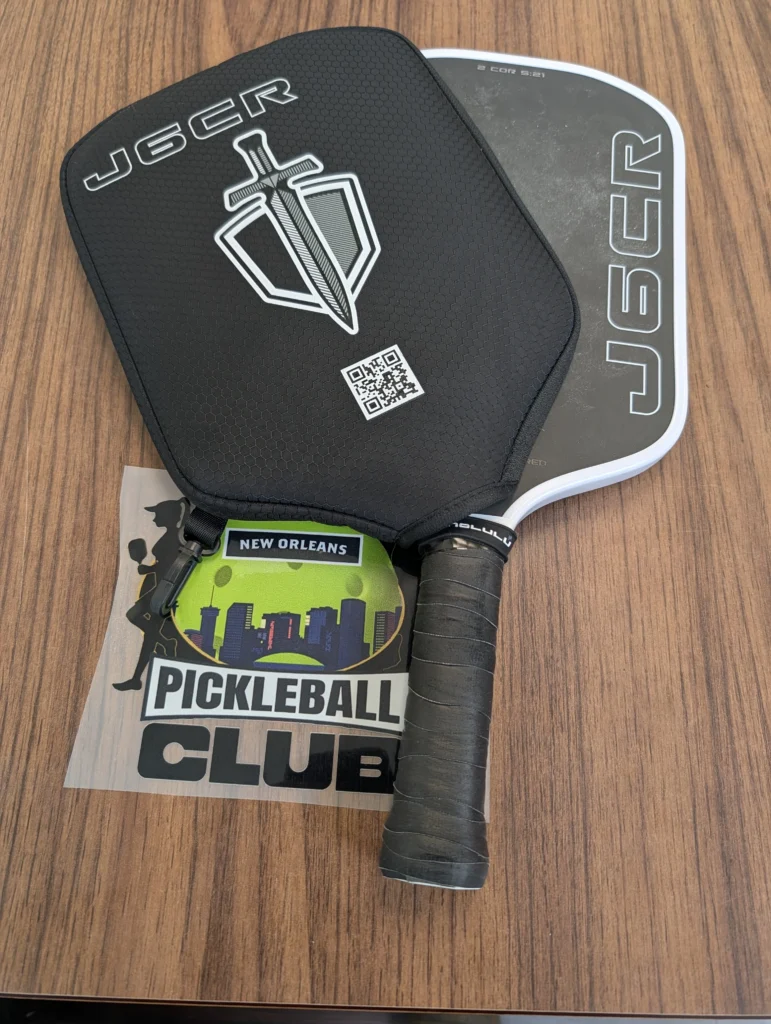
| Paddle | Honolulu J6CR (Core Reactor) |
| Shape | Elongated |
| Thickness | 16mm |
| My measured swing weight | 114.99 |
| My measured twist weight | 6.46 |
| My measured spin (avg) | 2338 RPM (with spikes near 2400) |
Note: factory tolerances exist. That’s why I publish my measured numbers instead of pretending every unit is identical.
Factory tolerances are real. My unit measured 114.99 swing weight and 2338 RPM average spin (with spikes near ~2400). Other reviewers have reported spin around ~2,390 RPM and a swing weight around ~112 on their samples, so expect normal unit-to-unit spread.
Quick Navigation for the J6CR Review
- Price + Pre-Order + Ship Date
- Quick Verdict: Who This Paddle Fits
- Core Reactor Technology: What It Actually Is
- Where It Sits in the Market (0–10 Ratings)
- Feel, Feedback, and Touch in the Soft Game
- Power, Pop, and the J6CR Response Curve
- Break-In Update: What Changed (and What Didn’t)
- Sweet Spot, Stability, and Forgiveness
- Spin, Texture, and Shot Shaping
- Weight Setup (Optional): How I Tuned It
- Who Should Buy the J6CR (and Who Should Pass)
- Related Honolulu Reviews + Deep Dives
- J6CR FAQ
Price + Pre-Order + Ship Date
The Honolulu J6CR was supposed to officially launch on the announced date, but the “launch” basically got eaten by pre-orders. If you’re searching j6cr price, honolulu j6cr for sale, or anything that smells like a release date question, here’s the clean answer.
J6CR PRE-ORDER
3rd Batch SOLD OUT – 4th Batch Ships March 20, 2026
If you want it, preorder early, batches have been moving fast.
Tip: if you already planned to buy it, using our link supports PickleTip at no extra cost.
Quick Verdict: Who the Honolulu J6CR Fits
Who This Helps
- Players who want a fast-swinging elongated paddle that doesn’t feel like a frying pan when hands speed up.
- Players who want real power but still want a control window they can live inside.
- Players who like a paddle with personality and are willing to spend a few sessions learning it.
- Tinkerers who want a platform with room to add weight without turning it sluggish.

The simple answer to this “Honolulu J6CR review”? This paddle is built to hit hard and swing fast for an elongated shape, and that combo is the whole story. The sweet spot is bigger than it has any right to be for this geometry, and once your timing is locked, the power becomes predictable instead of spooky.
Want the CR shape breakdown? Start here: CR Decision Map (quick fit guide).
Core Reactor Technology: What It Actually Is
“Core Reactor Technology” is the marketing label, but the performance behavior comes from the core layout and how it manages compression and rebound under speed. This is not just “some foam in there.” It’s a multi-material, multi-density build intended to keep the paddle explosive without turning directional control into a coin flip.
Core specifics (the part technical readers care about)
- Multi-density EPP center foam: the center section is designed to compress and recover in a repeatable way, so your “good contact” balls don’t randomly launch when you swing fast.
- EVA perimeter foam: the perimeter foam supports stability and helps protect the response on imperfect contact, especially when you’re reaching or getting handcuffed.
The pivoting core joint (what that actually means)
When I say “pivoting core,” I’m not talking about the paddle feeling floppy. The idea is a controlled micro-pivot built into the lower face region that helps stabilize rebound angles on fast exchanges. In plain terms: it’s trying to prevent the “unpredictable launch” you get when the ball hits low on the face during a rushed counter or a defensive punch.
Linear deflection (why the ball stops squirting 5-10 degrees off-line)
Linear deflection is the concept that the core compresses symmetrically, so the ball doesn’t pop off at a weird angle just because contact was a hair off-center or because you caught it in a slightly different spot during a high-speed rally. That “5–10 degrees off-target” problem is what turns a good idea into an unforced error. The J6CR’s core design is aiming to keep that rebound angle more consistent under stress.
The “Timing Tax” (why foam-core paddles feel different under pressure)
If you’ve ever felt like a foam-core build makes you pay for lazy timing, especially on counters and short punches, I broke that down here: The Timing Tax: Why Foam-Core Paddles Feel Different Under Pressure.
Where It Sits in the Market
I publish my measured numbers because they matter, but ratings are still useful for players who want instant context. Here’s where the J6CR lands on my 0-10 scale as a standalone snapshot of how this paddle plays.
| Power | 9.6 / 10 |
| Pop (hands battles, punch shots) | 9.2 / 10 |
| Sweet Spot | 9.1 / 10 |
| Control | 9.0 / 10 |
The J6CR is a power-forward paddle that still behaves if you swing compact and meet the ball clean. The “learning curve” isn’t because it’s uncontrollable, it’s because it has enough response that sloppy timing gets exposed.
Feel, Feedback, and Touch in the Soft Game
The J6CR feel is best described as crisp with a hollow edge, but not harsh. You get clean feedback on contact, especially on counters and compact blocks. It feels “connected,” like the face is telling you the truth without slapping you in the mouth.
The surprise is the soft game. A lot of high-power builds ask you to babysit the face on dinks, drops, and resets. This one doesn’t feel springy on touch shots. The ball gets on and off the face quickly, but it still feels steerable. If you’ve ever played a paddle that makes you feel like the ball is either dead or launching into orbit, this doesn’t live there.
I wouldn’t call it syrupy or ultra-dwelly. It’s not a “hold the ball forever” paddle. It’s more like: quick contact + controllable direction, and that’s exactly why it plays so well when exchanges get frantic.
Power, Pop, and the J6CR Response Curve
Let’s talk straight: this paddle has real firepower. Putaways, drives, serves, if you bring intent, it gives you back a heavier ball. The pop is also strong, especially on short punch shots at the kitchen line. That’s why it feels dangerous in hands battles: it doesn’t need a long swing to do damage.
The Response Curve (This Is the “Personality”)
The J6CR has a response curve that you feel most in compact swings. Short, snappy movements can create more juice than you expect. Full swings feel more “normal,” but still heavy.
- Compact swings: counters, flicks, quick rolls, this paddle can jump.
- Full swings: power shows up without feeling like the paddle is freelancing on you.
- Early sessions: you might donate a couple balls long if your timing is lazy or you contact too far out front.
- Once dialed: the power becomes a tool instead of a surprise.
The J6CR pickleball paddle is built for players who want speed in the hands without giving up the reach and leverage that makes elongated shapes so fun.
Break-In Update: What Changed (and What Didn’t)
After more play time, here’s what I’ll own: I got more consistent because I learned where this paddle wants contact and how it wants to be swung. There’s a break-in period, but the bigger “break-in” is the relationship between your timing and the paddle’s reactivity.
What changed after break-in
- Pop timing got easier: my short punches stopped floating because I started meeting the ball with cleaner face angle and less panic.
- Control window widened: I felt more confident keeping the ball down on hard swings because I stopped over-hitting the same ball I used to “guide.”
- Hard swings felt safer: once the timing locked in, the paddle stopped feeling like it had a mystery gear.
What didn’t change
- Sweet spot stayed consistent: it has that “big target” feeling across a wide section of the face.
- Speed in hands stayed elite for elongated: it still gets to contact fast.
- Spin behavior stayed strong: I can still shape the ball and bring it down when I need it.
Who adapts fastest
Drive-heavy players usually click with the power quickly, but kitchen-first players often end up loving it once they realize the soft game is steerable and the paddle doesn’t force panic dinks. Either way, the fastest path is the same: compact swings, cleaner contact, and stop trying to “muscle” every ball.
Sweet Spot, Stability, and Forgiveness
The sweet spot is one of the J6CR’s biggest wins. For an elongated paddle, it feels oversized, not “marketing oversized,” but actually playable when contact gets imperfect. Off-center hits don’t instantly turn into disasters, and the response stays consistent across a wide chunk of the face.
Stock stability is solid considering how fast it swings. It’s not a widebody brick, but it’s absolutely playable stock. The real win is that the baseline swing speed leaves room to add stability without turning the paddle into a slow shovel.
One practical note: because it swings fast, some players meet the ball early at first, too far out in front. That’s not the paddle being “wild.” That’s your timing being optimistic. Give it a few sessions and it settles down.
Spin, Texture, and Shot Shaping
Spin is high. I can shape drives, roll volleys, and bring the ball down when I need it. It doesn’t feel like a gimmick. It feels like the face is working with you instead of demanding perfect mechanics to get action.
The surface grips well, and a lot of the spin “staying power” comes from how the paddle pockets and releases the ball, not just from angry sandpaper vibes. If you’re a heavy user, all surfaces change over time, so I focus less on fear and more on what the paddle does when you’re tired, late, and still trying to hit a smart ball.
Weight Setup (Optional): How I Tuned It
Because the stock swing feel is so fast for an elongated paddle, this is one of those rare platforms where a little weight can help without killing the main advantage. You don’t have to add anything. But if you want extra stability and a calmer face at speed, this is the clean path.
My weight setup (optional)
I like small, boring changes that you can feel immediately in real points. Here’s what I ran when I wanted the paddle to feel more planted without turning sluggish:
- 3 & 9 o’clock: small strips, 2–4 grams total (split evenly) to calm twist and stabilize blocks.
- Stop there first: play two sessions before adding anything else.
- If you overdo it: you’ll steal the quick-hands advantage you bought this paddle for in the first place.
Stock is the “fastest hands” version. Light 3-and-9 is the “same speed, calmer face” version. Pick the one that costs you fewer points when rallies get rude.
Optional: If you want to stabilize the J6CR without losing its quick hands, a little side weighting goes a long way.
See My Weighting Guide (Simple Setups)
Who Should Buy the Honolulu J6CR (and Who Should Pass)
You should strongly consider the J6CR if…
- You want a high-power elongated paddle that still feels fast in hand.
- You win points with counters, flicks, and quick exchanges, and you want the face to respond instantly.
- You want a big sweet spot in an elongated shape (for real, not marketing).
- You’re willing to spend a few sessions learning the paddle’s timing and contact window.
You should probably pass if…
- You want “plug-and-play” behavior on Day 1 and hate any learning curve.
- You don’t want to manage pop at all and prefer a more muted response.
- Your number one priority is long-term texture obsession above everything else you actually do in points.
Quick Decision Snapshot
- Best for: aggressive all-court players, counter-heavy players, fast hands + reachable length
- Power: high (9.6/10)
- Pop: lively on short punch shots (9.2/10)
- Sweet spot: oversized for elongated (9.1/10)
- Control: strong for the power class (9.0/10)
- Maneuverability: unusually quick for elongated
- Learning curve: real, but worth it
Related Honolulu Reviews + Deep Dives
If you want more context on Honolulu’s CR line and how foam-core behavior shows up under pressure, these will help.
- CR shape decision map for shape, play style, and learning curve
- Honolulu J2CR Review
- Honolulu J2NF Review
- RPM Friction Pro Review
J6CR Frequently Asked Questions
Yes. It settles in like most paddles, but the bigger break-in is you learning the response curve. Once timing locks in, the power feels more predictable and the soft game gets easier to steer under pressure.
3rd Batch sold out – 4th batch ships March 20, 2026.
It’s controllable for how much pop and power it has, but it’s responsive, especially on compact swings. Give it a few sessions, tighten timing, and it becomes much easier to keep in your preferred window.
You don’t have to. If you want a calmer face and more stability, small weight at 3 and 9 o’clock (2–4g total) is the simplest, lowest-risk change.
Many players describe the stock handle as on the thinner side. If you prefer a thicker grip, plan on an overgrip (or two) to build it up to your comfort.
Traditional peel-ply textures can smooth out over time. In real play, I care more about whether the paddle still shapes the ball when I’m late and under pressure, so I’ll keep updating this if the surface behavior changes materially.
Final Take: The J6CR Is a Power Paddle That Rewards Players Who Learn It
This paddle isn’t magic. It won’t turn a 3.5 into a 4.5 overnight. But it does reward good habits: clean contact, quick preparation, and disciplined timing, especially when points get fast and messy.
If you want a high-performance elongated paddle that swings fast, hits hard, and still gives you a generous sweet spot, the J6CR is worth a serious look. Give it a few sessions. Learn the curve. Then let it eat.
If you were waiting for the simple takeaway, this J6CR paddle review comes down to one thing: do you like paddles that reward you for dialing them in? If yes, you’re going to enjoy this paddle.
Ready to grab it? Batch 4 ships March 20th 2026.
If you pick one up, come back and tell me what you felt on Day 1 and then after a week. I read the comments like film.
Honolulu Discount Code Disclosure: Some links on this page may be affiliate links. If you buy through them, PickleTip may earn a small commission at no extra cost to you.


