First Day Playing Pickleball: My Pickleball Diary Beginning
My First Day Playing Pickleball: A Hybrid Origin Story for New Players
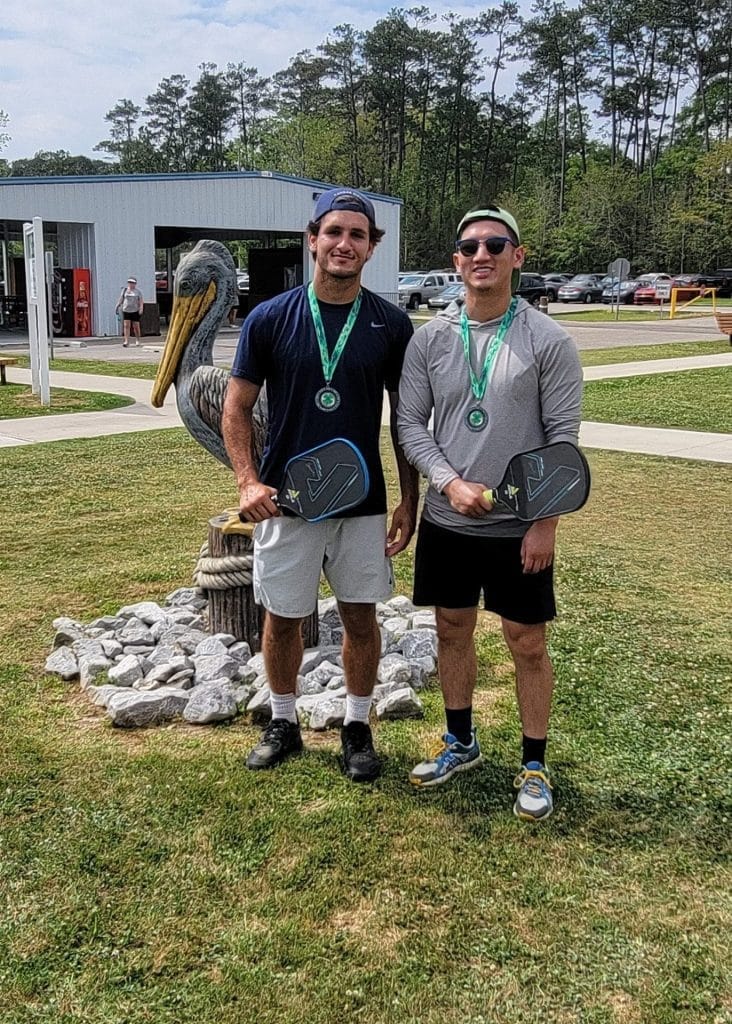
On my first day playing pickleball, I wasn’t thinking about strategy, footwork, or mechanics. I was thinking about my son AJ, the silver medal he and Tristan had just earned at Pelican Park, and whether a 40-something ex–volleyball guy with a bad habit of over-swinging still had any business stepping onto a court. I can still feel the dryness in my throat as we pulled into Pontiff Playground that evening – that half-nervous, half-curious sensation that happens right before you do something both humbling and strangely hopeful.
Picture this: you’re watching your kid compete, surrounded by hundreds of players across every age and body type. A 66-year-old with hands like a metronome. A heavier guy whose touch somehow defies physics. A grandmother who resets better than anyone on your rec ladder today. And then, hours later, you find yourself gripping a paddle for the first time, trying not to embarrass yourself while simultaneously wondering whether this strange little sport is about to take over your life.
It did. And looking back now – more than two years, thousands of games, and countless lessons later – I can see exactly where my early confusion, excitement, and ego-driven mistakes turned into something much more meaningful. This is the part of the Pickleball Diary many players wish they had captured: the raw first steps, the embarrassing urges to hit everything hard, the processing of the rules in real time, and the unexpected joy that comes from being bad at something new.
This page explains my first day playing pickleball and the beginner fundamentals I wish I knew before stepping on the court.
It blends my Day One emotions with modern beginner guidance so new players can avoid the mistakes that shaped my earliest pickleball experiences.
Before we move into the lessons, I want to make something clear: none of this is theoretical. These are the exact mistakes I made. If you’re just learning the pickleball rules, trying to understand why positioning feels impossible, or wondering why your instincts tell you to swing harder than you should, you’re about to see your future self in my past self. And you’re going to be glad you read this now instead of repeating my errors later.
- First Day Playing Pickleball: A beginner’s initial on-court experience, often marked by instinctive errors, emotional excitement, and rapid lessons about rules, positioning, and swing control.
- Non-Volley Zone (Kitchen): The seven-foot zone by the net where you cannot volley. Most beginners misunderstand its purpose, which leads to rushed footwork and unnecessary errors.
- Pickleball Positioning: The strategic placement of players on the court. Proper positioning determines whether you survive a rally or spend the whole day backpedaling from bad choices.
- Beginner Mistakes: Common errors made by new players – like overswinging, poor spacing, late preparation – which slow down improvement unless corrected early.
- Pickleball Diary: A narrative recounting of personal pickleball experiences, used to track growth, emotions, and evolving tactical understanding.
Do most beginners struggle on their first day playing pickleball?
Yes. Most beginners over-swing, misread the Kitchen, and stand in the wrong positions. These mistakes are normal and easy to correct once fundamentals become clear.
The Moment Everything Shifted: The Tournament Spark
Watching my son compete opened my eyes to how accessible and deceptively strategic pickleball really is for beginners.
Seeing players of all ages succeed reframed my assumptions about what early gameplay demands from a first-time player.
I didn’t walk into the 2023 Paddles for Paddy’s Day tournament expecting anything more than a casual father-son day. But as AJ and his partner Tristan carved their way through the bracket at Pelican Park, I found myself studying players instead of spectating them. A sixty-year-old with lightning-fast exchanges. A retiree whose resets hit the same spot like he had a machine inside his wrist. A teenager with footwork that looked more tennis than pickleball. The diversity wasn’t just striking – it was magnetic.
That contrast is important for new players to understand. Many beginners assume pickleball favors the fit, the flexible, or the young. But my first impression was the opposite: pickleball rewards positioning, preparation, and the ability to stay calm in small moments. Those are all learnable skills – and most are easier than people think. If you’re new, this mental shift alone will accelerate your progress faster than any gear upgrade.
- Every age group thrives because the sport rewards timing over explosiveness.
- Experienced players rely on ball control, not brute force.
- The learning curve is steep at first but flattens quickly with proper fundamentals.
By the time AJ and Tristan earned their silver medal, I was already reconsidering my own hesitation. If players with knee braces and slower footsteps could win long rallies through sharp decisions, then maybe I didn’t need to be athletic anymore. I needed to be intentional. That concept would eventually become one of the core principles in my coaching today, but on that day, I couldn’t yet articulate it. I just knew something inside me was shifting.
The fastest beginner improvements almost always come from increasing awareness – not mechanical adjustments.
When a beginner stops judging their physical limitations → their decision-making improves immediately.
On the car ride home, AJ broke down the matches in the wild, joyful way teenagers do when they’re proud but trying not to show it. “Dad, some of those older players were insane,” he said. I laughed, but inside I agreed wholeheartedly. Their hands weren’t just fast – they were purposeful. Their resets weren’t lucky – they were practiced. That was the moment I began to understand the sport’s layers.
When we pulled into Pontiff Playground, I had no intention of playing. But you already know how this story turns. AJ gave me that sideways look – the one teenage sons save for dads who say, “Maybe next time.” I shrugged, grabbed a spare paddle, and stepped onto the court for the first time.
My First Pickleball Game: Humbling, Messy, and Exactly What I Needed
Most first-time players swing too hard, stand too close to the baseline, and panic when the ball speeds up – I made every one of those mistakes.
The common early errors I experienced mirror what nearly all beginners face while learning the court’s geometry and timing.
The first ball that came to me might as well have been a beachball pitched underhand. I swung so hard that the wind from my paddle felt louder than the contact itself – except there wasn’t any contact. I whiffed completely. My second attempt? Into the net. Third? Twenty feet long. This is the honest part most people skip when telling their origin story, but I want you to see it clearly so you don’t hide from your own early mistakes.
If you’re starting fresh, this is where understanding pickleball basics can save you weeks of frustration. The sport rewards compact swings, early preparation, and controlled pace. My Day One instincts were the opposite: I wanted to hit everything hard because it looked cool — the same bad habit I see in beginners every week now.
AJ covered most of the court while I flailed my way through rallies. At one point he said, half-laughing, “Dad, stop trying to murder the ball.” It was the exact coaching cue I needed without realizing it. Big swings in small spaces create big mistakes. That lesson sits at the center of my teaching today, but back then I hadn’t earned the wisdom to understand it.
When a beginner’s swing size exceeds their control level → their unforced error rate skyrockets. Overswinging The #1 beginner error; results in long balls and reduced rally confidence. Late Preparation Happens when you stare at your partner instead of turning early. Static Footwork Beginners plant their feet too long instead of adjusting micro-steps.
Looking back, I wasn’t playing pickleball – I was wrestling my own expectations. I thought power would solve everything. I assumed athletic instincts would carry me. I believed “try hard” would translate into “play well.” But the sport has its own logic, and it humbled me quickly. That emotional imprint is why I now tell beginners to embrace the chaotic, messy, embarrassing first hour. It’s supposed to feel like that.
What I didn’t know then is that many of my errors came from poor positioning, something I eventually studied deeply and now teach in pickleball positioning guides. But on Day One? I was standing in “anywhere but the right place.”
Learning the Rules and Core Concepts I Didn’t Understand Yet
The first day playing pickleball exposes how confusing the Kitchen, scoring, and serve rules feel before context brings clarity.
Most early-game confusion disappears once players learn the court zones, scoring flow, and non-volley restrictions.
On my first day, I knew nothing beyond: “Serve underhand. Don’t step in the Kitchen. Try to keep the ball in.” For a sport that looks simple, the rules reveal their complexity fast. The Kitchen rule alone derailed half my rallies. I didn’t know why you couldn’t volley there – I just knew someone yelled “Kitchen!” at me like I’d insulted their dog.
If you’re where I was, reading the pickleball rules will give structure to what feels like chaos. The Two-Bounce Rule. The Non-Volley Zone. The side-out scoring. Once those pieces click, gameplay stops feeling like a pop quiz you didn’t study for and starts feeling like a rhythm you can dance with.
The part that surprised me most was how deeply the rules influence positioning. When you fundamentally misunderstand the Kitchen, you automatically stand too far back. When you misunderstand the serve and return flow, you hesitate instead of advancing. When you don’t know scoring, you spend half the game confused instead of present. Rules create awareness. Awareness creates confidence. And confidence creates calm hands.
- The Kitchen isn’t a punishment; it’s a protection zone for the soft game.
- The scoring system rewards patience more than aggression.
- Most footwork errors come from rule misunderstanding, not athletic limitations.
My first day playing pickleball taught me a foundational truth: rules aren’t bureaucratic hurdles – they’re the skeleton of strategy. They determine where you stand, how you move, and why you choose certain shots. If you internalize them early, you can skip months of beginner confusion.
One of my biggest regrets is not doing this sooner, and this is where you can be smarter than I was. Don’t just “play to figure it out.” Read, learn, and experiment. Your improvement will accelerate exponentially.
The Positioning Problems I Didn’t Know I Had
Most first-day players stand in the wrong zones, react late, and unknowingly drift into spots that increase their error rate.
Early struggles with court coverage usually come from poor spacing and misunderstanding the geometry of beginner pickleball.
When I watched that tournament earlier in the day, nobody told me that the secret to consistency is where you stand – not how hard you swing. So naturally, I spent my entire first session chasing the ball instead of shaping the rally. I stood too deep on returns. I lingered too close to the kitchen line after mistakes. I drifted sideways when I should’ve moved forward.
I didn’t know that positioning determines whether a rally feels frantic or controlled. I didn’t know that being two feet off from the ideal spot forces rushed swings and panic blocks. And I didn’t know that proper spacing creates time – the most valuable resource in pickleball. This is why I now recommend all beginners study pickleball positioning early. It’s the difference between surviving a rally and actually feeling in control of one.
- Good positioning reduces the perception of speed.
- Proper spacing improves your margin of error.
- Early movement resets your balance after bad shots.
This is also where the emotional part of Day One matters. You don’t just feel lost; you feel rushed. You don’t just miss; you miss for preventable reasons. That gap between “what happened” and “why it happened” frustrates a lot of first-time players. And the truth is simple: if you fix positioning, rallies suddenly make sense. The game slows down. Your decisions sharpen. And your confidence skyrockets.
When a beginner consistently reaches the Kitchen line early → their rate of unforced errors drops dramatically.
Why is positioning so important for new pickleball players?
Because positioning determines time, balance, and shot difficulty. Good positions create easier shots; bad positions turn easy balls into errors.
The Same Beginner Mistakes I Made – And You Probably Will Too
Beginner pickleball players tend to overswing, freeze at the Kitchen line, and underestimate how often resets beat power.
These predictable early mistakes reflect natural instincts that conflict with optimal beginner mechanics.
On Day One, I threw myself into every rally like a football drill – body tense, shoulders tight, paddle swinging like a sledgehammer. I had no concept of the soft game, no understanding of how resets worked, and zero patience for point construction. Nearly every mistake I made falls into the same categories I now teach in my common pickleball mistakes clinics.
Beginners don’t fail because they’re unathletic; they fail because their instincts betray them. Pickleball requires quiet hands when your brain wants loud hands. It rewards early preparation when everything inside you wants to watch the ball too long. The sport pulls you toward exactly the wrong impulses. Instinctive Overswinging Harder swings produce harder misses – especially near the Non-Volley Zone. Late Movement Waiting to react instead of anticipating forces rushed, off-balance shots. Panicked Speed-Ups Beginners attack from low positions, which hands better players free points.
Months later, during a private lesson, one of my regulars said, “Coach Sid, how come every beginner wants to crush the ball?” I laughed because I had been Exhibit A. My first day playing, I thought power would impress people. I thought strength equaled control. I thought I could smash my way to competence. I told him the truth: “Because swinging hard feels familiar. Soft control feels foreign.” And that’s exactly what Day One teaches you – doing less often creates more.
PickleTip Insight: A beginner’s biggest jump forward usually happens the moment they finally trust a slower, smaller swing.
Reflections From Two Years Later: What I Wish I Knew on Day One
Two years of drilling and coaching revealed how foundational my Day One mistakes were – and how easily beginners can avoid them.
Experience reframes early errors as predictable learning patterns that simplify long-term improvement.
Now, with thousands of games behind me, I look back at that first day with a sense of nostalgia and clarity. Everything I struggled with – the rules, the rushing, the overswinging, the bad positioning – were signs of a player who hadn’t yet learned the sport’s rhythm. And that’s the part I wish every new player understood. Your early chaos is not failure. It’s the beginning of your pickleball IQ being built brick by brick.
If I could time-travel, I’d hand my younger self five simple truths:
- You can’t out-athlete the game.
- Power is a liability when balance is missing.
- The Kitchen line is home base, not danger.
- Resetting wins more points than attacking.
- Good footwork produces calm hands.
The most eye-opening realization? Improvement isn’t linear – it’s layered. You don’t learn everything at once. You learn one mistake at a time. And then, suddenly, your rallies last longer. Your decisions sharpen. Your confidence stabilizes. That shift happened for me after Day One, and it became much more noticeable as I studied pickleball basics for beginners and refinements in footwork, resets, and spacing.
When a player embraces slower, more intentional swings → their learning curve accelerates significantly.
What Happened Next: The Drive to Day Two
My second day of pickleball set the tone for my long-term improvement because I brought curiosity instead of ego.
Focusing on structure and fundamentals reshapes a beginner’s progression from random to intentional.
If Day One humbled me, Day Two focused me. I returned with questions, awareness, and a desire to understand what had felt so chaotic. That mindset shift is why my guide on Day Two remains one of my most referenced pieces – it explains how quickly beginners can grow when they stop trying to win rallies and start trying to learn from them.
So if you’re here because you’re on your own Day One, this is the path forward: curiosity, patience, and the willingness to slow down. Master these early lessons, and you will skip months of frustration.
Frequently Asked Questions
Expect chaos, overswinging, confusion around the Kitchen, and fast emotional highs. These are normal beginner experiences.
Because power feels familiar, but pickleball rewards control. Smaller swings produce more consistency.
Learn the rules, study positioning, reach the Kitchen early, and practice controlled swings.
Most players improve noticeably within a few weeks once they focus on spacing and softer hands.
Near the Kitchen line whenever possible. Proper positioning stabilizes rallies and reduces errors.
Your Next Step: Practical Homework
Run a simple experiment for the next five sessions: reduce the size of your swings by 40%, reach the Kitchen line early, and track how many unforced errors you make each hour. Your improvement will surprise you.