11SIX24 Vapor Power 2 (16mm) Review: HexGrit Durability, Fast Hybrid Hands
Everybody’s got spin on day one. The question is what you’ve got on day forty.
Picture this: you’re two games deep, legs heavy, and somebody keeps jamming speed-ups at your right hip. You’re late by a blink. You stab a block and it rockets long. Next rally you try to “soften up”… and it sits up for a putaway. Wrong paddle: your block pops up and you get eaten. Right paddle: you hold the line and the point keeps breathing.
Coach-note: The 11SIX24 Vapor Power 2 (16mm) is a fast hybrid built for counters + shaping, but it demands face-angle discipline on blocks and soft resets.
Durability Check (Updated Weekly): Last checked: Feb 22, 2026 • Total play: 5 hours • HexGrit bite: holding • Shaping outcomes: consistent • Face wear: none • Issues: none • Recommendation: unchanged.
Quick verdict after 5 hours: This paddle delivers elite “shape” potential (rolls, dip, angles) with quick hands, and the HexGrit story is real enough to matter. It’s not magic. It’s a higher bite baseline that doesn’t fall apart the second you stop babying it.
Key takeaways (10-second scan):
- Identity: fast hybrid frame built for counters, hands battles, and shot shaping.
- What it rewards: “nose-down” paddle face and early paddle position, clean mechanics get paid.
- What it punishes: sloppy face angle when you’re late (blocks and soft reloads turn into long rockets or sit-ups).
- HexGrit after ~5 hours: bite stayed usable; shaping didn’t vanish the way many grit-dependent paddles do.
- Specs reality: published ranges matter here, small changes can flip “fast hands” into “stable tank.”
- Legality snapshot: listed as UPA-A certified; not currently shown on the USAP approved list at the time of writing, verify before any USAP-only event.
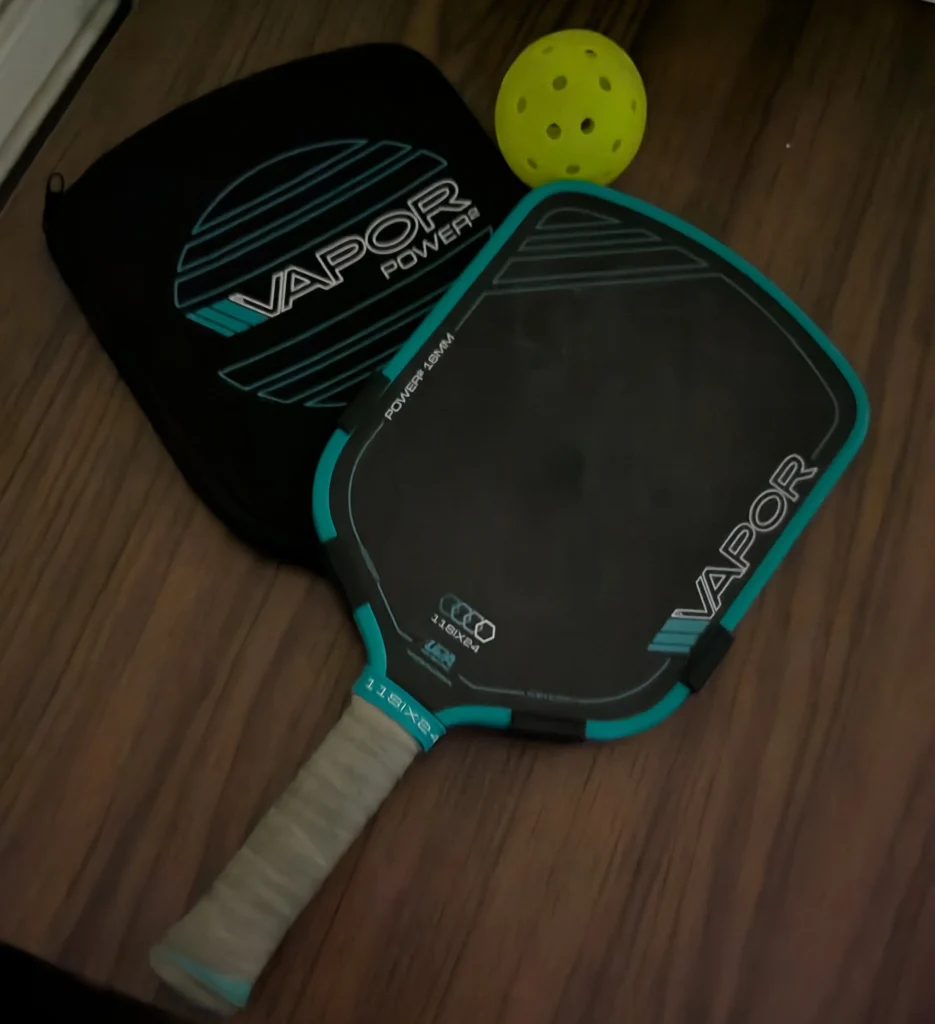
Big shaping ceiling + quick hands… as long as your blocks and resets stay disciplined.
Choosing between lanes? My current main is the Ronbus Quanta R4. Vapor Power 2 is more “chaos-capable” (faster hands + more bite + more pop potential), but the Quanta lane is calmer and more forgiving when you’re late.
How I tested the Vapor Power 2: This review uses the same pressure-based framework I use across PickleTip, including late-contact blocks, fast hands exchanges, rushed resets, off-center forgiveness, and the miss profile that shows up when your timing slips. Read the full PickleTip paddle testing method.
Who This Helps
- You win points by countering and taking space, not by floating everything back and hoping for mercy.
- You want a paddle that stays quick in hands battles when exchanges get nasty.
- You want shape (rolls, angles, dipping drives) and you care if that shape still shows up after real hours.
- You’re willing to be coached on blocks and soft reloads instead of blaming the paddle every time a ball pops up.
- You like a paddle that feels “alive” and lets you redirect pace without a big swing.
- Skip if… you want maximum “everything comes back safely” forgiveness when you’re late or handcuffed.
Paddle at a Glance
Coach’s Rule: If a paddle is built for bite + pop, your paddle face matters more than your swing speed.
The Vapor Power 2 (16mm) lives in the power-hybrid lane: quick hands, shaping potential, and a foam-forward feel that’s trying to stay consistent instead of doing the usual “week 3 identity shift.” It’s not a babysitter. It’s a tool that rewards early position and a quiet, nose-down face, especially under pressure.

| Category | What shows up in real play |
|---|---|
| Speed / Hands | Fast in tight exchanges; wants to counter instead of just survive. |
| Launch Discipline | Late, open-face blocks/resets get punished fast (long balls or sit-ups). |
| Shape Potential | Rolls and dipping drives show up easily, especially when fatigue hits. |
| Durability Story | HexGrit is the headline: the question isn’t day-one spin; it’s whether it stays usable after real hours. |
Specs + What Varies
Coach’s Rule: With fast hybrids, a “small spec shift” can change the whole personality, hands speed, stability, and how late contact behaves.
Published specs (manufacturer ranges): hybrid shape with 8.0–8.3 oz weight range, 108–112 swing weight, and 6.6–6.8 twist weight, plus a 5.75″ handle and 16.25″ total length. Ranges matter because they change whether this paddle feels like a quick scalpel or a more stable club.
| Spec | Published Range | What it changes on court |
|---|---|---|
| Weight | 8.0–8.3 oz | Plow-through vs fatigue; stability on late blocks. |
| Swing weight | 108–112 | Reaction time in firefights; how fast you can reload after contact. |
| Twist weight | 6.6–6.8 | Off-center forgiveness (body shots + handcuffed counters). |
| Length / width | 16.25″ / 7.75″ | Hybrid reach and leverage without feeling like a hammer. |
| Handle | 5.75″ | Two-handed stability; backhand roll comfort. |
What I can say confidently: this review reflects a “typical” feel, not an extreme outlier unit. I did not publish my exact measured swing/twist numbers here, so treat the on-court notes as match behavior, not lab output (because I played with 2 different units).
What varies by unit: a few points of swing weight or a small jump in twist weight can change whether your late blocks hold or launch. If you’re sensitive to hands speed vs stability, verify your unit’s numbers from the seller if available.
Tolerances disclaimer: published ranges are real-world ranges. Don’t assume two units will feel identical if you’re picky about hands speed or stability.
What Actually Matters On Court
Power vs Control: How the ball leaves the face
Match-play scenario: it’s 9–9, your legs are toast, and you need a “safe” third that still drives the point forward. You’re not trying to swing harder, you’re trying to keep the ball from sitting up.
This paddle can feel lively in the best way (easy pace, easy shape) and in the worst way (late contact gets loud). The control window is there, but you have to steer it with face angle and contact point.
Coach Sid Advice: “Show the net, not the sky.” Start slightly closed and let your swing be small. If you open the face to “be safe,” you usually create the pop-up you were trying to avoid.
When you get late and your face opens, the ball launches, either long or high enough to get eaten.
When your contact drifts behind your hip → the paddle adds pop → your “safe ball” becomes a sit-up.
Hands Battles: Counters, blocks, speed-ups
Match-play scenario: the other team keeps jamming your right hip with speed-ups. You’re not swinging big, you’re blocking, redirecting, and trying to steal the point back with a counter.
This is the Vapor Power 2’s home court. When you’re early and square, counters come off clean and aggressive without needing a hero swing. It feels fast enough to reload for the next ball instead of watching your paddle lag.
Coach Sid Advice: “Catch it, don’t slap it.” Paddle out front, soften the grip, absorb first… then redirect.
Panic-stabbing with an open face creates pop. Over-deaden it and you leave a floater that gets punished. This paddle won’t hide that decision.
When your paddle starts from your belly instead of out front → you’re late → your block turns into a rocket or a gift.
PickleTip Insight: “Fast hands” isn’t just speed, it’s how quiet the face stays when you’re handcuffed. This one stays connected… if you meet the ball early.
Soft Game Reality: Drops, dinks, resets
Match-play scenario: you’re stretched wide, you’re late, and you need a reset that lands without floating up. That’s the whole point of the soft game: survive the heat without giving up the kitchen.
You can absolutely drop and dink with this paddle, but it’s not free. If you’re coming from a plush control paddle that rescues sloppy mechanics, you’ll feel a learning curve here.
Coach Sid Insight: “Quiet hands, soft grip, tiny finish.” Think ‘absorb and guide,’ not ‘push and hope.’
The most common miss is the “I tried to be soft” ball that still sits up. That’s usually an open face plus a pushy finish.
When you push forward instead of absorbing → the ball carries → your reset turns into a speed-up invitation.
Sweet Spot, Forgiveness, Stability
Match-play scenario: you get tagged in the ribs and can only throw the paddle at the ball. Off-center contact is real life, not a lab test.
Published twist-weight ranges suggest it’s built to be reasonably stable for a fast hybrid. But here’s the truth that matters: stability feels great when you’re early, and it gets exposed when you’re late and off-center.
Coach Sid Says: “Win space early.” Your best stability upgrade is not lead tape, it’s starting with the paddle out front and meeting the ball sooner.
Off-center blocks can either float up (easy kill) or drift long (free point) if your face is open and your contact is late.
When contact slides toward the edge → the face twists → your block loses direction → you donate either height or length.
Spin, Grit, Shot Shaping
Match-play scenario: you’re tired and you need the ball to dip, not float. You want a drive that forces a pop-up, not a “nice swing” that comes back harder.
This is the “shape payoff.” Rolls and dipping drives show up easily, and that matters most when fatigue hits and your footwork gets lazy. That’s why people chase HexGrit in the first place.
Coach Sid Advice: “Brush, don’t rip.” Your best shape comes from contact + path, not trying to swing out of your shoes.
If you get greedy and open the face to ‘create spin,’ you often get the opposite, floaty contact that sits up and dies.
When your face opens to chase shape → launch angle rises → your ‘dip’ disappears → your ball gets punished.
Break-In / After Hours Update
What stayed true: the identity stayed “fast hybrid with bite.” It kept rewarding early paddle position and clean counters.
What got clearer: the real separator isn’t day-one spin, it’s whether shaping outcomes stay consistent once the paddle has lived through real points and real balls.
What changed: nothing about the learning curve went away. If your face angle gets lazy when you’re late, the paddle still tattles. That’s the price of this lane.
My 5-hour verdict (plain English):
- Bite stayed usable. Roll dinks didn’t suddenly start floating, and shaped drives didn’t lose their dip.
- Outcome consistency stayed stable. I didn’t feel the “week 3 identity shift” where the same swing produces different results.
- The paddle still punishes sloppy face angle. That part doesn’t go away. (It’s the power-hybrid lane.)
How to self-check durability (no lab required): run a quick “same swing, same outcome” check with your roll dinks and controlled dipping drives. If the same motion starts producing higher floaters or long misses, clean the face and re-test. Dirt can impersonate durability loss.
Tuning Notes
If you buy this paddle and want a clean stability-first starting point, don’t overthink it.
4 & 8 recipe: a small strip at 4 o’clock and a small strip at 8 o’clock. Stop there for two sessions.
If you’re getting bullied by off-center contact or body shots, move to a more classic stability setup:
- 3 & 9 to calm the face and widen the usable window.
- Only then consider a touch at 12 if you want more plow-through (test first; don’t stack weight like a maniac).
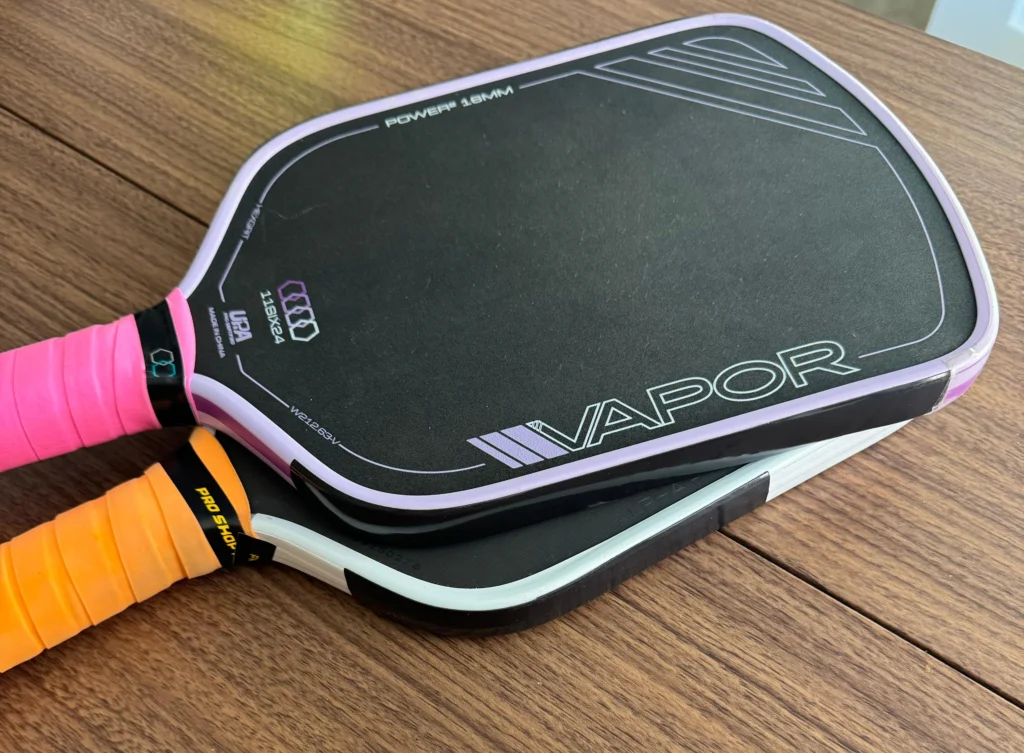
Coach’s reminder: test for two sessions before you add more. Most “tuning problems” are really early-paddle-position problems.
Cross-Shopping Notes
Ronbus Quanta R4: Pick this if you want a calmer control window and easier forgiveness on blocks and soft reloads when you’re late. Vapor Power 2 is more “chaos-capable” (faster hands + more bite + more pop potential), but it asks you to drive the steering wheel.
Plush control lane (generic): Pick that lane if your identity is resets, dinks, and never giving up a pop-up. This paddle can play soft, but it’s not built to rescue lazy mechanics under fire.
Pros and Cons (Real Play)
Pros:
- Fast hands in tight exchanges; counters feel natural.
- High shaping ceiling (rolls, angles, dipping drives) without needing hero swings.
- Durability story held up better than typical grit-dependent faces after real hours.
- Clear identity: rewards discipline and proactive paddle position.
Cons:
- Not forgiving when you’re late, open-face blocks/resets get punished.
- Learning curve if you’re coming from a plush control paddle doing the work for you.
- Legality split: UPA-A lane is straightforward; USAP-only environments require verification before you buy.
Who Should Buy / Who Should Skip
- Buy if: you like to counter, take space, and turn hands battles into points.
- Buy if: you want shape that still shows up after real play hours.
- Buy if: you’re willing to keep your paddle face disciplined on blocks and soft reloads.
- Skip if: you want maximum forgiveness when you’re late or handcuffed.
- Skip if: your whole game is “float it back safely” and you don’t want a paddle that exposes face angle mistakes.
Key takeaways:
- Identity: fast hybrid frame built for counters, hands battles, and shot shaping.
- What it rewards: “nose-down” paddle face and early paddle position.
- What it punishes: sloppy face angle when you’re late.
Quick Decision Snapshot:
- Best for: counters, hands battles, shaping drives and rolls under pressure
- Power tier: power-leaning hybrid (loud when you’re late)
- Control window: earned with face angle + quiet hands
- Maneuverability: fast for the category (especially in exchanges)
- Learning curve: medium—blocks/resets demand discipline
Vapor Power 2: Common Questions & Performance Concerns
It’s a power-leaning hybrid that stays fast in hands battles. Control is there, but it’s not “free forgiveness.” If your blocks and resets rely on a paddle rescuing your face angle, this one will expose that.
After roughly 5 hours, the bite stayed usable and my shaping outcomes stayed consistent. Clean the face and re-test if outcomes shift, dirt can mimic spin loss.
Blocks and soft reloads. If your paddle face opens when you’re late, balls launch long or sit up. This paddle rewards early paddle position and a quiet, nose-down face.
Yes, this is one of the paddle’s clear strengths. The published swing weight range is low for the category, and that shows up as quicker reaction and easier reload in exchanges.
It’s listed as UPA-A certified. For USAP-only events, verify the current USAP approved paddle list before purchase. Lists change.
Upgrade Your Game (CTA)
If you’re building a game around counters, hands battles, and shaping the ball under pressure, this paddle makes your decision-making louder, in a good way when your mechanics are clean, and in a bad way when they aren’t. Note: If you want to cross-shop it against another paddle in this lane check out the Spartus P1 Hybrid.
Coach Sid final note: This paddle doesn’t make you better. It makes your first decision louder. If your face is disciplined, it rewards you. If it’s lazy, it tattles.
Where to buy: The Official 11SIX24 product page