
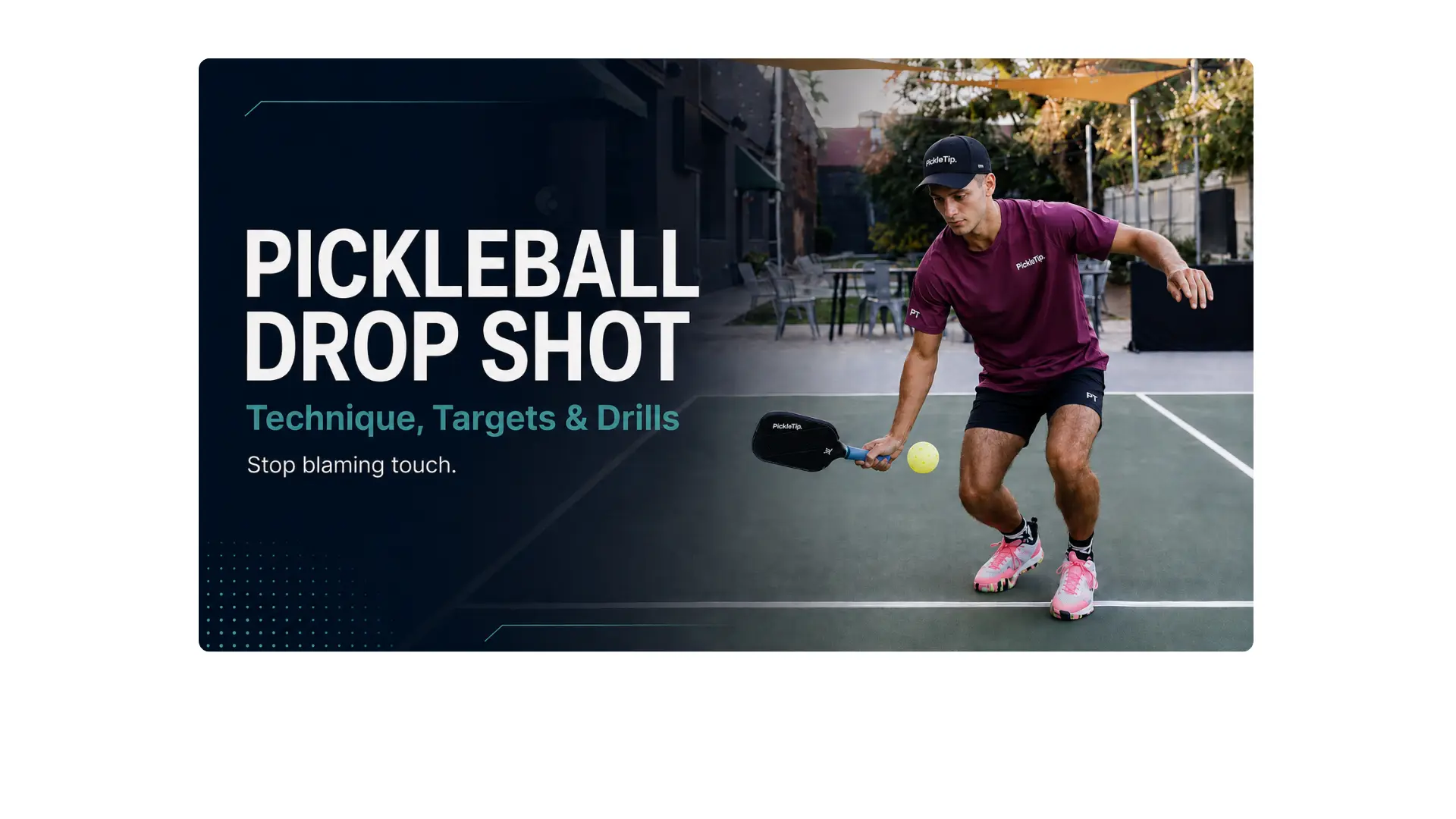
How to Hit a Pickleball Drop Shot: Technique, Targets & Drills
If your third shot keeps getting buried, stop blaming “touch.” Most bad drops are not mysterious. They usually start before contact: poor spacing, late feet, a grip that gets tight, too much wrist, or a trajectory that never had enough margin.
I learned this the hard way. A tournament partner once asked me to stop dropping on the third because two of my “perfect” drops floated belt-high and got punished. She told me, “Trust your legs, not your wrist.” That changed how I teach the shot. A good drop is not a cute soft ball. It is a repeatable stroke with a stable base, clean contact, enough margin, and a purpose.
A pickleball drop shot is a soft rally ball, often hit as the third shot, that lands in or near the kitchen and forces the opponent to contact below net height.
Quick clarification: A drop shot is not a drop serve. It is a rally shot used to neutralize the receiving team’s positional advantage and create a safer path forward. If you are still deciding whether the third should be a drop, drive, hybrid, or neutral ball, start with Pickleball Third Shot Strategy.
Jump to a Section
- What a pickleball drop shot is
- Drop shot vs dink
- Drop-shot mechanics
- Contact point and timing
- Trajectory and net clearance
- Where to aim
- Forehand and backhand drops
- Slice, roll, and reset drops
- Common mistakes and fixes
- Drop-shot drills
- Frequently asked questions
What Is a Pickleball Drop Shot?
A pickleball drop shot is a soft, controlled ball hit from deeper in the court that descends into the opponent’s kitchen or close enough to the kitchen line that they must contact it low.
The goal is not to hit a winner. The goal is to remove the opponent’s ability to attack downward and create a more neutral next ball.
- It reduces pace: the rally slows down.
- It lowers contact: the opponent must lift, scoop, dink, or reach.
- It buys time: your team may earn controlled steps toward the kitchen.
- It shapes the next ball: a good drop often produces a predictable soft reply.
Coach Sid test: A good drop makes the opponent’s next contact worse. If they are reaching, lifting, scooping, blocking, or taking the ball below net height, it worked. I do not care if it landed six inches deeper than you wanted.
Drop Shot vs Dink
| Shot | Where It Is Usually Hit | Primary Purpose |
|---|---|---|
| Drop shot | From the baseline or transition zone | Neutralize pace and create a safer path to the kitchen |
| Dink | From or near the kitchen line | Keep the ball unattackable during a soft exchange |
Both shots are soft and usually land in the kitchen, but they solve different problems. The drop helps you arrive. The dink helps you stay.
The 5-Part Pickleball Drop-Shot Stroke
The most repeatable drop I teach has five parts: stable grip pressure, compact preparation, leg support, contact in front, and a forward finish. None of them needs to look dramatic.
1. Stabilize the Grip
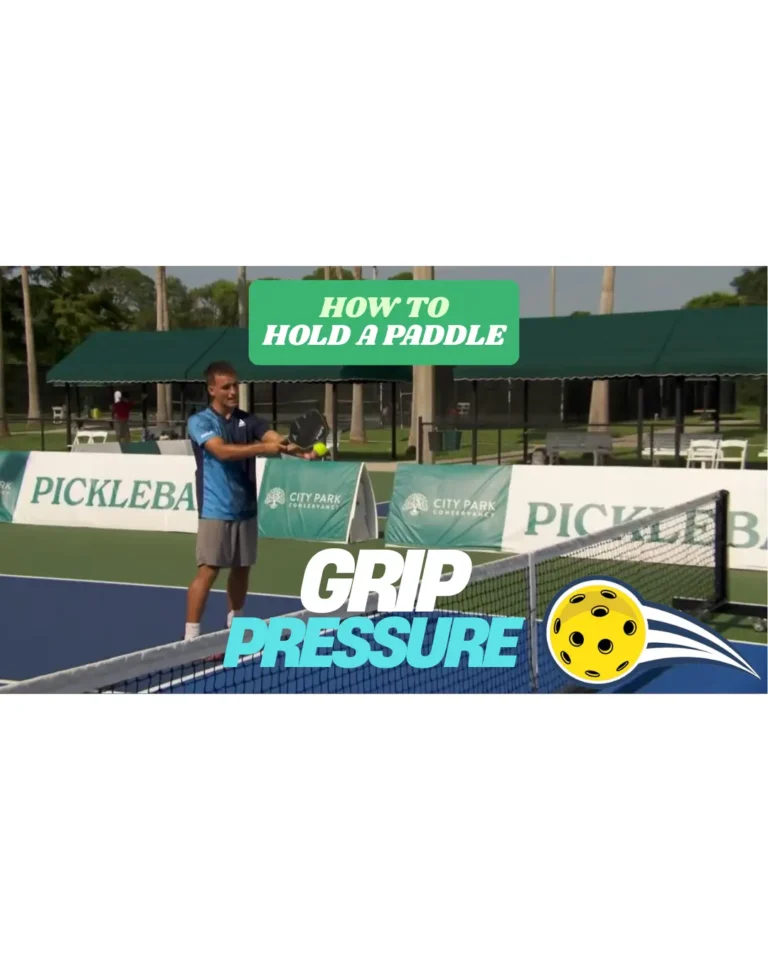
Use a continental or slightly eastern grip with light-to-moderate pressure. Around 3–4 out of 10 is a useful starting point. If grip tension keeps changing from shot to shot, use my Pickleball Grip Pressure guide to find a dependable starting point.
- Too tight: the ball rebounds off the paddle and floats.
- Too loose: the face wobbles and direction disappears.
- Balanced pressure: enough stability to control the face without squeezing the touch out of the shot.
When I see soft balls pop up in rec games, DUPR sessions, or clinics, the player usually thinks the problem is touch. A lot of the time it is not. The grip tightened, the feet never got set, the paddle face opened, or the contact crowded the body before the ball ever floated.
2. Keep the Preparation Compact
Set the paddle in front of the body with minimal backswing. If the paddle travels far behind the hip, the stroke is already becoming too large.
3. Use the Legs for Lift and Stability
Bend the knees and build a stable base. The legs help create lift and control. The wrist should not be trying to rescue the ball at the last second.
4. Contact the Ball in Front
Contact the ball in front of the body with the arm relaxed and the paddle face controlled. Contact beside or behind the hip usually forces the face open and sends the ball too high.
5. Finish Forward, Not Up
Guide the paddle forward toward the landing window. Avoid a last-second upward flick. The stroke should feel smooth and quiet, not scooped or slapped.
| Mechanic | Do | Avoid |
|---|---|---|
| Grip | Light-to-moderate pressure | White-knuckle squeeze |
| Backswing | Compact and in front | Large loop behind the hip |
| Base | Bend and stabilize | Standing tall or drifting |
| Contact | In front of the body | Beside or behind the hip |
| Finish | Forward toward the target | Upward wrist flick |
These five pieces are defaults, not five boxes you must hit perfectly on every ball. If you are stretched, jammed, moving, or handling more pace, the stroke may get shorter and uglier. Keep the face predictable, solve the contact you actually have, and make the opponent hit up.
Simple cue: Soft hands, strong legs, quiet face, forward finish.
Contact Point and Timing
Many players find the drop easier when they contact the ball after it has reached the top of the bounce and begins to descend. That timing gives the shot a more predictable starting point and reduces the urge to fight the rising ball.
That is a useful default, not an absolute rule. Match situations may force earlier contact. The important part is that the ball stays in front and your body remains balanced.
One thing I watch before a bad drop is whether the miss actually started before the paddle touched the ball. If the feet arrive late, the player reaches, the body is still rising, or the ball crowds the hip, the paddle has to do emergency work. That is usually when the face opens or the wrist tries to rescue the shot.
- Too early: the ball may jump off the face before you establish touch.
- Too late: contact drifts behind the body and the paddle face opens.
- Better window: the ball is in front, the body is stable, and the paddle can guide rather than rescue.
Contact test: If you feel like you must scoop the ball up from beside your hip, you are late.
Drop-Shot Trajectory and Net Clearance
Do not chase one universal net-clearance number. The right arc changes with distance, incoming pace, spin, wind, contact height, and target. From the baseline, a useful drop often needs more air than nervous players want to give it.
I would rather give the ball enough margin to work than chase a perfect low line into the tape. A ball that clips the net never gets a chance to become a good drop. Give it enough height to cross safely, then shape the descent so the opponent still has to hit up.
Faster play makes the cost of extra height obvious. I have watched a drop arc nicely, sit up just a little too high, and come back as a line drive while the serving player is still moving forward. That is the part players miss: the safest ball is not always the slowest one. It is the one that arrives low enough that the opponent cannot comfortably attack it.
If your drops used to feel safe but now keep getting rolled or speeded up, my Modern Drop Shot in Faster Pickleball guide goes deeper into that problem.
Where Should a Pickleball Drop Shot Land?
The best target is the one that keeps the opponent from attacking downward. The ball does not always need to land deep inside the kitchen to succeed.
| Target | Why It Works |
|---|---|
| Crosscourt kitchen | More court length and a safer diagonal descent |
| Middle kitchen | Reduces angles and creates communication pressure |
| Weaker backhand side | Forces an uncomfortable reach or scoop |
| Near the kitchen line | Can still work if the opponent must contact below net height |
Crosscourt is often the easiest starting target because the diagonal gives you more distance and margin. Middle is useful when you want to reduce angles or make both opponents decide.
Forehand and Backhand Drop Shots
I coach the two sides a little differently. The forehand temptation is usually size: players see more room to swing and turn the drop into a mini drive. On the backhand, I pay more attention to whether the hand stays quiet and the paddle keeps traveling toward the target instead of rolling or sweeping across the body.
Forehand Drop
- Keep the backswing smaller than a drive.
- Contact in front of the lead hip.
- Use the legs to lift instead of flipping the wrist.
- Finish through the landing window.
Backhand Drop
- Keep the elbow relaxed and the paddle face quiet.
- Use the shoulder and legs instead of a wrist jab.
- For a two-handed backhand, let the second hand add stability and shape rather than brute force.
- Finish compactly so the paddle stays ready.
Drop-Shot Variations
Slice Drop
A slice drop uses backspin to slow the ball and keep the bounce lower. It can be useful when you are stretched or want extra control, but too much cut can leave the ball floating.
Roll Drop
A roll drop adds topspin so the ball travels with more pace and dips later. It can pressure opponents who lean forward or crowd the kitchen line, but it requires cleaner timing than a basic lift.
Inside-Out Drop
An inside-out drop bends the ball away from the apparent swing direction. It is useful for creating angle or avoiding a stronger middle paddle, but it should come after basic control is dependable.
Transition Reset
A reset from the transition zone may look like a drop because it also tries to neutralize pace and produce low contact, but the incoming pressure and mechanics are different.
For reset mechanics and pressure neutralization, use How to Reset in Pickleball.
A hybrid drop-drive adds more pace and topspin than a traditional drop while still trying to force low contact. It is useful when the ball gives you more offense than a basic drop but not enough to justify a full drive.
When Is a Drop Shot Useful?
A drop is commonly useful when you need time more than pace, especially on low or deep returns against settled opponents. The drop is a tool, not a religion. If the real question is whether the third should be a drop, drive, hybrid, or neutral ball, use Pickleball Third Shot Strategy. This page stays focused on how to execute the drop once you have chosen it.
What Comes After a Good Drop?
A good drop may earn your team ground, but this execution page stops at the opponent’s next contact. Do not turn a successful drop into an automatic sprint forward. Pickleball Third Shot Strategy owns the Movement Permission decision, and the Pickleball Transition Zone guide owns the stopping, and staged movement that follow.
Once your drop reliably creates a predictable deep or upward fourth ball, the Third-Shot Bait Drop Crash teaches the advanced read-and-pickoff pattern.
Common Drop-Shot Mistakes and Fixes
| Mistake | Likely Cause | Fix |
|---|---|---|
| Ball hits the net | Fear poke, low aim, or no leg lift | Add margin and finish forward |
| Ball floats high | Open face, late contact, or upward wrist flick | Contact in front and quiet the finish |
| Ball sails long | Too much pace or a large backswing | Shorten the stroke and reduce force |
| Ball lands too short | Deceleration or contact too far behind | Move the feet and guide through the target |
| Inconsistent direction | Face wobble or excessive wrist | Stabilize grip pressure and paddle face |
| Drop breaks down under pressure | Trying to use drill tempo in live pace | Practice variable feeds and decision pressure |
The correction I make most often: Get the ball farther in front and make the swing smaller. Players usually try to fix a bad drop by adding more “touch.” In rec games, DUPR sessions, and clinics, I keep seeing the same thing: the real leak is often spacing, balance, grip pressure, or a paddle face that changed right before contact.
If the same floaty miss is showing up on dinks, resets, and blocks too, the drop may not be the only problem. Use How to Stop Popups in Pickleball to trace the same spacing, face-angle, balance, and grip-pressure leaks across the rest of your soft game.
Pickleball Drop-Shot Drills
1. Self-Feed Landing Drill
Start near the baseline. Self-feed and hit controlled drops into a crosscourt kitchen target. Focus on contact in front and a forward finish.
2. Kitchen-to-Baseline Slinky Drill
Begin at the kitchen line and hit a soft ball into the opposite kitchen. Take one step backward after each successful rep until you reach the baseline, then work your way forward again. More details: Slinky Drill
3. Variable-Pace Partner Drill
Have a partner alternate slow, medium, and faster feeds. Your goal is to maintain the same compact mechanics while adjusting trajectory and pace.
4. Attack-the-Floater Drill
Your partner attacks any ball contacted above net height. This forces you to judge success by opponent contact rather than whether the ball simply lands in.
5. Forehand-Backhand Alternation
Alternate ten forehand drops and ten backhand drops to the same target. Track which side loses contact position or changes trajectory first.
6. Pressure Ladder
Play live points where the serving team must use at least one drop before speeding up. Give the ball a reason to feel important: start at 9–9, limit the serving team to one attempt, or make the drop target visible. Increase pressure only after the shot stays recognizable against realistic pace. The goal is not to make players afraid of missing. It is to see whether the same mechanics survive when the rep matters.
Drill standard: Count a rep as successful only when the opponent must contact low or cannot attack cleanly.
Frequently Asked Questions About Pickleball Drop Shots
A drop shot is a soft rally ball hit from deeper in the court that lands in or near the opponent’s kitchen and forces low contact. It is often used as the third shot to neutralize the receiving team’s positional advantage.
Aim for the kitchen or close enough to the kitchen line that the opponent must contact below net height. Crosscourt and middle are dependable starting targets, but opponent contact matters more than painting one perfect spot.
There is no fixed clearance. Give the ball enough net margin to cross safely, then make sure it descends before the opponent can attack comfortably.
Usually the ball is being aimed too low, contacted late, or steered after crowded contact. Create space, add net margin, and finish forward.
Start before the swing. If spacing, balance, or the paddle face changed before contact, fix that first. Then make the motion smaller and quieter.
No. The drop is strongly associated with the third shot because the serving team often uses it to neutralize opponents at the kitchen, but the same basic drop mechanics can be used on fifth, seventh, or later balls when you are deeper in the court and need to create low contact.
Yes. Beginners benefit from learning a repeatable drop because it gives them a way to neutralize opponents who are already at the kitchen. Build the basic mechanics first, then use the Third Shot Strategy guide to learn when the return actually calls for it.
A drop is usually hit from the baseline or transition zone to help the serving team create lower opponent contact. A dink is usually hit from the kitchen line during an established soft exchange. The drop helps you arrive. The dink helps you stay.
Keep Working on the Third Shot
- Third Shot Strategy — read the return and decide whether the third should be a drop, drive, hybrid, or neutral ball.
- Third Shot Drive in Pickleball — use pace when the return gives you a clean attack window.
- Hybrid Drop-Drive — use the controlled middle option when a full drive is too much and a soft drop gives away pressure.
- Pickleball Transition Zone — stop and move through midcourt after the drop earns ground.
- Third-Shot Bait Drop Crash — attack a predictable fourth ball after your drop has actually earned it.

Xin chào, tôi muốn biết giá của bạn.
That story about your tournament partner saying “trust your legs, not your wrist” genuinely stopped me mid-scroll — I’ve been coaching that exact mistake out of my own game for two years and never had language for it until just now. What clicked for me reading this is how the sequencing framing (3rd, 5th, 7th) reframes failure as *patience*, not incompetence, which is a mental shift I think a lot of us at the 3.5–4.0 transition desperately need. It’s worth noting that USA Pickleball’s player survey data consistently shows the transition zone is where the majority of recreational doubles points are actually decided, which tracks perfectly with your hybrid drop-drive logic — the threat matters as much as the execution. I’ll confess I’ve donated more pace on third-shot drives than I care to admit, basically gift-wrapping belt-high opportunities like some kind of well-meaning ball machine. For anyone else who’s been living in that “just drive it” safety blanket, this framework feels like a genuine way out rather than just another technique checklist. What do you find is the most common *mental* pattern — not mechanical — that keeps players from committing to the drop even when they intellectually know it’s the right call?