How to Stop Flinching and Feel Safer at the Pickleball Kitchen
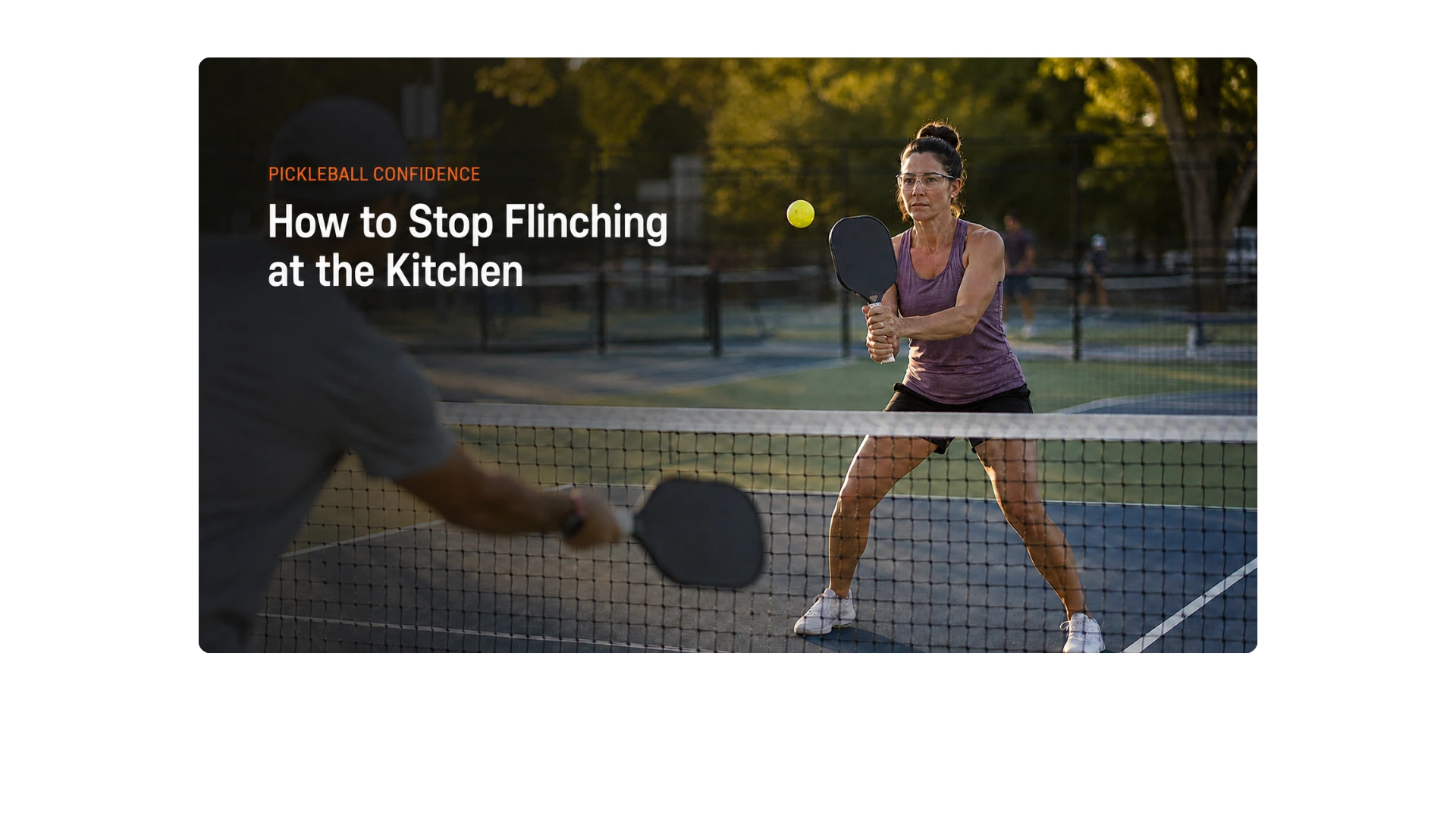
Some players say they are afraid of the kitchen. Usually, the kitchen is not what scares them. They are afraid of the ball arriving before they know what to do with it.
I have watched players close their eyes, turn their head, swing wildly, back away from every speed-up or abandon the line before the opponent has even attacked. That does not make them weak. Flinching is a protection response. The problem is that an uncontrolled protection response often leaves the face exposed, the paddle late and the next decision unavailable.
How to Stop Flinching at the Pickleball Kitchen
The goal is not to become fearless or stand still for every hard ball. The goal is to recognize the attack early enough to choose a controlled response: block, counter, dodge, retreat or let the ball go.
Confidence usually shows up after the player has collected enough calm repetitions to trust what happens next.
What Fear at the Kitchen Actually Looks Like
| What the player does | What may be happening |
|---|---|
| Turns the head or closes the eyes | Fear of impact or a feed that is already too fast |
| Raises the paddle after the attack begins | Late ready position or delayed recognition |
| Backs away from every fast ball | Cannot yet distinguish playable pace from a ball that should be avoided |
| Swings wildly | Panic response replacing a compact block or counter |
| Freezes after being hit previously | Learned fear from a bad experience |
| Avoids the kitchen entirely | Lack of exposure, positioning knowledge or trust |
| Feels tense in every type of rally | A broader pressure response rather than a fast-ball-specific problem |
Before trying to fix “confidence,” identify the behavior. A player who closes the eyes needs a different progression from a player who sees the ball but uses the wrong paddle response.
Not Every Flinch Has the Same Cause
In lessons, I usually find that the flinch is coming from one of three places:
- Recognition problem: The player sees the attack too late to organize the paddle or move safely.
- Protection problem: The player does not trust the ready position, block, eyewear or ability to get out of the way.
- Experience problem: A previous hit or reckless feed has taught the player that incoming pace is unsafe.
A late paddle is not always a hand-speed problem. Sometimes the player spends the first part of the ball’s flight protecting against impact instead of reading where the ball is going. Slow the feed down until the player can keep the eyes forward, recognize the direction and make a deliberate choice.
During open play at Adventure Quest, a fellow player kept backing away from the kitchen line whenever the ball sped up. She could get to the line, but the moment an opponent raised their paddle or drove a ball toward her, she would retreat two or three steps and try to defend while still moving backwards.
At first, she thought she needed faster hands. What I saw was different. Her biggest problem was not reaction speed. It was that fear was pulling her out of position before the ball was even hit. By continuing to back up while the opponent was hitting the ball, she gave the other team more space, more angles, and more time to attack her feet.
I asked her to stay at the line for one full drill and gave her only two jobs: keep the paddle in front of her body and make the smallest possible block. She did not need to counterattack, swing hard, or win the exchange. She only needed to hold her ground and get the ball back.
The first few attempts were uncomfortable. Then she blocked one hard shot into the kitchen. On the next exchange, she stayed balanced and redirected another ball without taking a step back. As the drill continued, she began to realize that the speed felt much more manageable when she met the ball in front instead of continuing to retreat.
By the end of the session, she was not fearless, but she was no longer automatically abandoning the line. A small adjustment can create useful space when the opponent has clear leverage. The problem was not that she ever moved back. It was that she automatically retreated from ordinary speed-ups and was still moving when the ball arrived. Her hands had not suddenly become faster. She improved because she stopped giving fear control of her feet.
Fear Is Not the Same as Bad Judgment
Some caution is useful. A hard ball near the eyes, throat or face deserves protection. An opponent contacting an overhead from high above the net may require you to retreat and create time. A ball clearly traveling long may deserve a dodge rather than a desperate swing.
The goal is not to eliminate every protective instinct. It is to replace blind flinching with an informed response.
Courage at the kitchen is not refusing to protect yourself. It is recognizing the ball early enough to choose the correct protection.
A Four-Step Plan for Training the Flinch
I needed a simple way to slow this problem down during lessons, so I started separating it into four jobs: find the fear, start from a protected position, choose a response and expand the speed. I call it the PickleTip FACE Plan.
| Step | Main question | Result |
|---|---|---|
| F — Find the Actual Fear | What exactly makes me flinch? | You know what the drill must fix |
| A — Start From a Protected Position | Am I balanced, watching contact and protecting the middle? | The player feels less exposed |
| C — Choose the Correct Response | Block, counter, dodge, retreat or let it go? | Fear becomes a decision |
| E — Expand Speed Gradually | Can I succeed before pace increases? | Calm execution comes before higher pace |
F — Find the Actual Fear
Ask what the player is protecting against. The answer may be:
- Being hit in the face or eyes.
- Another injury after a previous bad experience.
- Not knowing whether the ball is in or going out.
- Not trusting the block or counter.
- Feeling embarrassed in a fast exchange.
- Believing every hard ball must be attacked.
- General pressure that appears across the entire match.
If the same tight grip, rushed breathing and scattered attention appear in many situations (not only fast balls) use the CLEAR pressure routine. FACE is for the specific moment when incoming pace triggers hesitation or panic.
A — Start From a Protected Position
The ball feels less threatening when the player is balanced and the paddle is already in place before the attack begins.
- Stay balanced, not rocked onto the heels and not pitched forward onto the toes.
- Use a stable base with small adjustment steps.
- Keep the paddle in front of the chest.
- Slightly favor the backhand side to protect the middle of the body.
- Watch the opponent’s paddle preparation, swing size and contact height. Those clues often tell you whether the ball is likely to arrive hard, dip below the net or travel long.
- Keep the movement compact enough that the paddle does not need to race back to the ball.
Grip pressure, paddle angle, contact and finish are separate blocking skills. The PickleTip blocking guide covers those details. When the player sees the ball without panic but the paddle still starts late, work through the quick-hands guide instead.
Eye protection: USA Pickleball highly recommends proper eye protection for players. A confidence drill should never require someone to accept unnecessary risk to prove courage. Learn more through the USA Pickleball Health and Safety Hub.
C — Choose the Correct Response
Fast hands are not the first test. The player must recognize whether the incoming ball calls for a block, counter, dodge, retreat or no swing at all.
| Incoming ball | Best initial choice |
|---|---|
| Hard ball rising toward the upper body or likely traveling long | Protect, dodge or let it go |
| Hard ball near the body | Compact backhand block |
| Ball inside a controlled counter window | Short counter with no large backswing |
| Ball dipping at or below net height | Block or reset rather than force an attack |
| Opponent has a true overhead from high contact | Retreat and create reaction time |
| Ball clearly traveling long | Move safely and let it go |
Good defense does not always touch the ball. Dodge the ball traveling long, reset the low attack and retreat when an opponent owns a true overhead.
Use the countering bangers guide when the problem is opponent strategy, and the doubles defense guide when partner spacing, middle protection or shared recovery keeps breaking down.
E — Expand Speed Gradually
Do not train surprise before you have trained protection. Predictability comes before pace.
Progress rule: Do not increase pace because the player returned three balls. Increase pace when the player saw all three, stayed balanced and made the intended decision. Successful contact alone is not enough.
| Level | Drill | Progress when… |
|---|---|---|
| 1 | No-ball rehearsal: ready position, compact block, controlled dodge and retreat footwork | The player stays balanced and keeps the eyes forward |
| 2 | Predictable hand feeds to one known location at moderate pace | The player no longer turns away or loses paddle shape |
| 3 | Predictable paddle feeds to the same location | Compact blocks remain controlled |
| 4 | Two-location random feeds at moderate pace | The player recognizes direction without panic |
| 5 | Block-or-dodge drill with playable balls and intentional out balls | The player chooses instead of swinging at everything |
| 6 | Live dink-to-speed-up drill with agreed attack balls | The player reads contact height and stays organized |
| 7 | Game-speed application | Earlier levels remain calm and technically stable |
If the eyes close, the drill is too fast.
How the Feeder Keeps the Drill Safe
- Agree on pace before the drill begins.
- Use eye protection.
- Begin with predictable locations.
- Never aim at the face.
- Increase one variable at a time: location, speed or randomness.
- Let the defender call “slower” or “stop” without argument.
- Stop when the defender closes the eyes, turns away or loses balance.
- Do not use humiliation, punishment or surprise as training.
- Keep feeds controlled enough that the feeder can repeat the intended location.
Do not have a fearful player turn around while someone hits a surprise ball toward them. That trains surprise, not recognition. The player needs more visual information first, not less.
How to Practice Overhead Defense Without Making Fear Worse
Do not begin by smashing full overheads toward a fearful player at close range.
- Start with controlled chest-height volleys.
- Feed to a known location.
- Use moderate pace.
- Let the defender practice paddle protection and a controlled dodge.
- Add random left-or-right direction.
- Increase pace only with the defender’s consent.
- Practice retreating before defending a true overhead.
- Stop when the response turns into panic.
The player is not failing by retreating. Moving back can create time, protect the body and improve the chance of returning the next ball under control.
I sometimes teach a small space-making step when the opponent has obvious leverage and the defender can move before contact while staying balanced. That is different from automatically drifting backward through every speed-up. The step should create time, not leave the player moving when the ball arrives.
After a Ball Hits You
Pause and assess the impact before demanding another hard feed. Do not treat immediate exposure as proof of toughness.
- Check whether there is pain, swelling, vision change, dizziness or another concerning symptom.
- Identify whether the player lost sight of the ball, used the wrong response or received an unsafe feed.
- Restart below the previous pace if it is appropriate to continue.
- Do not aim the next ball at the same area to “get over it.”
Stop playing and seek evaluation from a qualified medical professional after an eye strike, vision change, dizziness, significant head or facial impact, or symptoms that are severe, worsening or do not resolve.
A possible concussion should not be judged on the court, and the decision to return to play belongs to a healthcare provider. Review the CDC signs and symptoms of concussion for additional guidance. This article cannot determine whether an injury is safe to play through.
FACE will not fix every problem by itself. It cannot repair a block that breaks down even at comfortable pace, replace proper vision or medical care, make an unsafe feeder safe, or solve pressure that appears throughout the entire match. Use the table below to identify the better next step.
When the Problem Is Bigger Than Fast Balls
| What is happening? | Best next step |
|---|---|
| The player feels tense in every part of the match | Use the CLEAR pressure routine |
| Blocks keep popping up or flying long | Use the blocking guide |
| The opponent’s power strategy is the real problem | Use the countering bangers guide |
| Partner spacing and middle coverage keep failing | Use the doubles defense guide |
| Being hit continues affecting later rallies | Use the PACE next-ball reset |
| The player has pain, injury symptoms or vision changes | Stop and seek appropriate medical care |
The PickleTip FACE Card
FIND:
What exactly makes me flinch?
ASSUME:
Am I balanced, watching contact and protecting the middle?
CHOOSE:
Block, counter, dodge, retreat or let it go?
EXPAND:
Can I succeed before pace increases?
Questions Players Ask About Flinching at the Kitchen
Start with predictable, moderate feeds from a protected ready position. Increase only one variable at a time (location, speed or randomness) and do not progress while you are still closing your eyes, turning away or losing control.
Flinching is a protective response. It often appears when the ball arrives faster than you can recognize it, when the paddle starts late, or after a previous hit made incoming pace feel unsafe. The first step is identifying which of those problems is actually happening.
Choose by ball height, balance and reaction time. A ball at or below comfortable contact usually favors a block or reset. A ball inside a controlled counter window may allow a compact counter. A dangerous or clearly long ball may be better dodged.
Often, yes. When an opponent has high contact and clear leverage, retreating can create reaction time and protect the body. That is different from automatically drifting backward through every ordinary speed-up.
Agree on pace, begin with predictable locations, increase one variable at a time, never aim at the face and let the defender call slower or stop. End the drill when technique turns into panic.
It may. USA Pickleball highly recommends proper eye protection for players. Eyewear does not replace recognition, positioning or technique, but it may reduce the feeling that every fast ball threatens the eyes.
Stop and assess the impact before continuing. Seek evaluation from a qualified medical professional after an eye strike, vision change, dizziness, significant head or facial impact, or symptoms that are severe, worsening or do not resolve. Do not try to judge a possible concussion on the court.
Replace Panic With a Choice
Fear usually fades after the moment stops feeling random. Slow the ball down, build a protected starting position and give the player enough successful decisions that incoming pace becomes something to read instead of something to survive.
You do not need to prove that fast balls cannot scare you. You need enough preparation to recognize which ones deserve a block, a counter, a retreat or no swing at all.